


Discover whether marketplaces or your own storefront is better for digital products. Compare traffic, control, fees, SEO, and long-term growth.
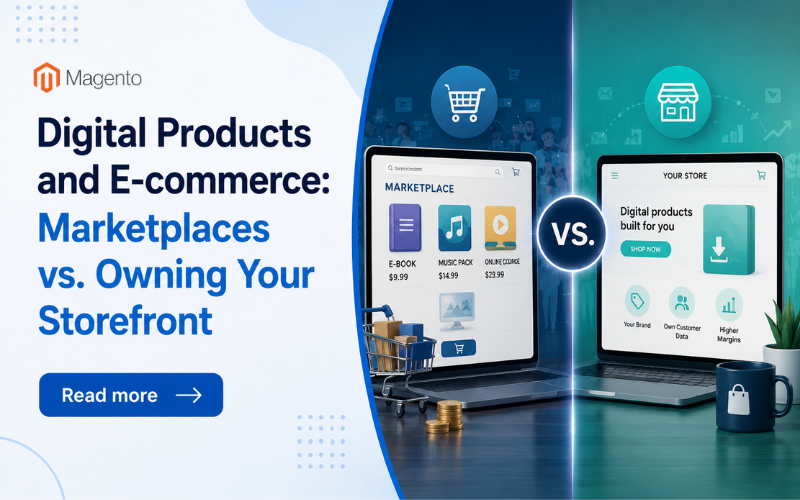
If you are selling anything online, you have probably wrestled with a version of this question: do you set up shop on an existing marketplace, or do you build your own storefront from scratch?
It sounds like a simple decision, but it is one of those choices that ripples through everything. Your pricing, your brand identity, your customer relationships, your margins, your growth strategy. The platform you sell on shapes all of it, often in ways that are not obvious until you are deep in.
Both approaches have genuine strengths. Marketplaces give you access to built-in audiences and handle a lot of the technical overhead. Your own storefront gives you control, flexibility, and direct customer relationships. The right answer depends on where you are, what you sell, and what kind of business you are trying to build.
This piece digs into the real tradeoffs between the two, without pretending one is universally better than the other.
How Marketplaces Actually Work for Sellers
A marketplace is any platform where your products sit alongside other sellers' products, and the platform itself drives some (or most) of the traffic. Think Amazon, Etsy, Gumroad, Creative Market, or the App Store. You list your product, the marketplace surfaces it to potential buyers, and you pay a cut of each sale.
The appeal is obvious. You are not starting from zero. The marketplace already has traffic, trust, and payment infrastructure. A customer who has never heard of you might still find your product because they were browsing the platform. That kind of passive discovery is extremely hard to replicate on your own.
But there is a cost beyond the commission fees. When someone buys your product on a marketplace, they are the marketplace's customer first and your customer second. You often have limited access to buyer data. You cannot always control how your product is presented. And you are competing directly with every other seller in your category, often within a search algorithm that you have no visibility into.
How Owning Your Storefront Changes the Game

Running your own storefront means you control the entire experience. The branding, the checkout flow, the pricing strategy, the customer communication, the upsells, and the data. Everything.
Platforms like Shopify, WooCommerce, and Squarespace make it relatively straightforward to set up an independent online store. For digital products specifically, tools like Podia and Teachable offer more specialized features. And for creators and businesses that want to go beyond just product listings, platforms like Whop let you bundle digital products with communities, memberships, courses, and live events under one roof.
The setup takes more effort than listing on a marketplace, but the long-term advantages compound.
Every visitor lands on your domain, building your brand's authority. Every buyer enters your ecosystem, where you can nurture the relationship through email, content, and additional offers.
You are building an asset you own, not renting shelf space in someone else's store. If you are curious about what a self-hosted storefront looks like in practice, there are solid walkthroughs for building a Gumroad clone that give you a concrete sense of the technical lift involved.
The Real Tradeoffs, Laid Out Honestly
Forget the marketing spin. Here is what each option actually gives you and what it costs you.
Factor | Marketplace | Own Storefront |
Audience Access | Built-in traffic and discovery | You drive all your own traffic |
Brand Control | Limited; your listing exists within their design | Complete; everything is on-brand |
Customer Data | Restricted; the platform owns the relationship | Full access; direct relationship with buyers |
Commission/Fees | 5% to 30% per sale, depending on the platform | Payment processing only (2% to 3% typically) |
Setup Effort | Low; list your product and go | Moderate to high; design, hosting, payments |
Trust Signal | Platform's reputation helps with first-time buyers | You build trust yourself through branding and social proof |
Competition | Direct; your product sits next to competitors | Indirect; visitors came specifically for you |
Scalability | Capped by the platform's rules and algorithms | Limited only by your marketing and infrastructure |
SEO Benefit | Goes to the marketplace's domain | Goes directly to your domain |
One thing this comparison makes clear: marketplaces front-load the benefits (traffic, trust, ease) while storefronts back-load them (ownership, margins, compounding growth). If you need sales today, a marketplace gets you there faster. If you are building for the long term, owning your storefront pays off more over time.
When Marketplaces Make More Sense
Marketplaces are not the wrong choice for a lot of situations, and it is worth being specific about when they are genuinely the smarter path.
If you are validating a new product idea, a marketplace is the fastest way to get it in front of real buyers. You skip all the setup overhead and get feedback within days. This is especially valuable early on when you are not sure if the product has traction.
If your product category already has strong marketplace search demand, listing there puts you in the flow of existing buyer intent. A handmade jewelry seller on Etsy, for example, benefits from the millions of people who go to Etsy specifically to browse handmade goods. Replicating that kind of intent-driven traffic on a standalone site would take months or years of SEO work.
And if you are a solo creator or a small team without the bandwidth to manage a full ecommerce operation (marketing, customer support, payment disputes, site maintenance), the all-in-one nature of a marketplace significantly reduces your operational load.
When Your Own Storefront Wins
The arguments for owning your storefront get stronger as your business matures. Here is when the switch typically starts making sense.
When your margins are getting squeezed by marketplace fees. A 15% to 30% cut is manageable when you are starting out, but as revenue grows, that commission starts looking like a significant line item. On your own storefront, you are typically paying only 2% to 3% for payment processing.
When you want to build deeper customer relationships, marketplaces often limit how you communicate with buyers. On your own platform, you can build email lists, run loyalty programs, create membership tiers, offer bundles, and design the entire post-purchase experience. This is especially important if you are selling something with a natural upsell path, like a course creator who also offers coaching, a community, and premium content.
When your brand is part of the value proposition. If people buy from you because of who you are, not just what you sell, then your brand experience matters. A marketplace listing will never capture the personality, trust, and identity that a well-designed storefront communicates instantly.
The Marketplace-to-Storefront Migration
Most successful digital product sellers end up running some version of a hybrid model. They use marketplaces for discovery and audience building, while funneling engaged customers toward their own storefront for the full experience.
The transition usually looks something like this: you launch on a marketplace, prove the product works, and build an initial customer base. Then you set up your own storefront and start directing your marketing efforts (social media, email, content) to your owned platform. Over time, the balance shifts until the marketplace becomes a secondary channel rather than your primary one.
The key is not burning the bridge with the marketplace while you build out your storefront. Both can coexist. Amazon sellers who also run strong Shopify stores understand this well. The marketplace brings in new customers, and the storefront captures the repeat business.
What a Good Independent Storefront Needs
If you are leaning toward building your own presence, there are some non-negotiables worth thinking about upfront.
A clean, fast checkout experience is at the top of the list. Every extra step or second of load time costs you conversions. Payment processing needs to be seamless, with support for the methods your customers actually use.
Next is mobile optimization. Depending on your audience, 60% to 80% of your traffic is coming from phones. If your storefront is not built mobile-first, you are leaving money on the table.
Email capture is critical. Unlike a marketplace where buyer communication is restricted, your storefront lets you build a direct line to your customers. Use it. A simple email opt-in at checkout or on a pop-up can dramatically increase your lifetime customer value.
And finally, think about what you are selling beyond the initial product. The most successful independent storefronts are not just selling one thing. They are creating an ecosystem: products, content, community, events, memberships. The storefront is the hub, not just a cash register.
Thinking Beyond the Binary
The marketplace vs. storefront debate is useful as a framework, but the most interesting businesses are the ones that do not treat it as a binary choice.
Some sellers use marketplace listings as top-of-funnel acquisition while their own storefront handles the high-value conversions. Others use their storefront for premium or exclusive offerings while keeping standard products on marketplaces for volume. And some build their entire business on a platform that blurs the line entirely, offering both marketplace-style discovery and storefront-level control in a single ecosystem.
The point is not to pick one lane forever. It is to be intentional about where you sell and why, and to evolve your approach as your business grows.
Conclusion
There is no universal right answer to the marketplace vs. storefront question, and anyone who tells you otherwise is selling something. What there is, though, is a right answer for where you are right now and where you want to be in a year or two.
Marketplaces are powerful launchpads. Own storefronts are powerful businesses. The smartest sellers figure out how to use both strategically, letting the marketplace do what it does best (discovery, traffic, trust) while building toward a future where they control the customer experience from start to finish.
Whatever you choose, the important thing is to choose deliberately. Your distribution strategy is not something that should happen by default. It should be one of the most intentional decisions you make.
Frequently Asked Questions
1. Can I sell on a marketplace and my own storefront at the same time?
Yes, and this is actually the approach most successful sellers converge on. The marketplace provides discovery and access to new customers, while your own storefront captures the direct relationship and higher margins. The key is differentiating the experience. Offer exclusive bundles, better pricing, or premium content on your own platform to incentivize customers to buy directly from you over time.
2. What is the biggest mistake people make when moving off a marketplace?
Cutting ties too early. The most common mistake is shutting down your marketplace listings before your own storefront has reliable traffic. A marketplace listing with established reviews and search rankings has real value, even if you are actively building elsewhere. Treat the migration as a gradual shift, not a hard cutoff. Let your owned channels grow into the primary revenue source organically while the marketplace continues generating supplementary income.
3. Do I need technical skills to set up my own storefront?
Less than you might think. Platforms like Shopify, Squarespace, and Whop have simplified the setup process to the point where you can have a functional storefront running within a day, no coding required. Where technical skills become useful is in customization: tweaking the design, setting up advanced analytics, or building custom integrations. But for the initial launch, drag-and-drop builders and pre-built templates get you surprisingly far.
Related Posts
- Top 5 Enterprise Laptop Return Shipping Solutions for Remote Workforce Asset Recovery
- International Link Building for E-commerce Brands: A Practical Guide
- Server Refresh vs Third-Party Maintenance: Which Option Makes More Sense?
- The Best Funnel Builder for Coaches and Course Creators
- How Magento Powers Modern eCommerce Businesses
- How to Price an Online Course Without Leaving Money on the Table?