



Compare the top 5 enterprise laptop return shipping solutions for remote teams, including pricing, coverage, security, automation, and best-fit use cases.
Remote and hybrid work have upended off-boarding. What was once a quick walk to IT is now a shipping relay—and many companies keep losing.
More than one in four organizations misplace at least 10 percent of their devices during off-boarding, reports CIO Dive. Each lost laptop costs about $50,000 in hardware, breach fallout, and fines, according to Ponemon.
Insider-driven breaches already make up 35 percent of unauthorized-access incidents, many sparked during the resignation window. When a device disappears, so can your data.
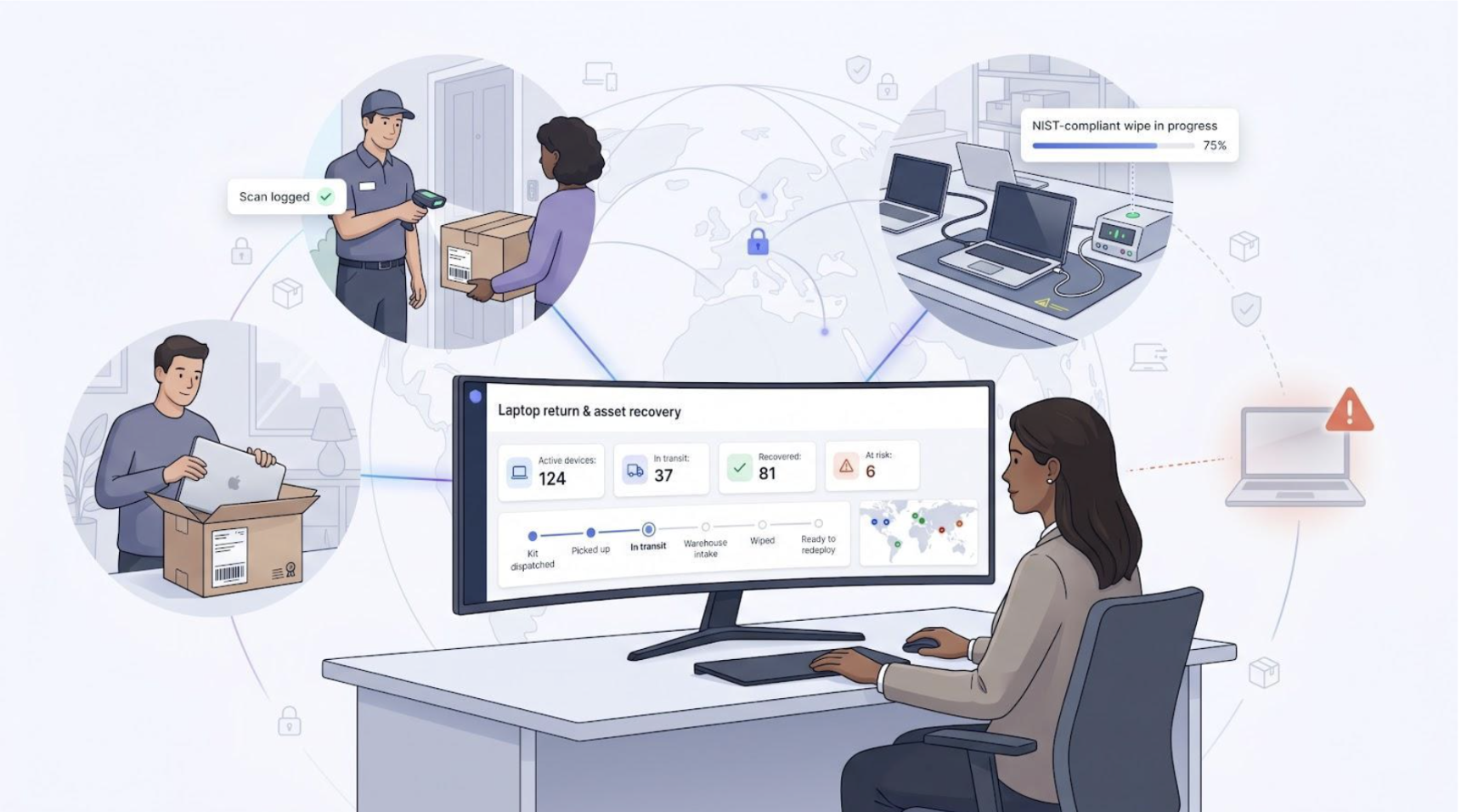
That’s why a new crop of enterprise-grade laptop-return services has emerged. They ship a padded kit to the departing employee, track every scan, certify the data wipe, and move the hardware back into your inventory—often in days, not weeks.
In the next few minutes, we’ll rank the five solutions that do this job best. You’ll see how we scored them, where each one shines, and which service fits your mix of head count, geography, and risk tolerance.
Ready to stop playing hide-and-seek with MacBooks? Here’s what we found.
How we ranked the return champions
You deserve to know why these five vendors made the cut, so here is our process.
We began by mapping every provider that retrieves corporate laptops. The long list reached double digits, ranging from subscription platforms to one-off couriers. We reviewed vendor sites, G2 ratings, Spiceworks threads, and interviewed IT managers who ship more hardware than some retailers.
We then built a scoring model that mirrors common priorities. Retrieval success and speed top the list because a bargain is meaningless if the laptop never returns. Security and compliance follow; auditors ignore friendly drivers when the chain-of-custody log is empty.
Cost efficiency matters once the device is safe. Global coverage and automation round out the model, ensuring the service scales across borders and connects to the tools you already use.
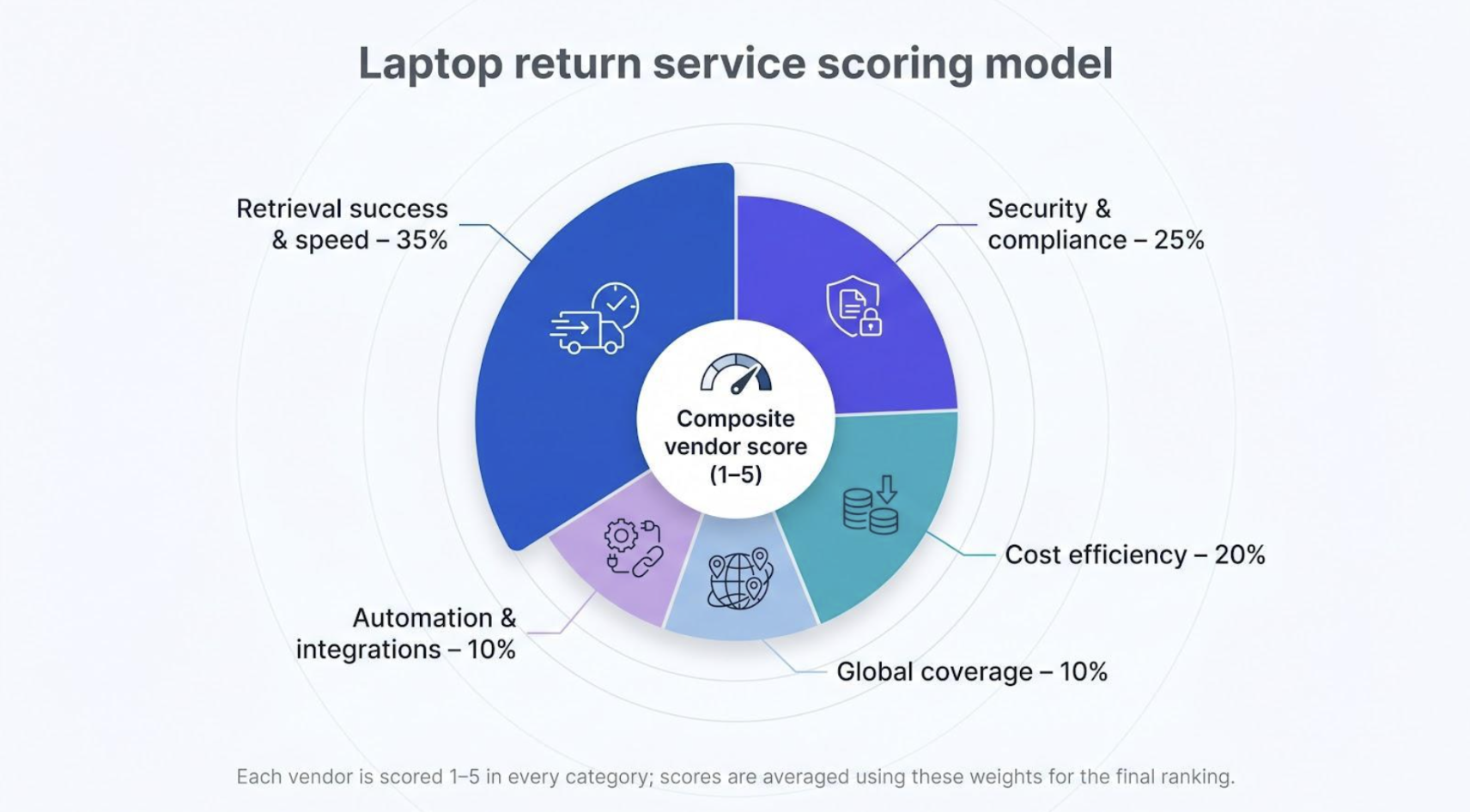
We weighted each factor:
• Retrieval success and speed: 35 percent
• Security and compliance: 25 percent
• Cost efficiency: 20 percent
• Global coverage: 10 percent
• Automation and integrations: 10 percent
Every vendor earned a 1-to-5 score in each category. We cross-checked marketing claims with case studies and user feedback, then averaged the numbers. The five highest composites make up the ranking.
No provider paid for placement. One sponsor appears later, and we flag that relationship in their profile. The numbers and the market evidence told the story.
With that context, meet our first contender.
1. Allwhere: full-service retrieval with reuse focus
Allwhere takes the top spot because it transforms off-boarding from a sunk cost into a savings loop.
When you mark an employee as departing, Allwhere ships a cushioned, recyclable kit that usually arrives within two days, part of an Allwhere equipment retrieval workflow that delivers a 91 percent on-time return success rate. Each courier scan updates a live dashboard—pickup, transit, warehouse intake—so no one needs to ask, “Where’s that MacBook?”
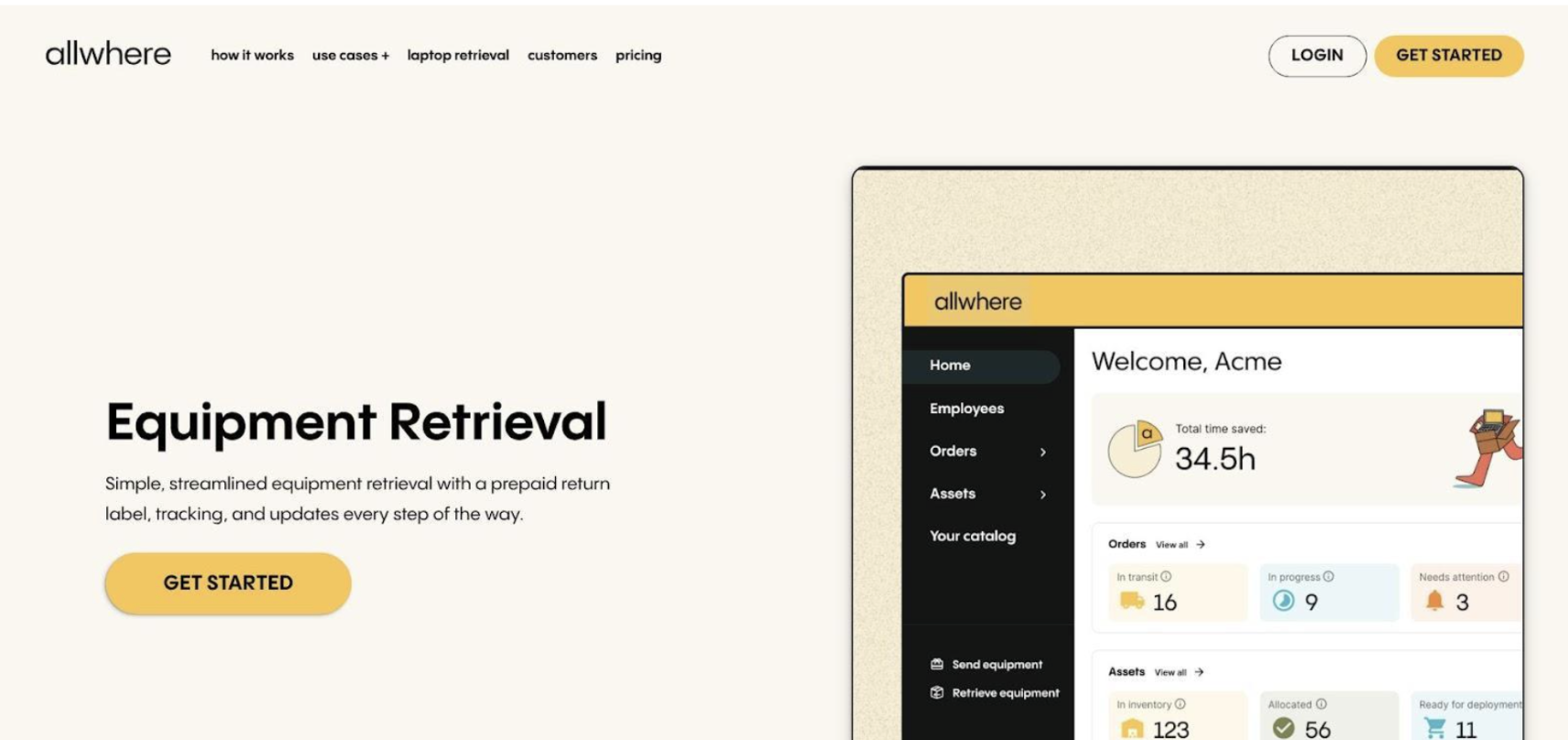
Allwhere enterprise laptop return equipment retrieval workflow screenshot
Speed is only half the value. Every laptop returns to a certified facility for a wipe, inspection, and redeployment queue. You buy fewer new devices and cut e-waste. IT clicks “assign” and the same machine ships to the next hire, already imaged.
Pricing adjusts with volume. Commit to a baseline number of pickups and the per-device rate falls, yet you can still pay as you go during quiet months. Mid-market teams like the predictability; finance likes the savings.
Coverage spans forty-eight countries across North America, Europe, and other key regions. If your workforce leans heavily toward APAC, review the service map; expansion is in progress.
Integration ties it together. A Workday termination can trigger the kit, and inventory updates feed into your MDM. This request-retrieve-refurbish-redeploy cycle keeps Allwhere in front for companies that value sustainability and tight operational control.
2. GroWrk: global reach without growing pains
If Allwhere shines at reuse, GroWrk wins on reach. Its network spans more than 150 countries, giving IT teams one dashboard for worldwide staff.
Here is how the process works. HR off-boards a teammate in São Paulo, GroWrk’s platform fires a webhook, prints a local courier label, and dispatches a padded kit from the nearest depot. The employee drops the box at a neighborhood pick-up point; no currency conversions or customs guesswork land on your desk.
Each scan updates the dashboard in real time. Behind the scenes, GroWrk’s AI reviews return patterns, flags hubs where devices linger, and predicts when a region needs more kits. Those insights help large enterprises tighten SLAs and plug leaks before auditors notice.
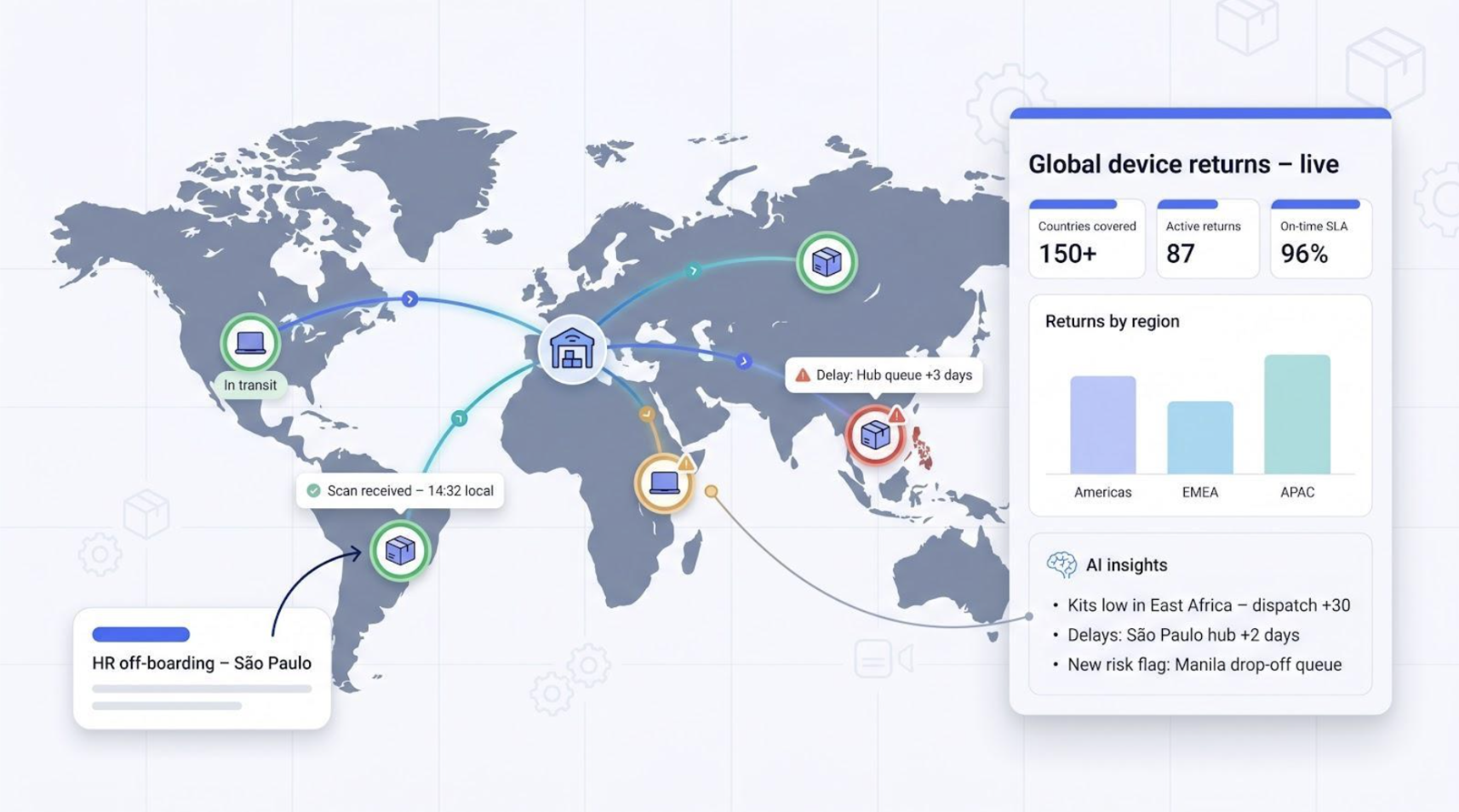
GroWrk follows a subscription model: a flat monthly fee per employee covers unlimited shipments. If you move gear daily, the cost per device falls quickly. Low-turnover teams may pay for unused capacity, so check the math.
Certified data wiping happens in regional warehouses that follow NIST and ISO standards. You can also recycle end-of-life stock in Nairobi or Nashville with a few clicks.
Pick GroWrk when your workforce looks like a world map and you want one system to cover procurement, deployment, swaps, and returns. Pass if your return volume is light or if fixed subscriptions unsettle Finance.
3. Deel Equip (Hofy): HR-native returns with a green streak
Deel built its name on global hiring and payroll. When it acquired Hofy, it folded laptop retrieval into the same dashboard, and off-boarding feels calmer as a result.
Mark an employee as “terminated” in Deel, and the checklist spawns a hardware-return task, sends an email to the leaver, and dispatches a recycled-cardboard kit from the nearest warehouse. No extra portals and no ticket ping-pong between HR and IT.
Hofy’s sustainability mindset remains clear. Packaging is curb-side recyclable, shipping is carbon-offset, and obsolete devices route to donation or certified recycling. ESG metrics arrive in a tidy monthly report, ready for the board deck.
Coverage extends to more than one hundred countries by riding on Deel’s payroll footprint. Service depth varies in remote areas such as rural Indonesia, so review the SLA if timing is critical.
Pricing is flexible. Existing Deel customers can add device management per employee, while occasional users pay per kit, a middle ground between full subscription and ad-hoc shipping.
Security holds strong. Returned machines receive a NIST-compliant wipe, and the certificate drops into the same audit folder that stores tax forms and NDAs. Auditors appreciate the single source of truth, and you will too during a SOC 2 renewal.
Choose Deel Equip when HR owns off-boarding or when sustainability scores matter to the CFO. Skip it if you are not on Deel; launching a full HR platform just for returns seldom pays off.
4. Workwize: flat-rate, set-and-forget subscription
Some IT teams value predictability over advanced features. Workwize meets that need with one flat monthly fee that covers every shipment, pickup, and swap.
Sign up, sync your HRIS, and set rules. After that, departures trigger automatically. The departing employee receives a branded email, chooses a pickup window, and gets a kit without chasing a tracking link. Managers watch the timeline move from “Kit dispatched” to “Device wiped” without opening a help-desk ticket.
The price model favors volume. At roughly eight to eighteen dollars per employee per month, unlimited logistics beat per-use rivals once you exceed about twelve moves a quarter. Light-turnover teams may pay for unused capacity, yet high-growth companies often welcome the cost certainty.
Workwize operates in more than one hundred countries and partners with carriers across Europe and North America. Spare devices sit in regional hubs, so redeployments leave as quickly as returns arrive. Wipe certificates and chain-of-custody PDFs land in your compliance folder automatically, reducing SOC 2 prep work.
Customization is a hidden strength. Need an SMS reminder the night before pickup? Turn it on. Prefer an extra signature step for finance-grade devices? Add it in the workflow builder. Once configured, the system runs quietly and lets your lean IT crew focus on higher-value projects.
Select Workwize when frequent hardware moves and budget predictability top your list. Pass if you ship only a few laptops each month; an on-demand service will likely cost less.
5. Onepak ReturnCenter: on-demand muscle for complex jobs
Sometimes you do not need a full platform, you need a forklift. That is Onepak’s strength.
ReturnCenter is a logistics engine first, software second. Send its API a pickup request and the wheels—often literal pallet wheels—start turning. Couriers arrive with custom-fit boxes, foam inserts, or shrink-wrap, whether you are reclaiming one laptop or clearing an entire satellite office.
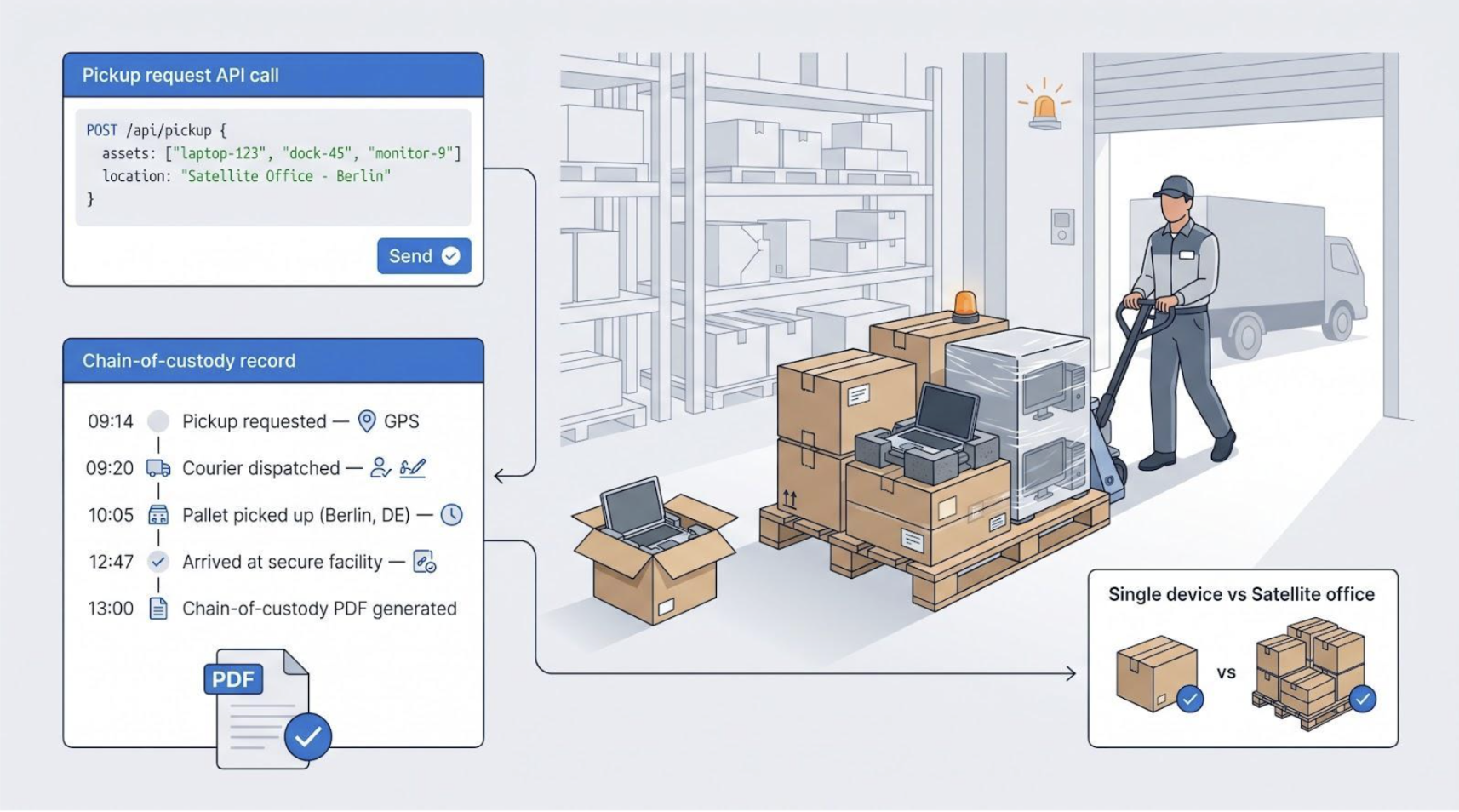
Pricing is pay-per-use and transparent. Each job receives a quote based on weight, distance, and service level, then locks before you agree. Large projects tap tiered discounts that Fortune 500 asset managers rely on when layoffs spike.
With roots in end-of-lease and ITAD work, chain-of-custody rigor comes standard. Every hand-off captures a timestamp, GPS coordinate, and signature. If auditors ask, you provide a PDF trail that reads like a flight manifest.
ReturnCenter does not remind the departing employee; you handle emails and follow-ups. In return, you gain options no glossy portal offers such as white-glove pickups, pallet consolidation, international freight with customs paperwork, and inside-delivery to secure labs.
Coverage reaches more than twenty countries directly, with partners extending farther. Lead times outside North America and Europe run longer than other vendors here, so add buffer days if you are collecting gear in Auckland or Accra.
Choose Onepak when assets are heavy, locations are messy, or your in-house ITAD team already wipes and redeploys hardware. Look elsewhere if you need an employee-friendly portal; ReturnCenter is the strength behind the curtain, not the velvet glove.
Comparative snapshot of how the leaders stack up
Individual profiles tell a rich story, yet nothing matches a direct comparison when you need to justify a budget line on Monday morning.
Scan the table below for headline metrics: where each service operates, how it prices jobs, and the niche it fills better than anyone else. We also added five runners-up so you can view the broader field at a glance.
Service | Core coverage | Pricing model | Stand-out strength | Best fit |
Allwhere | 48 countries | Tiered subscription or per use | Reuse and redeploy loop; deep HRIS/MDM hooks | Mid-market teams chasing cost savings and sustainability |
GroWrk | 150+ countries | Per-employee subscription | Global logistics; AI asset analytics | Enterprises with staff on multiple continents |
Deel Equip | 100+ countries | Add-on or per kit | HR-native workflow; carbon-neutral shipping | Companies already on Deel, ESG-focused teams |
Workwize | 100+ countries | Flat monthly per user | Unlimited pickups; workflow builder | High-growth firms wanting budget certainty |
Onepak | 20+ countries (partners beyond) | Pay as you go | Custom freight, pallet pulls, API control | Large layoffs, heavy gear, in-house ITAD teams |
Firstbase | 150+ countries | Subscription per seat | Polished interface, warehousing | Scale-ups valuing employee experience |
Quipteams | 130 countries | Per use (about $80–$150) | Fast kit dispatch, no contract | Contractors, unpredictable churn |
Retriever | US, UK, EU | Flat $95 per return | Low cost, next-day kit | SMBs needing a simple option |
Rayda | 170+ countries | Hybrid tiers | Full device lifecycle, loaners | Distributed start-ups on tight timelines |
Remote Retrieval | US-centric | Per kit | Free kits, email reminders | Domestic firms testing return services |
“Coverage” refers only to regions where a vendor guarantees door-to-door kit service. Some providers can stretch farther with partner carriers, but SLAs loosen once you leave their core map.
Use the table as a quick filter. Highlight the two or three names whose model and geography align with your needs, then return to their full profiles for nuance that never fits inside a cell.
Next, we will walk through a decision flow that turns those short-listed contenders into a confident choice.
How to pick the winner for your team
Comparison tables help, yet real life often lives in the grey zones between cells. Use the steps below to translate numbers into a confident yes.
Start with volume. Count how many laptops you reclaimed last quarter and estimate the next. If the tally barely reaches double digits, a pay-per-use service such as Onepak or Quipteams keeps costs tight. Once returns happen weekly, a subscription often costs less, even before you factor in staff hours.
Next, mark the map. A workforce clustered in the United States and Western Europe gives you the full menu of providers. Add Nairobi, Manila, or Medellín and GroWrk’s global network rises to the top. The farther employees work from major hubs, the more a deep carrier roster matters.
Now assess internal bandwidth. Lean IT teams usually prefer a hands-off process from Allwhere, Workwize, or Deel Equip, because these platforms chase employees, schedule couriers, and file wipe certificates automatically. If you already run an in-house ITAD program, Onepak’s raw logistics fit without disrupting existing steps.
Budget philosophy counts. Finance teams that dislike variable invoices sleep better with Workwize’s flat rate. CFOs who favor activity-based costing prefer per-kit pricing, even if the monthly spend shifts.
Finally, weigh sustainability and compliance. If ESG reports land on your desk, Deel Equip’s carbon-neutral routing and recycled packaging earn points. If auditors visit often, choose a vendor that provides NIST-compliant wipe logs and chain-of-custody PDFs without prompting; Allwhere and GroWrk perform well here.
Combine those filters—volume, geography, staffing, budget stance, and strategic values—and the shortlist reveals itself. Book a demo, ship a test kit to a friendly employee, and judge the experience first-hand. The right solution should feel invisible until the laptop rests safely back on your shelf.
What’s next for laptop retrieval in 2027 and beyond
Return logistics has left the back office. It is now a fast-moving tech segment, and the pace keeps rising.
The first change to watch is box-free returns. Carriers such as UPS and FedEx are piloting storefront kiosks where employees hand over an unboxed laptop, scan a QR code, and leave in seconds. As these pilots mature, enterprise vendors will add the option, cutting kit costs and removing another excuse for late send-offs.
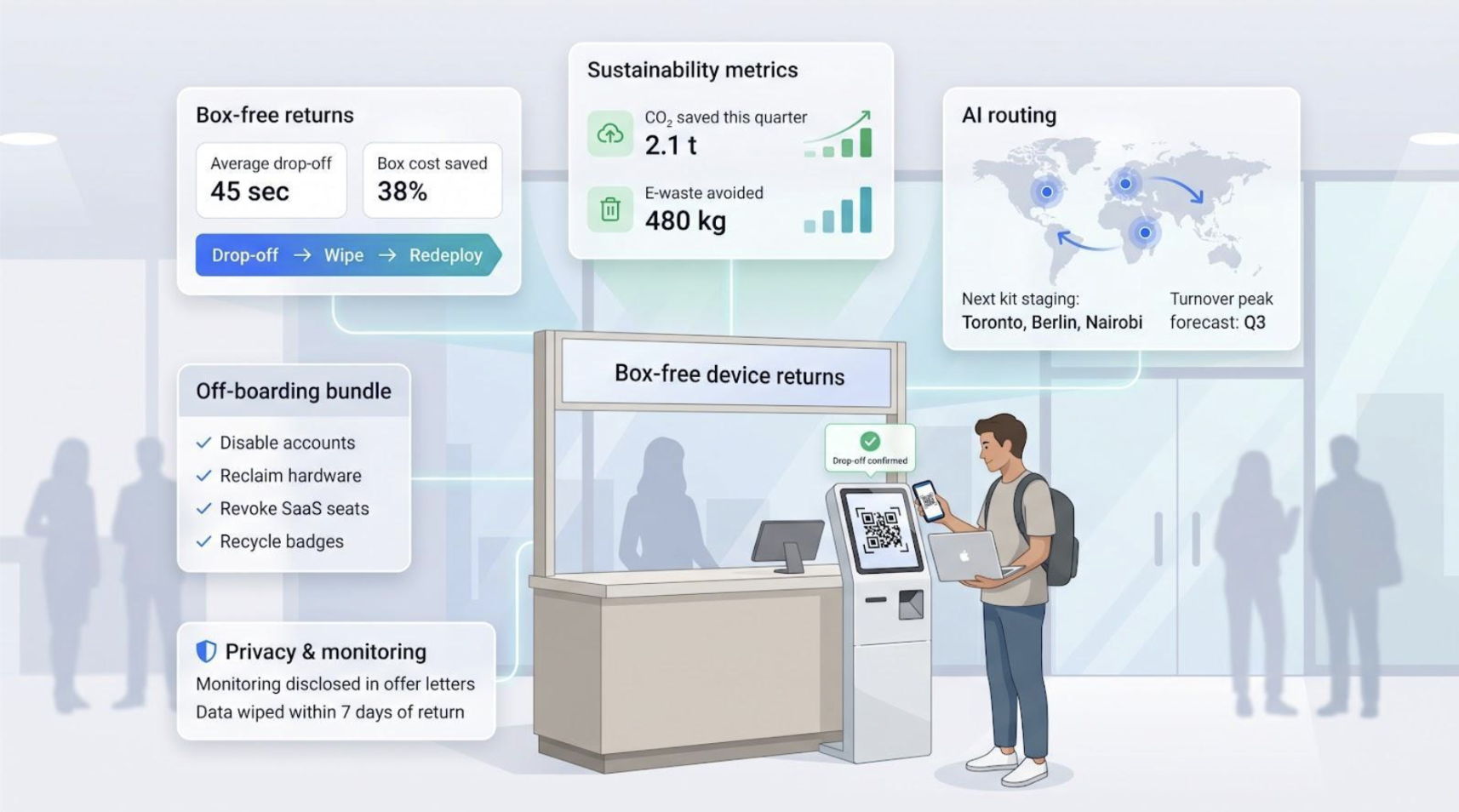
Sustainability is entering the boardroom. Directors now ask for hard numbers, not anecdotes. Providers are replying with dashboards that turn each redeployed device into kilograms of carbon saved and pounds of e-waste avoided. Soon those metrics will flow straight into ESG software, making retrieval an environmental lever rather than a tactical chore.
Artificial intelligence is moving from concept to practice. Early adopters already use machine learning to flag high-risk departures, such as employees with poor return histories or critical IP on the drive, and then schedule priority pickups. Next comes predictive routing: algorithms will stage kits and couriers based on seasonal turnover so devices land sooner and travel fewer miles.
Tech stacks are merging. HR platforms have started buying device companies (Deel–Hofy was only the first), and shipping giants are courting ITAD specialists. Within a few budget cycles, expect off-boarding bundles that disable accounts, reclaim hardware, revoke SaaS seats, and recycle badges, all triggered by one HRIS event.
Privacy optics also matter. As tracking grows smarter, companies must balance vigilance with respect. Clear policy language—why the device is monitored, when it is wiped, how data is handled—will become standard in offer letters and exit packets. Leading vendors already provide template clauses, and remote talent will notice who does and who does not.
Conclusion
Combine those filters—volume, geography, staffing, budget stance, and strategic values—and the shortlist reveals itself. Book a demo, ship a test kit to a friendly employee, and judge the experience first-hand. The right solution should feel invisible until the laptop rests safely back on your shelf.
FAQs quick-fire round
Q: Do we need a service, or can we just send a UPS label?
You can, and many small teams start that way. The gaps appear later: no tamper-evident packaging, no automated reminders, and no audit-ready chain of custody. A $30 label feels thrifty until a $50,000 data-loss risk surfaces. Services add the guardrails—secure boxes, tracking updates, certified wipes—so the laptop returns and the data stays safe.
Q: What does a “certified data wipe” look like?
Think of it as a forensic audit trail. The provider boots the machine into a sanitization tool that follows NIST 800-88 or DoD overwrite standards. The process logs drive serial numbers, pass counts, and checksum results, then generates a PDF attestation with a hash you can verify later. That certificate drops straight into your SOC 2 or GDPR evidence folder, proving the data no longer exists.
Q: How long should the entire return cycle take?
With the vendors in our top tier, domestic turns average seven to ten calendar days from HR trigger to warehouse receipt. International legs reach about fourteen days, mainly due to customs dwell time. Delays often occur when employees postpone boxing the device, which is why most platforms send escalating reminders and, after a cutoff, alert HR so you can withhold final pay or disable the machine remotely. The best process blends technology and policy so the timeline stays predictable.
Related Posts
- How to Start an Automotive Dropshipping Business in 2026
- 12 Best Custom Software Development Companies for Scalable EdTech Platforms in 2026
- How to Build a Sustainable Backlink Strategy for an E-commerce Website
- Top 5 Enterprise Laptop Return Shipping Solutions for Remote Workforce Asset Recovery
- International Link Building for E-commerce Brands: A Practical Guide
- Server Refresh vs Third-Party Maintenance: Which Option Makes More Sense?