



Discover the top web development trends for 2026, including AI, headless commerce, edge computing, WebAssembly, and Zero-Trust security for faster, secure websites.
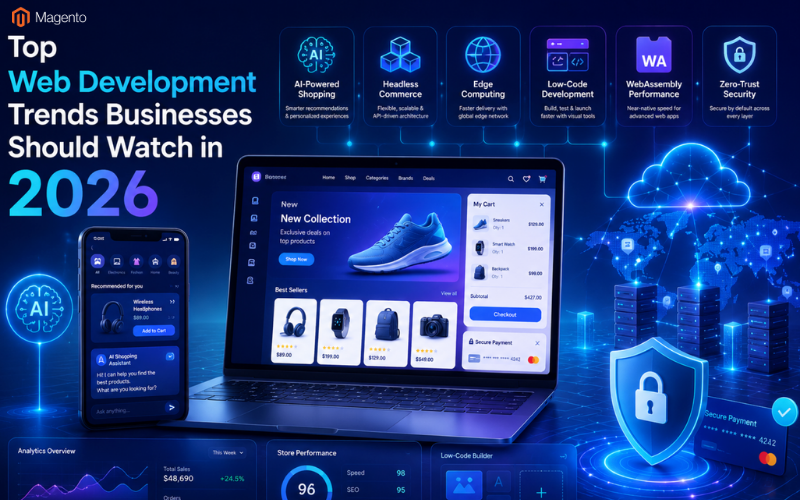
The global e-commerce landscape is shifting from transactional storefronts to real-time, interactive shopping environments. With rising acquisition costs and changing consumer behavior, online retailers can no longer rely on static product catalogs or standard checkout flows to drive conversions.
Evaluating web development trends 2026 requires looking past short-lived novelties and focusing on architectures that directly improve page load speeds, security, and customer lifetime value. For e-commerce leaders, digital store managers, and technical decision-makers, modernizing your digital storefront is about building an infrastructure flexible enough to handle rapid shifts in retail technology.
1. AI-Powered Web Development: Autonomous Agents in E-Commerce Checkout
The era of simple, rule-based chatbots sitting in the bottom corner of a storefront is over. Modern online stores are integrating autonomous AI shopping agents directly into their core application logic to guide customers through complex purchase decisions.
Rather than relying strictly on standard search filters or category menus, AI-powered web development enables conversational product discovery, real-time inventory matching, and dynamic cart optimization. These embedded agents act as digital store associates, answering detailed technical inquiries, comparing product specs on the fly, and generating custom bundle offers based on individual user intent.
Operational Advantages for E-Commerce Merchants
Conversational Cart Recovery: Embedded agents interact with hesitant buyers during checkout, resolving sizing or shipping questions before a session is abandoned.
Dynamic Checkout Personalization: Offers, payment methods, and shipping options adapt instantly based on customer history and geographic location without requiring full server reloads.
Automated Support Workflows: Post-purchase inquiries - such as order tracking, return processing, and exchange requests - are handled securely within the client session.
In modern enterprise e-commerce ecosystems, agentic frameworks are transitioning from external frontend widgets into serverless backend functions, allowing store admins to maintain speed without straining core server resources.
2. Low-Code Web Development in Enterprise E-Commerce Governance
Launch velocity remains a core priority for growing digital brands. While early visual builders were limited to basic marketing pages, today’s low-code platforms support complex workflows within large-scale online stores.
Visual development platforms are now mainstream enterprise architecture. With most new business applications leveraging low-code and no-code frameworks, brands can deploy promotional workflows rapidly without compromising core system security. In online retail, the primary focus for 2026 is balancing rapid marketing rollouts with strict IT governance and data compliance.
By separating visual layout editing from core backend logic, e-commerce managers can launch seasonal sales, update product pages, and test promotional banners without modifying core database schemas or risking site stability.
Balancing Agility and Security
Centralized Design Tokens: Standardized component libraries ensure brand consistency across web stores, mobile web apps, and headless storefronts.
Role-Based Access Controls (RBAC): Granular permissions prevent unauthorized staff from altering critical store settings, payment gateways, or pricing rules.
Hybrid Deployment Pipelines: Marketing teams configure promotional layouts through visual drag-and-drop interfaces, while technical architects oversee core security patches and database scaling.
Integrating low-code web development inside an enterprise commerce ecosystem reduces development backlogs, allowing core developers to focus on custom module creation, system integrations, and speed optimization.
3. Edge Rendering and Headless Architecture for High-Speed Stores
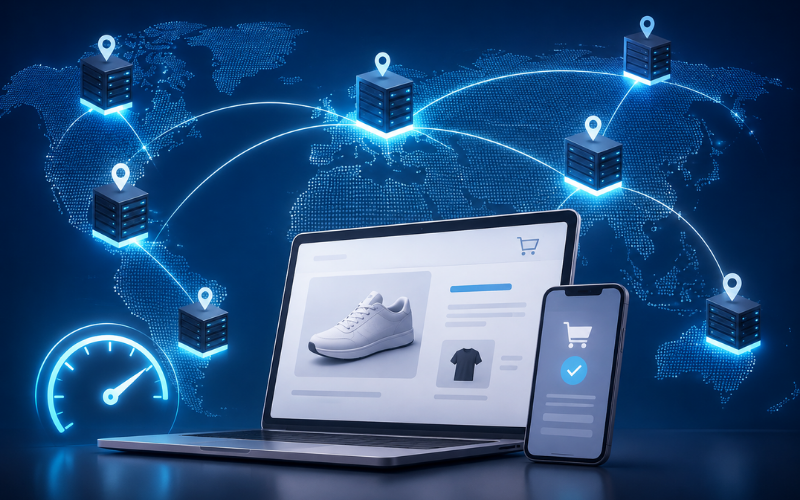
Page speed remains a primary driver of e-commerce conversions. A delay of even a few hundred milliseconds can cause a measurable dip in completed checkouts. Relying solely on centralized cloud servers located far from your shoppers creates latency, lowers Core Web Vitals scores, and harms organic search rankings.
Modern enterprise web development addresses this by pushing rendering and API logic directly to edge networks - processing requests at data centers closest to the shopper's physical location.
Key Benefits of Edge-Driven Commerce
Sub-50ms Catalog Rendering: Dynamic price updates, localized currency conversions, and inventory checks execute at edge nodes, bypassing origin database round-trips.
Peak Traffic Resilience: Distributed edge infrastructure routes traffic during flash sales or Black Friday spikes, maintaining uptime when transaction volumes surge.
Headless Storefront Flexibility: Decoupling your frontend display (such as a Progressive Web App or custom React interface) from your underlying e-commerce engine guarantees rapid page delivery across all devices.
Meta-frameworks built on edge serverless technology allow online retailers to deliver app-like performance within standard web browsers, ensuring shoppers experience zero lag from homepage to final payment.
Platform Comparison: Legacy Monolithic vs. 2026 E-Commerce Architecture
Choosing the right technology stack directly impacts site maintenance costs, infrastructure scaling, and conversion rates during peak retail seasons.
Architectural Dimension | Legacy Monolithic Storefront | 2026 Modular / Headless Stack | Retail Business Impact |
Rendering Strategy | Server-Side Rendering (Central Origin) | Hybrid Edge-Rendering & Micro-Frontends | Eliminates latency, accelerating product page load times globally |
Release Velocity | Delayed deployment cycles; coupled code | Independent API modules & visual layout management | Rapid launch of marketing campaigns without breaking checkout logic |
Security Architecture | Standard firewall around main database | Zero-Trust API gateways & edge sanitization | Protects customer data and minimizes vulnerability exposure |
Traffic Handling | Hardware scaling constrained by server limits | Distributed serverless edge nodes | Prevents store crashes during sudden traffic spikes |
Storefront Experience | Heavy client-side JavaScript bundles | WebAssembly modules & optimized PWA components | Native app performance directly inside any desktop or mobile browser |
4. Custom Web Development via WebAssembly for Interactive Shopping
As online stores offer richer interactive experiences such as 3D product configurators, augmented reality (AR) virtual try-ons, and real-time custom engraving previews - standard JavaScript often hits browser performance limits.
WebAssembly (Wasm) solves this challenge by allowing languages like Rust, C++, and Go to run in web browsers at near-native speed.
With global online retail expanding rapidly, rising consumer expectations are driving unprecedented demand for high-performance storefronts. Investing in custom web development using enables brands to replace clunky third-party plugins with lightning-fast, client-side tools.
Applications in Modern Retail
In-Browser 3D Product Customization: Customers can modify product materials, colors, and dimensions in real time without waiting for cloud rendering queues.
Instant Price and Tax Calculations: Complex B2B order calculators, tiered volume discounts, and regional tax rules process instantly on the client side.
Client-Side Data Encryption: Sensitive customer information and payment details are encrypted directly in the browser before transmission, reducing middleman vulnerabilities.
Utilizing WebAssembly allows merchants to offer rich, immersive shopping features without slowing down page rendering or degrading overall site performance.
5. Zero-Trust Security Models in E-Commerce Ecosystems
With online stores relying on interconnected networks of third-party extensions, shipping APIs, payment gateways, and analytics scripts, traditional perimeter-based security is no longer enough. Cybercriminals increasingly target third-party vendor code, client-side scripts, and session cookies to compromise customer payment details.
Modern store development requires a strict Zero-Trust approach: treating every incoming request, third-party plugin, and internal API call as unverified until explicitly authenticated.
Core Security Standards for 2026
API Gateway Authentication: Every data exchange between your frontend storefront, core database, and third-party fulfillment services undergoes strict token validation.
Client-Side Script Shielding: Real-time monitoring tools detect unauthorized form-jacking, malicious script modifications, or credential-stuffing attempts at the browser level.
Granular Extension Sandboxing: Third-party extensions operate within restricted environments, preventing a compromised plugin from gaining access to core customer databases or payment pipelines.
Adopting proactive security protocols protects store integrity, safeguards shopper data, and maintains compliance with global privacy regulations like GDPR and PCI-DSS 4.0.
Strategic Action Items for E-Commerce Leaders
Updating your online store technology requires focused planning rather than a complete system overhaul. Technical teams and e-commerce managers can follow this structured approach:
Audit Global Store Performance: Evaluate page load times and Core Web Vitals across major customer regions. Shift dynamic catalog rendering and static assets to edge networks.
Establish a Unified Design System: Bridge the gap between marketing teams and developers by deploying centralized UI components compatible with your low-code page builder.
Optimize Heavy Interactive Features: Shift complex client-side calculations, 3D visualizers, or custom configurators to WebAssembly to eliminate browser lagging.
Enforce Zero-Trust API Security: Verify that all third-party integrations, extensions, and payment gateways operate through authenticated API layers to prevent data leaks.
Closing Thoughts
Navigating web development trends 2026 requires a sharp focus on site performance, agility, and uncompromising security. Retailers that proactively upgrade their underlying software architecture today place themselves in the best position to offer seamless, highly engaging shopping experiences - ultimately lowering customer acquisition costs and unlocking sustainable revenue growth over time.
Read more:
1. How AI Is Transforming Website Development Tools in 2026
2. How to Build a Scalable IT Support System for Growing Businesses
3. Which Tool Is the Most Effective and Best AI for Business Writing?
Related Posts
- Top 5 Enterprise Laptop Return Shipping Solutions for Remote Workforce Asset Recovery
- International Link Building for E-commerce Brands: A Practical Guide
- Server Refresh vs Third-Party Maintenance: Which Option Makes More Sense?
- The Best Funnel Builder for Coaches and Course Creators
- How Magento Powers Modern eCommerce Businesses
- How to Price an Online Course Without Leaving Money on the Table?