


Build a sustainable backlink strategy for your e-commerce website with practical steps to audit links, create link-worthy assets, earn quality backlinks, and grow safely.
Nobody wants to link to a product page. That's the uncomfortable truth behind most ecommerce link building. Bloggers link to research, to tools, to arguments they agree with. They don't link to your "Men's Running Shoes" category because there's nothing there to say anything about.
So store owners end up buying links, trading them, or stuffing guest posts onto sites nobody reads. It's understandable. It's also why so many shops rank beautifully for six months and then quietly disappear.
There's a better way to do this, and it doesn't require a huge budget or a PR agency. It requires giving people a reason to link, then being patient about it.
This guide explains how to build backlinks for ecommerce: what to fix first, which pages give people a reason to link, and how to keep those links useful as your store changes.
What Is a Sustainable SEO Backlink Strategy for E-commerce?
Sustainable vs. short-term link building
The word "sustainable" gets thrown around a lot, so here's what it means in this context and nothing more: links that don't need to be replaced.
That sounds obvious until you look at how most stores actually get links. They buy a package, rankings go up, the package "expires" or the seller's network gets flagged, rankings drop, and they buy another package. It's a subscription, basically.
Except the thing being rented is the store's own visibility.
A sustainable approach spends the same money and effort on links that stick. Which usually means links from sites that have an actual audience, in a topic that's at least loosely related, pointing at pages that gave them a reason to link. Slower to build. Much cheaper over any horizon longer than a year.
One more thing worth saying plainly: sustainable doesn't mean perfect. A shop with 300 referring domains will have some junk in there.
That's fine. Google is used to junk. A reasonable percentage of toxic backlinks is present in any natural backlink profile. But what Google isn't used to is a store where the junk is the whole profile.
Why e-commerce sites are different
A software company writes one decent industry report and gets cited for years. A store selling garden furniture has no equivalent move. Its most valuable pages, the ones that actually sell, are lists of chairs with prices. Nobody links to a list of chairs.
On top of that, inventory changes constantly, so hard-won links end up pointing at dead pages. This problem extends well beyond online stores: an Ahrefs study covering more than two million websites found that 66.5% of links had rotted over the nine-year period studied.
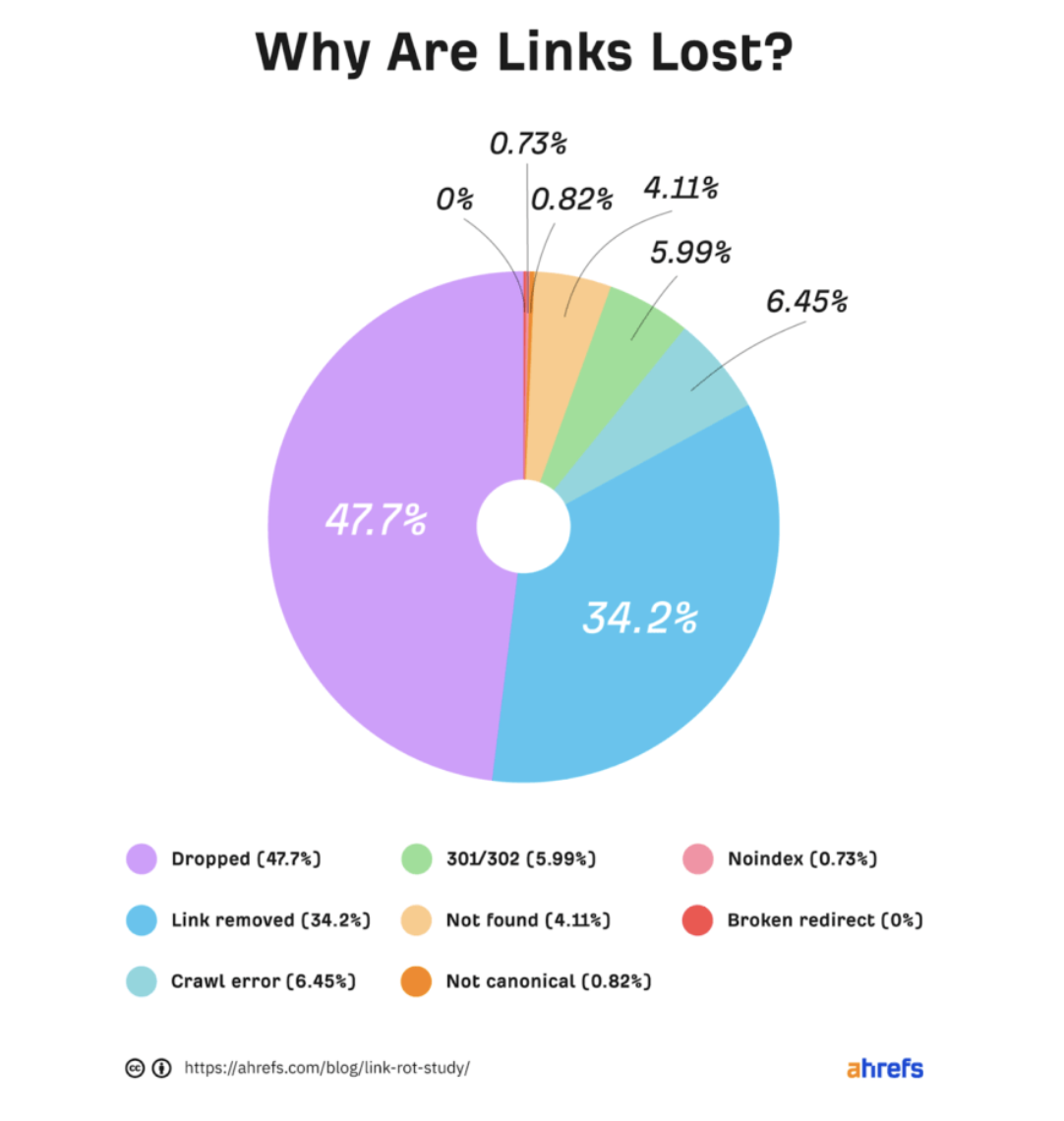
Source: Ahrefs
Earning the link is only part of the job. Keeping the destination useful after a product sells out is part of SEO for ecommerce, too.
And every competitor has the same chairs from the same wholesaler. The content problem and the sameness problem stack on top of each other, and that's before anyone's even mentioned link building.
Why Ecommerce Backlinks Still Matter for Online Stores
Somebody on a podcast said links don't matter anymore. Somebody always does. Then a few months later there's a Google update, and the stores that lose the most traffic are, not by coincidence, the ones with the thinnest link profiles.
One of the headaches of ecommerce SEO is that competing stores often sell identical products and describe them in almost identical words.
Say a person types "cast iron dutch oven 5 quart." Google can pick from a hundred stores selling the identical Lodge pot at nearly the identical price with nearly the identical product description copied from the same manufacturer feed. Nothing on the page separates them.
Links do.
Not exclusively, and not the way they did in 2012 when quantity alone could push a spammy page to the top.
But when everything else is equal, the shop that's been mentioned by a few cooking sites, a couple of regional news outlets, and a kitchen supply forum is going to sit above the one that hasn't. That's just how it works, and pretending otherwise doesn't change the search results.
There's also the plain fact that a link is a doorway. A store that gets written up in a "best budget cookware" roundup will see orders from that article for years, long after the ranking effect fades. Those readers arrive already sold on the idea. They just needed somewhere to buy it.
It’s also worth exploring free backlink sources where shoppers already look for ideas and answers. A useful contribution to a relevant discussion gives people a reason to visit the store before they’ve even searched for its name.
Rankings matter. Referrals sometimes matter more.
How to Build a Sustainable Backlink Strategy for Your E-commerce Store: 4 Steps
Four steps. They aren't complicated, but they do go in order, and the order is exactly what every good strategy is about.
Tellingly, everyone wants to start with content creation or blogger outreach because they give a sense of progress. But unless you understand where you currently stand and where you should go, your energy and time might be wasted.
Step 1 — Audit Your Current Backlink Profile
Before earning more ecommerce backlinks and putting all your energy and resources into it, you should review and potentially improve what your website already has. So, this step is about reviewing your existing backlinks and sites that point to your website and bring you human traffic or bots.
Begin with referring domains. One website may link to your store 100 times, but it still counts as one referring domain. Generally, ten links from ten relevant, reputable websites are more valuable than 100 links from one weak site.
Your audit should focus on these critical areas:
• Backlink quality: Does the ecommerce website that links to your site have a worthy (original, deep, human-made, or moderated) link that is closely related to your niche/area?
• Linked pages: Do all business-critical pages on your website receive inbound links equally? Use relevant SEO tools to help you understand that.
• Broken destinations: Links tend to break over time. Identify the ones with error codes and fix them, e.g., redirect orphan URLs to the closest relevant page.
• Anchor text: Assess the health of your typical anchor text used in backlinks. A natural profile should consist of brand names, page titles, URLs, and descriptive phrases. Avoid exact-match anchors with stuffed keywords.
• Unusual patterns: Thousands of links from unrelated or low-quality sites may indicate bad (the so-called black-hat link-building) or spammy link building for ecommerce.
Do not panic over every suspicious website. Some spam is normal. The aim is to spot broader patterns, recover valuable links pointing to dead pages, and understand what the store actually lacks.
That gives the next stage of the strategy a healthier foundation, a solid stepping-stone for your gradual takeoff.
Step 2 — Build Link-Worthy Assets on Your Store
“Publish useful content” is easier said than done, especially in the age of AI when chatbots can churn out huge volumes of seemingly good content in minutes. When you know that your competitor has already published 40 versions of the same buying guide, what is left for you?
Think out of the box. Consider doing something your competitors have never done before (and it’s OK to ask AI for ideas at this stage).
For example, look at your returns inbox.
A furniture store might discover that customers keep ordering tables that won’t fit through their stairwells. People complain, and some even return their orders. There’s a useful topic to explore and help people find solutions to their problems, e.g., know how to disassemble their tables or take proper measurements before buying.
That’s essentially what link-worthy assets are—pages someone else can reference, such as:
• Illustrated instructions for a job people regularly get wrong.
• Product tests with measurements and photographs.
• Original data that answers a question in your niche.
For that furniture shop, a guide to measuring doorways, lifts, and tight corners would make sense. A moving company could link to it when advising customers about delivery access.
Think of other link building tactics to use and what particularly you can do to attract quality links.
For example, include diagrams and quality photos in your guest posts. People love simple explanations. Leave the sales pitch and your eloquence for later; someone measuring a stairwell has a fairly immediate problem to solve.
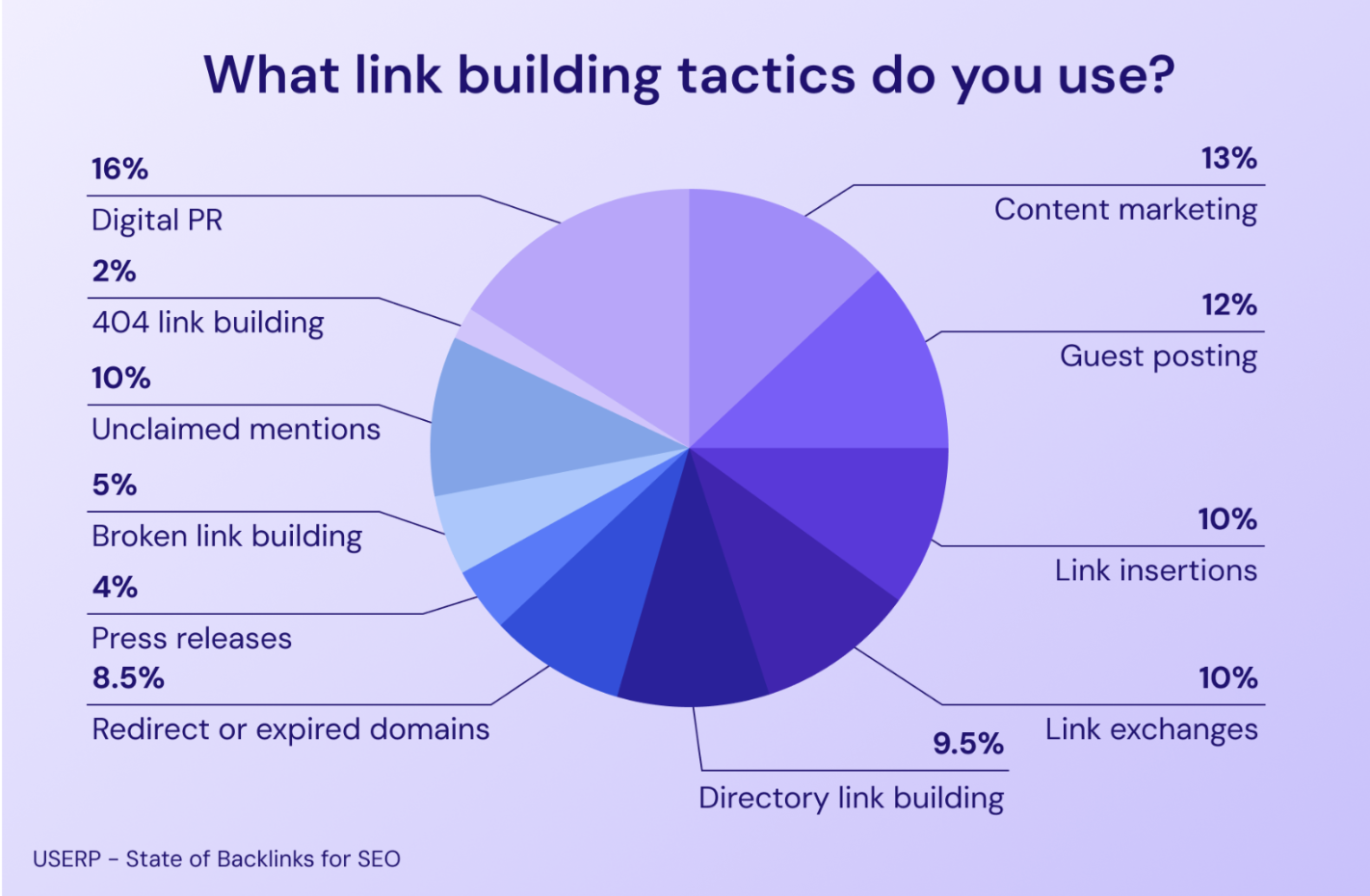
Source: Searchenginejournal
Step 3 — Earn Links Through Relationships, Not Volume
A content outreach email that starts with "I came across your wonderful blog" has a reply rate somewhere near zero, and everyone who's ever run a blog knows why. It's the digital version of a stranger complimenting your shoes right before asking for money.
The stores that get high quality backlinks don't send that email.
What they do instead is slower and less scalable, which is exactly why it works. A camera shop sends a lens to a photographer with a small YouTube channel and says, "Keep it, no strings".
Half the time nothing happens. The other half, the lens shows up in a video, the shop gets mentioned, and that photographer now knows the owner by name. One link, but the kind that leads to the next one.
Where this tends to pay off, in no particular order:
• Suppliers and brands. Most have a "where to buy" page and will add a retailer who asks. Almost nobody asks.
• Small creators in the niche, sent a product with no strings attached.
• Guest posts, but only on relevant websites whose readers would actually shop there.
• Sites that already mention the store and just forgot the link.
• Old links pointing at deleted products. Redirect them, or ask for an update.
On guest posting, one caveat worth stating plainly: if an ecommerce website would publish anything for $80, the link is worth about $80. One article on a gardening blog that real gardeners read beats ten on "lifestyle" sites that exist to sell placements.
The last two bullets are the free money. Links the store already earned and then dropped on the floor. Ten minutes with a brand search and a crawler usually finds a handful.
Step 4 — Set a Safe Link Velocity and Anchor Mix
There's a particular graph in Ahrefs that gives away a bought campaign every time. Flat line for two years, then a cliff going straight up in March, then flat again. Nobody who's earned links has a graph like that.
Steady is better than fast in link-building.
A store that picks up four or five decent links a month, every month, looks like a store people talk about. A store that gets sixty in one month and none after looks like a store that ran a promotion on a link marketplace. Google can tell the difference, and even if it couldn't, the second pattern usually stops working the moment the budget does.
Anchors follow the same logic. A profile that grew naturally tends to look something like this:
• Mostly the brand name, or the brand plus a word or two.
• A fair chunk of plain URLs and "click here" type links.
• Some loose descriptions, "this guide to tent sizes" and the like.
• Only a sliver of exact commercial phrases.
If "buy cheap tents online" is the most common anchor, that's not a profile that grew naturally, and it reads that way.
Don’t overdo the tracking part. Just look at the graph once a month and ask whether it looks like a real business or a campaign.
The Bottom Line
Most of what passes for ecommerce link building is a way to rent rankings by the month. The alternative is to build a strategy and execute it step-by-step. Yes, it’s a longer path, but it's more reliable and brings results that last.
Three things worth keeping the most from what we have discussed today:
• Nobody links to a product page. Build the page they would link to, then let it pass the strength along.
• Twenty people who know the store's name will do more than two thousand who've deleted its email.
• A link profile has a shape, and Google reads the shape before it reads numbers. Steady growth, brand-heavy anchors, a bit of junk. That's what real looks like.
Before adding more outreach to your ecommerce SEO strategy, spend an afternoon checking the links you already have. You may find a useful mention pointing to a deleted product or a guide that has moved. Give those links a working destination before chasing the next ones.
Related Posts
- How to Start an Automotive Dropshipping Business in 2026
- 12 Best Custom Software Development Companies for Scalable EdTech Platforms in 2026
- How to Build a Sustainable Backlink Strategy for an E-commerce Website
- Top 5 Enterprise Laptop Return Shipping Solutions for Remote Workforce Asset Recovery
- International Link Building for E-commerce Brands: A Practical Guide
- Server Refresh vs Third-Party Maintenance: Which Option Makes More Sense?