



Discover how Magento projects help CS students learn real-world software engineering, from architecture and APIs to security, testing, and scalability.
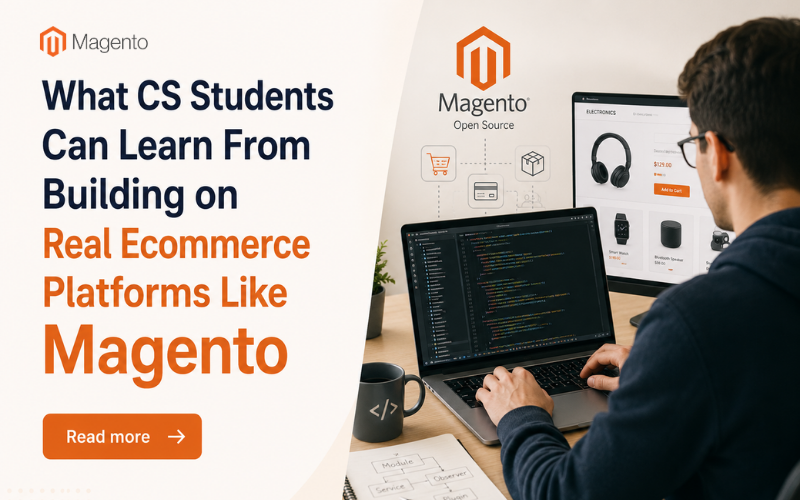
In CS courses, you normally start by writing tiny programs. Students develop calculators, note-taking applications, basic databases, or small web storefronts. The projects focus on learning algorithms and syntax. However, they hardly depict what happens to production software when multiple systems, users, and business rules come together.
Magento modifies that view. Magento Open Source provides a viable ecommerce foundation with public source code. Students learn how a mature platform manages retail features, administration, integrations, and infrastructure.
The key value is not mastering one product. A Magento project links classroom theory to architecture, databases, security, testing, performance, teamwork, and customer experience.
Why a Real Ecommerce Platform Teaches More
A tutorial shop might show products and take a mock order. A business platform, however, has to handle prices, stock, permissions, promotions, search, refunds, and external services.
That intricacy gives students a realistic view of software development. Every feature spans several layers, and a benign alteration can have unforeseen consequences elsewhere.
Complexity Reveals How Systems Connect
An ecommerce application is a combination of various technical fields. Students cannot see the interface, database, and server logic as distinct classroom exercises.
A typical store might include:
• catalog data and category structures;
• customer accounts, roles, and permissions;
• carts, coupons, taxes, and checkout rules;
• payment, shipping, and inventory integrations;
• search, indexing, caching, and analytics.
The study of these relationships promotes systems thinking. Learners want to know where the data comes from, who can change it, and which systems depend on it.
Business Rules Turn Code Into Engineering
A function could be conceptually correct and still fail from a business perspective. A discount might work theoretically but apply to excluded products. An inventory update may succeed but allow conflicting reservations.
Real platforms teach students how to translate imprecise criteria into exact behavior. They need to think about edge cases, competing rules, useful errors, and recovery methods.
Real ecommerce projects often arrive alongside reports, coding exercises, and group deadlines from several courses. That overlap can reduce the time available for testing, documentation, and careful problem-solving. Some students then consider outside options for handling written coursework while they concentrate on a demanding technical build. Before making that choice, they should review course policies and think carefully about personal responsibility. Under pressure, a student might admit, “I need someone to do my assignment at MySuperGeek while I focus on debugging the Magento module.” The phrase reflects a common workload problem rather than a shortcut to technical growth. Students still need to understand the concepts behind every submitted task and follow their university’s academic rules. The situation also reveals an important engineering lesson. Professional developers constantly decide which tasks need direct attention, which can be scheduled later, and where limited time creates the greatest risk. Learning to make those choices helps students protect code quality without neglecting their wider academic responsibilities.
Core Technical Lessons From Magento Development

Magento exposes learners to patterns utilized in large applications. The framework may seem difficult, but such difficulty shows how professional systems deal with complexity.
Modular Architecture and Extensibility
Magento and Adobe Commerce organize functionality into modules. Service contracts provide consistent interface definitions. Dependency injection supplies implementations and prevents classes from building their own dependencies.
Students can also learn about plugins and event observers. Plugins listen to public methods, while observers listen for dispatched events. Both extend behavior without directly altering core files.
These mechanisms help students comprehend dependency inversion, loose coupling, and extension points. They also demonstrate how excessive customization creates hidden interactions and maintenance risks.
APIs and Headless Storefronts
Retailers today may have different interfaces for the web, mobile devices, or kiosks. Magento supports REST and SOAP services, while GraphQL offers another option for frontend connections.
APIs for product searches, client sessions, carts, and orders are more than just classroom endpoints. Students practice validation, authorization, pagination, error handling, and backward compatibility.
They also learn why a stable contract is important. Internal code can change over time without forcing every attached program to adjust immediately.
Databases, Indexing, and Consistency
Ecommerce data is highly interconnected. Products can have attributes, categories, prices, stock records, media, and customer-group rules.
Magento relies on indexers to turn changing catalog data into structures optimized for storefront access. Reindexing keeps derived structures synchronized with the primary data.
This provides a practical lesson in eventual consistency and denormalization. Students understand why background processing and careful invalidation of optimized reads are important.
Changes to the database also require care. A migration needs to preserve existing data, minimize locking, and include a recovery strategy.
Performance as Part of Correctness
A page that gives the right result in five seconds is not a success. Shoppers demand speedy search, snappy navigation, and reliable checkout.
Magento has several cache types that developers can manage using command-line tools. Caching makes things faster, but incorrect invalidation can result in outdated data being served.
Students learn to profile searches, view network requests, test realistic catalogs, and compare cached behavior. They also see what happens to an entire journey when there are huge payloads or repeated calls.
Security With Real Consequences
Security becomes real when software manages accounts, addresses, administrative powers, tokens, and order information. Excessive access or weak validation can do a lot of harm.
Adobe suggests keeping patches current, using two-factor authentication, safeguarding connections, and reviewing security regularly. Its documentation also provides tips on scanning and incident response.
A student project should have the same mentality. Secrets live outside source control; inputs need to be validated; each role gets only the rights it needs.
Another good practice is threat modeling. Learners identify relevant data, exposed points of access, potential attackers, and appropriate controls before release.
Professional Habits Students Build
Large platforms reward diligent work. A fast patch can fix today’s symptom but create tomorrow’s maintenance issue.
Reading an Unfamiliar Codebase
Professionals end up reading more code than they write. Magento presents students with an organized environment in which to practice this skill.
They can follow a request through routing, services, repositories, database activities, and displayed output. Logs, debuggers, command-line tools, and targeted searches clear the way.
Eventually, learners stop guessing. They formulate theories, follow data flow, inspect configuration, and check behavior using evidence.
Testing Beyond the Happy Path
Magento documentation covers automated integration and functional testing. These techniques can test related components, online APIs, and complete user journeys.
A practical sequence that students can follow is:
1. Explain the desired behavior in a way that is easy for users to understand.
2. Test isolated rules using targeted unit tests.
3. Use integration tests to verify database and framework interfaces.
4. Practice critical storefront journeys with functional testing.
5. Review failures, test data, and logs before modifying code.
This approach contributes to safer refactoring and reproducible problem reports. It also reminds learners that testing minimizes risk but does not guarantee excellent software.
Collaboration and Deployment
The best way to work on a realistic ecommerce project is to use Git branches, pull requests, code reviews, and issue tracking. Students need to show why a change occurs, not just that it works.
Deployment shows the relationship between development and operations. Database updates, cache states, generated assets, scheduled jobs, dependencies, and environment variables need to stay in sync.
A Practical Magento Project for CS Students
A student project should be small enough to finish yet large enough to disclose platform behavior. A good example is an addition to a campus bookshop.
The module might include course labels, display semester availability, and provide assigned titles via an API. An administrator could manage those labels without touching any code.
A reasonable implementation plan should include:
• defining acceptance criteria and mapping out the user journey;
• creating a module with clear configuration and ownership;
• adding a service contract before exposing an endpoint;
• testing permissions, missing records, and invalid input;
• profiling the feature with caching enabled and disabled;
• documenting installation, limitations, and rollback steps.
Then, students should review the design rather than only demonstrate the interface. They can discuss trade-offs, unsuccessful ideas, security considerations, and scaling issues.
That reflection becomes proof of engineering judgment within a portfolio item. Employers can assess how the student handles uncertainty, quality, and maintainability.
From Classroom Knowledge to Engineering Judgment
Building on Magento does not replace training in algorithms, networks, operating systems, or databases. Instead, it gives those topics a common practical environment.
Students see data structures in catalogs, concurrency in ordering, networking via APIs, and software patterns in modules. They also deal with accessibility, trust, timelines, and commercial risk.
The key is that production software is a living system. Code has to work with people, infrastructure, data, regulations, and future changes.
Real ecommerce platforms make those relationships apparent. For CS students, that experience can translate technical knowledge into professional software engineering judgment.
Related Posts
- Top 5 Enterprise Laptop Return Shipping Solutions for Remote Workforce Asset Recovery
- International Link Building for E-commerce Brands: A Practical Guide
- Server Refresh vs Third-Party Maintenance: Which Option Makes More Sense?
- The Best Funnel Builder for Coaches and Course Creators
- How Magento Powers Modern eCommerce Businesses
- How to Price an Online Course Without Leaving Money on the Table?