



Compare the best unlimited bandwidth proxies for competitor research, price monitoring, SERP tracking, and marketplace intelligence.
Competitor research helps ecommerce brands, SEO teams, market researchers, and enterprise intelligence departments monitor prices, product availability, ad campaigns, search rankings, and marketplace activity. Competitive Intelligence Alliance reports that CI team sizes increased by 24%, while AI adoption in CI teams grew 76% year over year, showing how quickly companies are scaling competitor monitoring.
As teams collect more data across websites, marketplaces, search engines, and regions, bandwidth limits can quickly slow down research workflows. Unlimited-bandwidth proxies help remove that bottleneck, making it easier to collect accurate competitor intelligence without constant traffic limits, overage costs, or monitoring interruptions.
What Are Unlimited Bandwidth Proxies?
Unlimited-bandwidth proxies are proxy services designed to handle high-volume traffic without strict monthly data caps. Rather than limiting users to a fixed amount of traffic, these services support larger-scale data collection, monitoring, and automation workflows.
This is particularly useful for competitor research because recurring price checks, marketplace monitoring, SERP tracking, and content analysis can generate significant traffic over time. Depending on the provider, unlimited bandwidth may be available through residential, mobile, ISP, or datacenter infrastructure, while some vendors offer unmetered plans or enterprise packages designed for large-scale operations.
Why Do Large Teams Use Enterprise Proxies?
Large teams use enterprise proxies to monitor competitors continuously across prices, inventory, rankings, ads, and markets. They also help scale high-volume research, support multiple teams, and keep data collection stable.
Continuous Competitor Monitoring
Many organizations monitor competitors continuously rather than conducting occasional research. Product prices, inventory levels, search rankings, and advertising campaigns can change multiple times throughout the day. Enterprise proxy infrastructure helps support these recurring monitoring workflows at scale.
Multi-Market Research
Competitor data often varies by country, region, and city. A product may have different pricing, availability, promotions, or rankings depending on the market being analyzed. Before collecting localized data, many teams use an IP API to verify that their proxy is resolving to the expected country, city, ASN, and ISP, helping reduce location mismatches during competitor research. Enterprise proxies help businesses collect localized competitor intelligence across multiple geographic locations simultaneously.
Scaling Research Operations
As businesses expand into new markets or monitor additional competitors, data requirements increase. Enterprise proxy solutions provide the flexibility needed to scale monitoring operations without constantly adjusting bandwidth allocations.
Team-Based Workflows
Competitor intelligence frequently involves multiple stakeholders. Marketing teams, SEO specialists, data analysts, and automation systems often share the same proxy infrastructure. Enterprise-grade solutions help support concurrent access while maintaining performance and stability.
High-Volume Data Collection
Large competitor monitoring programs often generate thousands or millions of requests every month. Enterprise proxy infrastructure helps organizations maintain consistent access while collecting large datasets across multiple targets.
Why Competitor Research Needs the Best Rotating Proxies?
The best rotating proxies help competitor research by supporting repeated monitoring across multiple websites, locations, and marketplaces. They improve data accuracy, reduce access disruptions, provide localized visibility, and help teams collect larger datasets more consistently.
• IP Rotation: Spreads repeated requests across different IPs, helping reduce blocks during ongoing monitoring.
• Cleaner Data: Helps teams avoid missing prices, listings, rankings, product updates, or competitor activity.
• Localized Visibility: Shows prices, SERPs, ads, and availability from the market being researched.
• Session Control: Supports rotating access for scale and sticky sessions for longer research tasks.
• Bandwidth Flexibility: Helps high-volume monitoring workflows run without traffic caps or sudden interruptions.
How Do Leading Providers Compare?
Different providers approach unlimited bandwidth, session control, and competitor research infrastructure differently. Some are better for enterprise-scale monitoring, while others fit testing, localized research, or budget-conscious workflows. The table below compares the main proxy types, bandwidth policies, session options, best-fit use cases, and starting prices to help teams choose infrastructure based on real research needs, not just bandwidth claims.
Provider | Proxy Types | Bandwidth Policy | Session Control | Best For | Price |
1. Live Proxies | Rotating residential, rotating mobile | Available on select plans and enterprise infrastructure | Sticky up to 24h + rotating | Recurring competitor intelligence and high-volume monitoring | Starts at $70 for 4GB, with enterprise packages from $2,000/month for 1TB |
2. Oxylabs | Residential, mobile, datacenter, ISP | Enterprise-scale traffic support | Rotating + sticky sessions | Enterprise research | Plans begin at $30/month for 5GB, with enterprise options starting at $2,500/month |
3. Decodo | Residential, mobile, static residential, datacenter | High-volume traffic support | Rotating + sticky sessions | AI-powered monitoring | Residential traffic starts at $3.75/GB, with discounted enterprise rates on larger volumes |
4. SOAX | Residential, mobile, US datacenter | Flexible high-volume usage | Sticky + rotating sessions | Localized research | Entry plans start at $90/month for 25GB, with lower per-GB enterprise pricing available |
5. Rayobyte | Residential, mobile, static ISP, rotating ISP, static datacenter, rotating datacenter | Large-scale collection support | Product-dependent | Public data collection | Rotating datacenter proxies start at $3.75/IP, with custom enterprise pricing for larger deployments |
6. IPRoyal | Residential, ISP, datacenter, mobile | Flexible traffic purchasing | Sticky up to 7 days | Budget-friendly research | Residential traffic starts from $7.35/GB, with custom enterprise packages available |
7. Webshare | Rotating residential, static residential, private static residential, dedicated static residential, datacenter | Budget-friendly scaling | Static + rotating setup | Small teams | Residential traffic starts at $1.40/GB, while static residential IPs start at $0.23/IP |
8. ProxyEmpire | Rotating residential, static residential, unlimited residential, rotating mobile, dedicated mobile, rotating datacenter | Flexible plans | Sticky + rotating | International monitoring | Residential traffic starts at $7/GB, promotional pricing from $3.50/GB, and custom plans from $0.75/GB |
1. Live Proxies
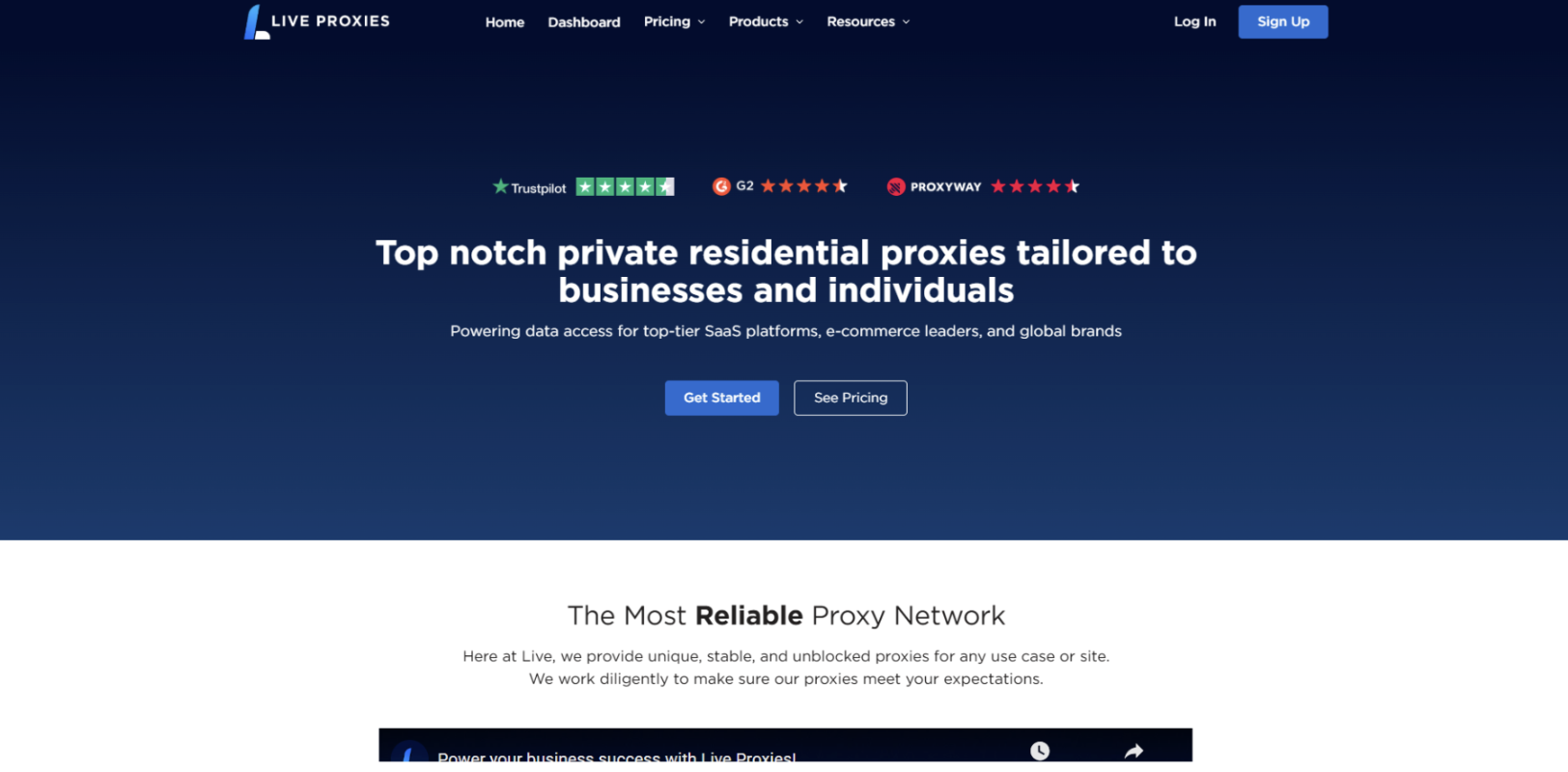
Live Proxies is a strong, unlimited rotating proxy option for teams that need controlled, stable, and recurring competitor intelligence across ecommerce sites, marketplaces, search engines, and public data sources. Unlike general proxy setups built only around traffic volume, Live Proxies combines a pool of millions of IPs, rotating residential proxies, rotating mobile proxies, private IP allocation, sticky sessions up to 24 hours, and country, city, and ASN targeting to support more consistent price tracking, SEO monitoring, marketplace research, localized validation, and high-volume automation.
Key Strengths
• Private IP Allocation: Helps reduce overlap on the same targets and keeps recurring monitoring more stable.
• Sticky Sessions up to 24 Hours: Supports longer research tasks where session continuity matters.
• Rotating Residential and Mobile Proxies: Gives teams flexibility for e-commerce, search, marketplace, and mobile-sensitive workflows.
• Advanced Geo-Targeting: Country, city, and ASN targeting help collect more accurate localized competitor data.
• Ethically Sourced Infrastructure: Supports responsible data collection through consent-based residential IP sourcing and compliance-focused practices.
• High-Volume Workflow Support: Fits recurring competitor intelligence, ecommerce monitoring, SEO tracking, AI data collection, and automation workflows.
Best Research Use Cases
• Competitor Price Monitoring: Track competitor prices, discounts, and promotions across ecommerce websites and marketplaces.
• Marketplace Research: Monitor listings, sellers, reviews, inventory, and category changes across major marketplaces.
• SEO and SERP Tracking: Collect localized SERP data and analyze competitor visibility across different regions.
• Product Availability Tracking: Monitor stock changes, new product launches, and availability shifts that may signal demand changes.
• Market Intelligence: Gather competitor data across websites, regions, and industries to support pricing, positioning, and growth strategy.
• AI Data Collection: Support automated research systems that need stable access, session control, and recurring public data collection.
2. Oxylabs
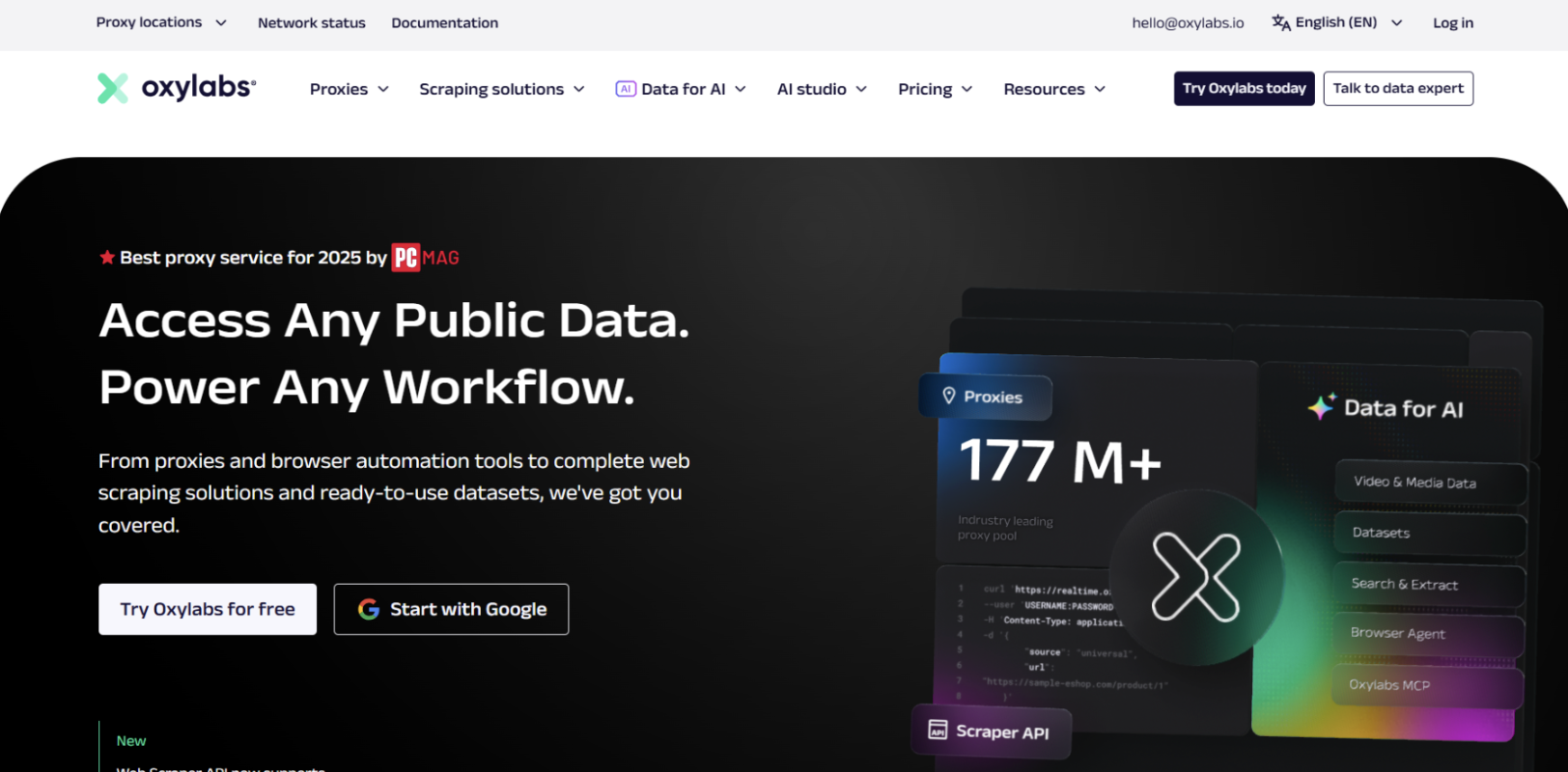
Oxylabs is a strong fit for enterprise teams that need large-scale public data collection and reliable infrastructure for recurring competitor research. The provider supports multiple proxy types and offers tools for scraping, browser automation, and structured data collection. This makes it useful for organizations monitoring competitors across many websites, search engines, marketplaces, and regions.
Key Strengths
• Multiple Proxy Types: Residential, mobile, ISP, and datacenter proxies support different research, scraping, and monitoring workflows.
• Advanced Geo-Targeting: Country, state, city, ZIP code, and ASN targeting help teams collect localized competitor data.
• Sticky and Rotating Sessions: Flexible session options support both stable workflows and large-scale request distribution.
• Enterprise Data Infrastructure: Built for high-volume public data collection, recurring monitoring, and complex research operations.
• Browser Automation Tools: Useful for dynamic websites, JavaScript-heavy pages, and rendered competitor content.
Best Research Use Cases
• Enterprise Competitor Intelligence: Monitor large competitor sets across websites, marketplaces, and regions.
• Pricing Research: Track regional prices, discounts, promotions, and product changes at scale.
• SERP Monitoring: Collect localized search results and analyze competitor visibility.
• Marketplace Research: Gather product, seller, review, and availability data from e-commerce platforms.
• Public Data Pipelines: Support structured data collection for analytics, research, and automation.
3. Decodo
Decodo is useful for teams that need flexible proxy infrastructure for scraping, automation, and recurring competitor monitoring. Its proxy products cover residential, mobile, ISP, datacenter, and static residential use cases, making it suitable for different levels of scale and trust. The platform also works well for workflows that depend on geo-targeting, session control, and API-based automation.
Key Strengths
• Broad Proxy Portfolio: Residential, mobile, ISP, datacenter, and static residential proxies support different research requirements.
• Precise Geo-Targeting: Country, state, city, ZIP code, and ASN targeting help collect market-specific competitor data.
• Session Flexibility: Sticky and rotating sessions support both longer tasks and large-scale monitoring workflows.
• API-Friendly Setup: Works well with scripts, crawlers, automation tools, and internal research systems.
• Automation Support: Fits recurring scraping, AI workflows, market monitoring, and competitor data collection.
Best Research Use Cases
• Automated Competitor Monitoring: Run scheduled checks across websites, search results, and regional markets.
• Localized Pricing Research: Compare prices, offers, and availability by country, city, or ZIP-level location.
• AI Data Collection: Feed public web data into AI-assisted research, analysis, and automation systems.
• Marketplace Tracking: Monitor product listings, seller activity, inventory changes, and customer reviews.
• SEO Research: Collect localized SERP data and track competitor ranking signals.
4. SOAX
SOAX is a good option for competitor research workflows where location accuracy matters. The provider offers residential and mobile proxies with targeting options that help teams view prices, ads, search results, and marketplace content from specific regions. Its session controls also make it useful for recurring monitoring tasks that require either rotation or stability.
Key Strengths
• Residential and Mobile Proxies: Supports trusted IP types for location-sensitive competitor research and monitoring.
• Regional Targeting: Country, region, city, ISP, and carrier targeting help collect localized market data.
• Session Control: Sticky and rotating sessions allow teams to match proxy behavior to the research task.
• Custom IP Refresh: Users can control IP rotation timing for different monitoring workflows.
• Scalable Access: Supports larger data collection workflows with flexible connection and session options.
Best Research Use Cases
• Localized Competitor Research: View prices, ads, SERPs, and marketplace content from specific regions.
• Price Monitoring: Track market-specific prices, discounts, and promotional activity.
• Marketplace Research: Monitor regional product listings, sellers, reviews, and availability.
• Ad Verification: Check how competitor campaigns appear across different locations.
• Regional Market Analysis: Compare competitor activity across countries, cities, ISPs, and carriers.
5. Rayobyte
Rayobyte fits teams that need scalable proxy infrastructure for public data collection and recurring competitor monitoring. Its residential, ISP, and datacenter products give businesses options for trust, speed, and stability depending on the target. The provider is especially useful for organizations building larger scraping, e-commerce tracking, or market intelligence workflows.
Key Strengths
• Residential, ISP, and Datacenter Proxies: Different proxy types support varied needs for speed, trust, and stability.
• High-Volume Infrastructure: Suitable for larger data collection workflows and recurring competitor monitoring.
• Reliable Routing: Focuses on stable request handling for scraping, e-commerce tracking, and public web data access.
• API Compatibility: Works with crawlers, automation tools, monitoring systems, and internal research workflows.
• Enterprise Scalability: Supports teams that need proxy infrastructure for larger or growing data programs.
Best Research Use Cases
• Large Competitor Datasets: Collect public data across many websites, categories, and target markets.
• Market Intelligence: Gather pricing, product, and availability signals from public web sources.
• E-commerce Monitoring: Track product pages, listings, inventory movement, and category changes.
• SERP Collection: Collect ranking and visibility data from different locations.
• High-Volume Scraping: Support traffic-heavy workflows that need stable proxy routing.
6. IPRoyal
IPRoyal is a practical option for teams that need residential proxy access, flexible sessions, and simple deployment. The provider supports residential, ISP, mobile, and datacenter proxies, making it useful for both lightweight and recurring competitor research workflows. It is especially relevant for teams that want localized monitoring without heavy enterprise complexity.
Key Strengths
• Multiple Proxy Types: Residential, ISP, mobile, and datacenter proxies support different monitoring workflows.
• Long Sticky Sessions: Extended sessions help maintain continuity for longer validation and research tasks.
• New IP per Request: Rotation options help distribute requests across larger monitoring workflows.
• Unlimited Simultaneous Sessions: Supports concurrent research tasks and broader data collection.
• Easy Authentication: Username/password and IP whitelisting simplify setup with common tools.
Best Research Use Cases
• Budget Competitor Research: Run recurring competitor monitoring without complex enterprise infrastructure or large upfront commitments.
• SEO Monitoring: Collect localized rankings, SERP changes, and competitor visibility data across different regions.
• Price Tracking: Monitor ecommerce prices, discounts, promotions, and regional offers over time.
• Account-Based Research: Use longer sticky sessions for workflows that need continuity across repeated checks or logged-in environments.
• Localized Validation: Compare competitor data by country, region, or city to verify what users see in different markets.
7. Webshare
Webshare works well for small teams, testing workflows, and lower-cost proxy setups. The provider offers residential, ISP/static residential, and datacenter proxies with self-serve access and API support, making it practical for teams that need quick setup without complex enterprise onboarding. It is a useful choice for businesses that want to validate competitor research workflows, test scraping logic, or run lightweight monitoring before investing in larger infrastructure.
Key Strengths
• Residential and Datacenter Options: Supports both trusted access and speed-focused monitoring workflows.
• Static Residential Proxies: Useful for repeated access and stable session-based research tasks.
• Unlimited Bandwidth Options: Certain plans support unlimited bandwidth for larger or recurring workflows.
• API Access: Helps connect proxies with scripts, crawlers, monitoring tools, and internal systems.
• Free Testing Option: Allows teams to test proxy behavior before scaling research operations.
Best Research Use Cases
• Small Competitor Projects: Start basic competitor monitoring with a lower-cost proxy setup before moving to larger infrastructure.
• Workflow Testing: Validate scraping, tracking, or automation systems before scaling them across more targets.
• Basic Price Monitoring: Track competitor prices, discounts, and product changes across smaller ecommerce lists.
• SEO Checks: Run lightweight SERP tracking and competitor visibility checks in selected regions.
• Development Environments: Test proxy integrations in internal tools, crawlers, scripts, and early prototypes.
8. ProxyEmpire
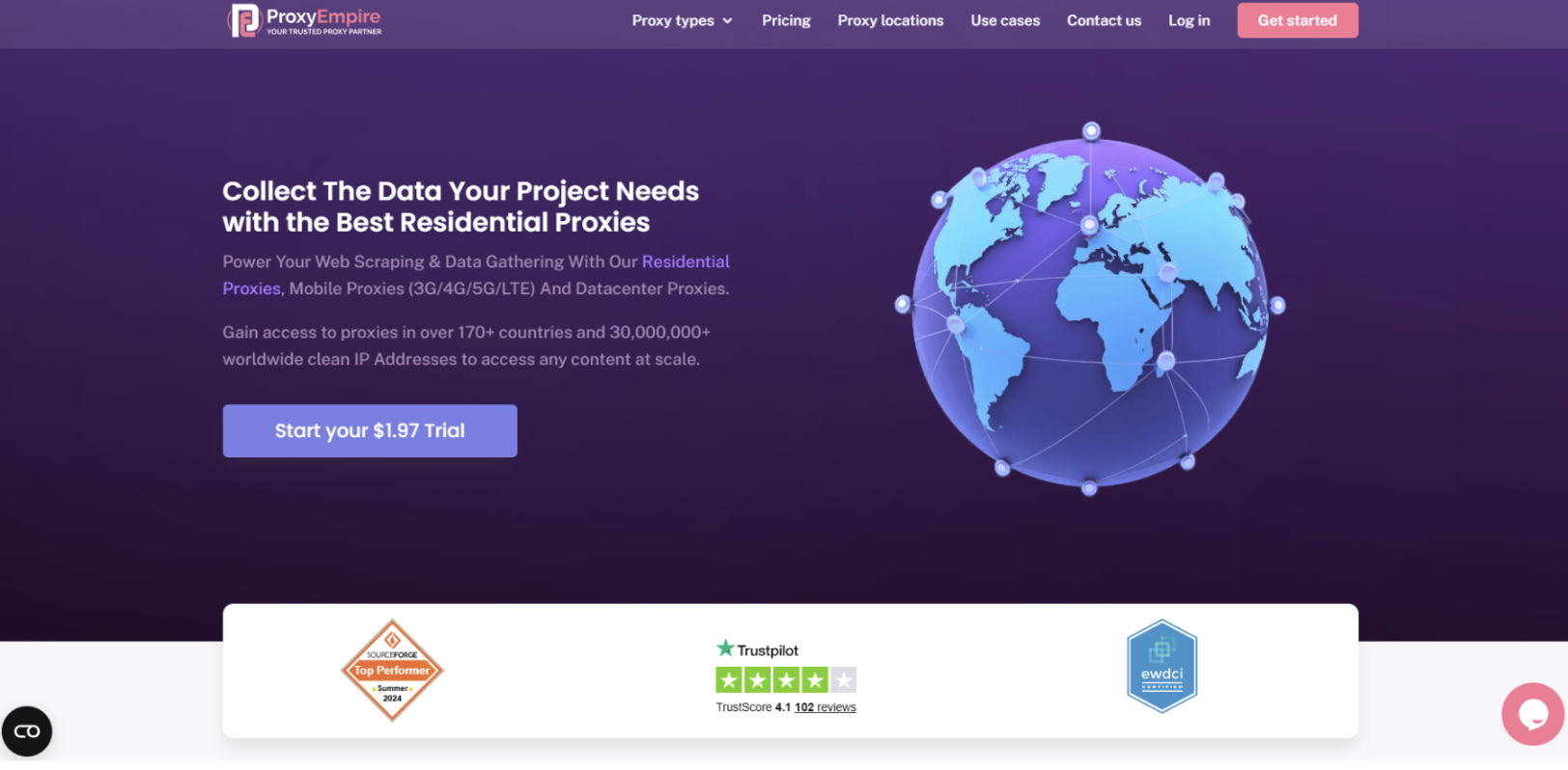
ProxyEmpire is suitable for teams that need international proxy coverage and flexible session control for competitor research. The provider offers residential and mobile proxies with country, city, ISP, and ASN targeting options, helping businesses collect localized data across multiple markets. Its combination of rotating and sticky sessions makes it a practical choice for recurring monitoring, while its geographic flexibility supports competitor research across regions, mobile environments, and location-sensitive websites.
Key Strengths
• Residential and Mobile Proxies: Supports different competitor research workflows across web and mobile environments.
• Country and City Targeting: Helps teams collect localized market data from specific regions.
• ISP and ASN Targeting: Adds more precision for advanced location-based monitoring.
• Sticky and Rotating Sessions: Supports both stable research tasks and broader IP rotation.
• International Coverage: Useful for teams monitoring competitors across multiple countries and markets.
Best Research Use Cases
• International Competitor Research: Monitor competitors across different countries, regions, and localized markets.
• Cross-Market Price Tracking: Compare prices, discounts, promotions, and product offers across multiple markets.
• Ad Verification: Check how competitor ads, landing pages, and campaigns appear in different regions.
• Mobile Research: Analyze mobile-specific content, app experiences, ads, and mobile search behavior.
• Marketplace Monitoring: Track sellers, products, inventory changes, and availability across international marketplaces.
How Do Unlimited Bandwidth Proxies Help Competitor Research?
Unlimited bandwidth proxies help businesses monitor competitors more consistently because they support repeated data collection across prices, search results, marketplaces, ads, content, and product availability. This is especially useful when teams need to collect large datasets regularly without constantly adjusting traffic limits.
Competitor Price Monitoring
Many retailers adjust prices frequently based on inventory levels, promotions, seasonality, and competitor activity. Unlimited bandwidth proxies help organizations collect pricing information repeatedly without worrying about traffic restrictions. This allows teams to build more complete pricing datasets and identify changes faster.
SERP Tracking
Search rankings often vary by location, language, and device type. Unlimited bandwidth proxies help SEO teams monitor competitor visibility across multiple regions, collect localized search results, and identify ranking changes more accurately. This information can support both competitive analysis and SEO strategy development.
Marketplace Monitoring
Marketplaces contain large amounts of competitive data, including product listings, seller activity, reviews, ratings, and pricing information. Unlimited bandwidth infrastructure helps support recurring collection workflows across larger product catalogs and multiple marketplaces without frequent traffic interruptions.
Competitor Content Research
Content teams frequently analyze competitor landing pages, category pages, product descriptions, and blog content. Unlimited bandwidth proxies support larger-scale content analysis projects and help businesses identify content gaps, new trends, and competitive positioning strategies.
Product Availability Tracking
Inventory levels can change rapidly across e-commerce websites and marketplaces. Continuous monitoring helps organizations identify stock shortages, product launches, and demand shifts that may influence competitor behavior. Unlimited bandwidth infrastructure makes this type of recurring monitoring easier to maintain.
Which Proxy Features Matter Most for Competitor Research?
For competitor research, the most important proxy features are unlimited bandwidth, sticky sessions, flexible IP rotation, geo-targeting, and high-quality residential or mobile IPs. Together, they help teams collect localized competitor data consistently, run long monitoring tasks, and reduce access issues across large-scale workflows.
• Unlimited Bandwidth: Supports recurring monitoring and large-scale data collection without traffic interruptions.
• Sticky Sessions: Keeps long-running tasks stable, including price tracking and SERP checks.
• Flexible IP Rotation: Spreads requests across IPs to reduce access issues.
• Geo-Targeting Controls: Helps collect accurate local data by country, city, region, or ASN.
• Residential and Mobile IPs: Improve reliability for location-sensitive websites, search results, ads, and marketplaces.
Are Unlimited Bandwidth Proxies Really Unlimited?
Unlimited bandwidth proxies are not always fully unlimited. Many plans still include fair-use rules, connection limits, or session restrictions. IP quality, routing stability, geo-targeting, uptime, and infrastructure reliability often matter just as much as bandwidth.
Fair-Use Policies
Some providers advertise unlimited bandwidth while still applying fair-use rules that may restrict excessive, abusive, or unusually high-volume usage. Businesses should review provider policies carefully to understand whether traffic thresholds, network protection measures, or other restrictions may affect large monitoring projects.
Connection Limits
Unlimited bandwidth does not always mean unlimited concurrency. Many plans still limit the number of simultaneous sessions, threads, requests, or active connections, which can directly affect how efficiently large-scale competitor monitoring workflows operate.
Session Restrictions
Session management varies significantly between providers. Some prioritize longer sticky sessions to support account-based tasks and continuous monitoring, while others focus on more aggressive IP rotation designed for broader data collection across multiple targets.
Performance Factors
Bandwidth is only one part of overall proxy performance. IP quality, routing stability, geo-targeting accuracy, session controls, uptime, and infrastructure reliability often have a greater impact on competitor research success than bandwidth alone.
Conclusion
The best unlimited bandwidth proxies for competitor research are not defined by bandwidth alone. Strong proxy infrastructure also depends on IP quality, targeting accuracy, session control, routing stability, and the ability to support recurring workflows across prices, SERPs, marketplaces, ads, and product availability.
For competitor price monitoring, marketplace intelligence, SEO tracking, ad verification, and availability monitoring, businesses should choose a provider that matches the workflow, not just the broadest unlimited bandwidth claim. The strongest setup combines scalable traffic capacity with reliable IPs, flexible rotation, sticky sessions, and precise geo-targeting, helping teams build more accurate, stable, and sustainable competitor intelligence programs.
Related Posts
- Top 5 Enterprise Laptop Return Shipping Solutions for Remote Workforce Asset Recovery
- International Link Building for E-commerce Brands: A Practical Guide
- Server Refresh vs Third-Party Maintenance: Which Option Makes More Sense?
- The Best Funnel Builder for Coaches and Course Creators
- How Magento Powers Modern eCommerce Businesses
- How to Price an Online Course Without Leaving Money on the Table?