



Learn why configuration management matters for Magento and cloud-hosted stores, from preventing environment drift to securing deployments.
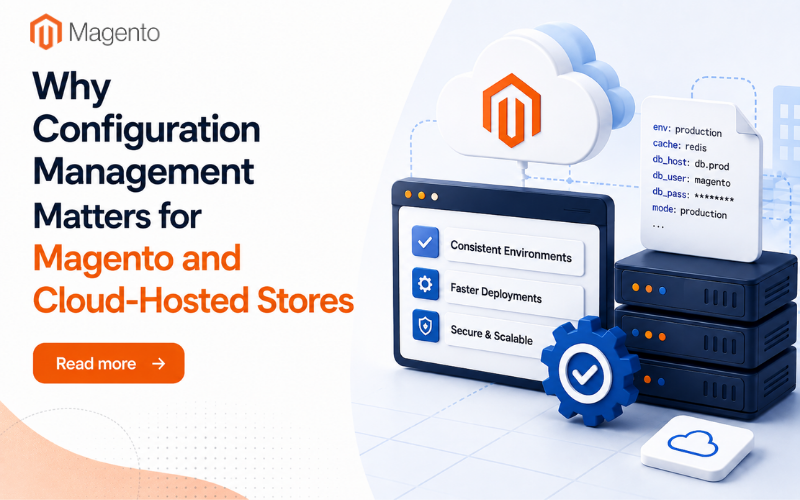
There are over 28 million ecommerce stores, but deployments in this market break when local development, staging, and production environments drift out of sync. Hundreds of store deployments fail because of minor environment mismatches, such as a missing PHP extension or an unmapped database key. Eliminating this friction requires a systemic approach to synchronizing infrastructure and application state.
When running resource-heavy platforms like Magento on cloud infrastructure, manual setup is no longer viable. Developers need guaranteed predictability across every node and stage of the deployment pipeline.
The Cost of Architectural Drift in Cloud Stores
Architectural drift happens when small modifications creep into individual servers over time. A developer tweaks a staging cache setting, a server patch installs on only two out of three cluster nodes, or a payment gateway API key remains hardcoded in a local testing instance.
These micro-changes accumulate silently until a production release triggers catastrophic application errors. Tracking down these inconsistencies without structured automation wastes hours of engineering bandwidth.
Using modern configuration management tools allows engineering teams to define server states as code, enforcing strict consistency across every instance automatically. This declarative approach ensures that every environment, from a local Docker container to a multi-region production deployment, matches the exact specified blueprint.
Operational Benefits for Enterprise Ecommerce
Decoupling store configuration from codebase releases stabilizes the deployment pipeline. It allows infrastructure adjustments without a full code redeployment or the risk of unexpected downtime.
Engineering teams relying on automated state enforcement experience three clear operational advantages:
• Environment provisioning takes minutes instead of days through automated playbooks
• Security updates apply uniformly across all server clusters without manual SSH sessions
• Rollbacks execute instantly by reverting configuration code to a previous commit state
This systematic isolation of configuration variables also protects sensitive merchant credentials. Secrets, API keys, and environment-specific database parameters remain safely stored outside the store's code repository.
Externalizing Runtime Parameters in Magento
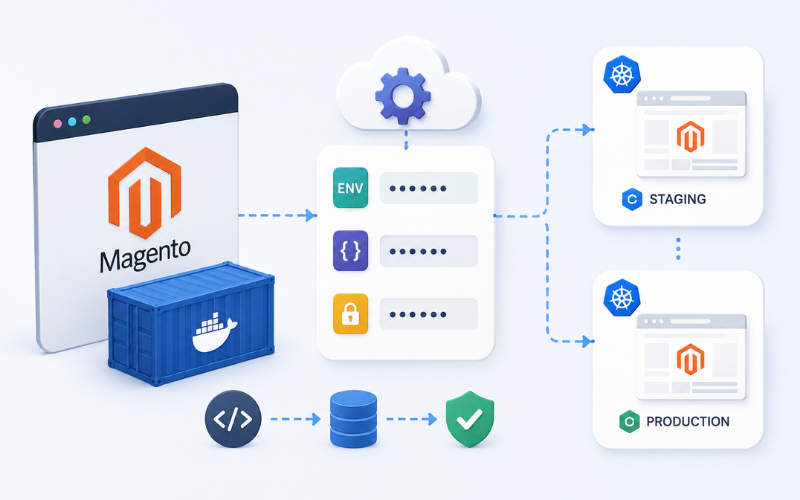
Magento relies heavily on complex database configurations and XML files to govern module behaviors. When running on cloud infrastructure, storing these settings inside the database creates synchronization hazards during database dumps and syncs between environments.
The modern standard involves storing application logic in code while pushing environmental variables directly to externalized runtime configuration patterns. Cloud infrastructure provisions settings dynamically through environment variables or secure key-value stores.
Platforms using container orchestration rely on Kubernetes-native patterns to separate configuration from underlying container images. This ensures the same application container image moves from staging to production, changing only its injected environment variables along the way.
Managing Continuous Integration for Multi-Tenant Deployments
Scaling modern cloud stores often involves managing multiple localized storefronts from a single shared core architecture. Without automated state tracking, deploying microservices or regional catalog updates across multi-tenant environments introduces severe cross-tenant contamination risks.
Standardizing pipeline steps ensures that localized pricing configs, tax engine rules, and regional staging flags are isolated into independent state layers. Pipeline triggers execute parallel testing suites across isolated tenant containers before touching live production nodes. This architecture protects regional operational uptime while giving engineering teams the freedom to deploy continuous updates safely.
Implementing Automated Control Standards
Transitioning to automated state control requires treating your infrastructure definitions with the same rigor as your primary codebase. Every script, playbook, and environment definition must live within version control.
Begin by auditing current environment variations to establish a baseline state. Replace manual server modifications with automated provisioning tools, and restrict direct SSH access to live production nodes to prevent ad-hoc configuration drift.
Standardizing infrastructure automation establishes a resilient base that can scale reliably during high-traffic sales events. Check out more of our posts for further insights into setting up and running a website, especially in the ecommerce space.
Related Posts
- Evaluating the Benefits of Shopify Plus for Enterprise Growth
- How AI APIs Are Changing Modern eCommerce Website Development
- Why Configuration Management Matters for Magento and Cloud-Hosted Stores
- Best AI Website Builder in 2026: Tested, Ranked, and Compared
- Why Customer Service Calls Are Getting Answered by AI Agents
- How to Choose the Best Data Quality Tools for E-commerce and Software Teams