



AI agents are transforming customer service calls by resolving routine issues faster, reducing costs, and seamlessly escalating complex cases to human agents.
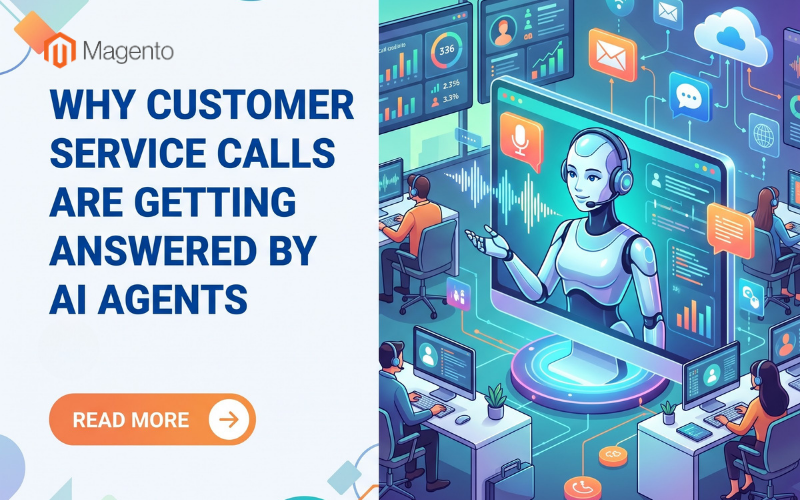
Customer service calls are getting answered by AI agents because the technology finally crossed the line from scripted phone tree to something that can actually understand a spoken problem, look up the relevant account data, and resolve it without a human. Voice AI got good enough, at roughly the same moment labour costs, hiring difficulty and customer impatience all got worse. When a capability matures and the pressure to use it peaks together, adoption moves fast.
The shift is not the old IVR menu wearing a new coat. Those systems recognised a handful of keywords and routed you. Today's agents hold an open conversation, pull from live systems mid-call, take an action like issuing a refund or rebooking a flight, and hand off cleanly when they hit their limit. That last part, knowing when to stop, is what separates the deployments that work from the ones customers rage about.
What Changed to Make AI Answering Calls Actually Work
Three things matured at once. Speech recognition got accurate enough to handle accents, background noise and interruptions in real time, with latency low enough that the pause before the agent responds no longer feels robotic. Large language models gave those systems the ability to interpret a messy, half-explained problem instead of demanding the exact phrase. And integration tooling improved to the point where the agent can read your order history, your subscription status and your last three tickets while you are still talking.
The older systems failed because they were brittle. Say something slightly off-script and you hit a dead end, which is why people mashed zero to reach a human. Modern agents degrade gracefully. They ask a clarifying question, restate what they heard, and only escalate when the problem genuinely needs a person.
Cost sits underneath all of it. A live phone interaction handled by a human agent typically runs several dollars once you count wages, benefits, training and overhead, while an AI-handled call lands at a small fraction of that. When call volumes hit tens of thousands a day, that gap becomes the entire business case. Industry data consistently points to routine, repetitive contacts as the bulk of any queue, and those are exactly what the agents absorb first.
Which Calls Get Handled by AI and Which Still Reach a Human
The dividing line is predictability, not simplicity. Order status, password resets, appointment scheduling, billing questions, return initiation and basic troubleshooting follow known paths with known data, and AI handles those cleanly, often resolving a majority of them end to end without a handoff. The customer frequently does not care whether a human or a machine tells them their package ships Thursday, as long as the answer is right and fast.
What still reaches a human tends to fall into three buckets. Emotionally charged situations, where someone is distressed and needs to feel heard rather than processed. Genuinely novel problems the system has never seen and cannot map to an existing procedure. And high-stakes or high-value cases, like a fraud dispute or a cancellation the business would rather save, where judgement and negotiation matter more than speed.
Good deployments make the handoff invisible. The AI passes the full context to the human agent, so the customer does not repeat their account number and their whole story for the third time. That single behaviour, no repetition after transfer, does more for satisfaction than almost anything else the system does.
How Different Industries Are Actually Using It
Retail and ecommerce lean on AI for the presale and post-purchase flood: where is my order, can I return this, is it in stock in my size. Volume there is enormous and seasonal, so the ability to scale to a holiday spike without hiring temporary staff is the draw.
Airlines and travel use it for rebooking during disruption, which is when their queues explode and human agents get overwhelmed. Banking and insurance use it for balance checks, claim status and card servicing, though they keep tighter guardrails because a wrong answer about money carries real consequences. Healthcare uses it for appointment scheduling and prescription refill requests, deliberately staying clear of anything resembling clinical advice.
The pattern across all of them is the same. The agent absorbs the high-volume, low-variance contacts so the human team can concentrate on the calls that actually need a person. Enterprises running this at scale usually treat it as one layer inside a broader automation stack, and the more comprehensive enterprise guide to agentic customer service is a useful reference for how those layers fit together across knowledge, routing and action. What varies is the risk tolerance, which is why a bank and a clothing brand end up with very different escalation thresholds.

What It Takes to Deploy and What It Costs
The technology is not the hard part anymore. The hard part is the knowledge and data feeding it. An agent is only as good as the systems it can read and the policies it can reference, so the real work is connecting order management, CRM, billing and the actual up-to-date rules for returns, refunds and exceptions. Feed it stale or contradictory information and it will state that wrong information confidently, which is worse than saying nothing.
Timelines depend on scope. A narrow deployment handling one or two call types on a clean platform can go live in a matter of weeks. A broad rollout across multiple regions, languages and back-end systems is a multi-month project, and the delay is almost always integration and knowledge cleanup rather than the AI itself. Budgets usually run on a per-resolution or per-minute basis rather than per-seat, which changes the maths compared to staffing a call centre.
The mistake that burns money is skipping the measurement setup. You need to track containment rate, but also whether the calls the AI closed actually stayed closed, because a resolution that generates a callback an hour later is not a resolution. Watching repeat-contact rate alongside deflection is what tells you the truth.
What Customers Actually Experience
The best outcome is boring in the best way. No hold music, an answer at 2am, and a problem solved in ninety seconds that used to take a fifteen-minute wait plus a transfer. When it works, most people stop caring that it was not a person, and some prefer it, because they get in and out without small talk or being sold anything.
The failure mode customers hate most is the loop, the sense of being trapped with something that will not let them reach a human. That single frustration drives more of the backlash against AI support than any other factor. The deployments people rate well always have a clear, quick path to a person, and they offer it early rather than after three failed attempts.
If you are weighing this, the question is not whether AI should answer calls. Enough of your queue is routine that some of it already should. The real decision is where you draw the line between what the machine closes and what a person handles, and that line is not fixed. As the systems get better at reading tone and handling ambiguity, it will keep moving, and the brands that revisit it every quarter rather than setting it once are the ones who will keep both their costs and their customers where they want them.
Related Posts
- Evaluating the Benefits of Shopify Plus for Enterprise Growth
- How AI APIs Are Changing Modern eCommerce Website Development
- Why Configuration Management Matters for Magento and Cloud-Hosted Stores
- Best AI Website Builder in 2026: Tested, Ranked, and Compared
- Why Customer Service Calls Are Getting Answered by AI Agents
- How to Choose the Best Data Quality Tools for E-commerce and Software Teams