



How AI APIs are reshaping eCommerce website development, from product search and personalization to pricing, latency and integration tradeoffs.
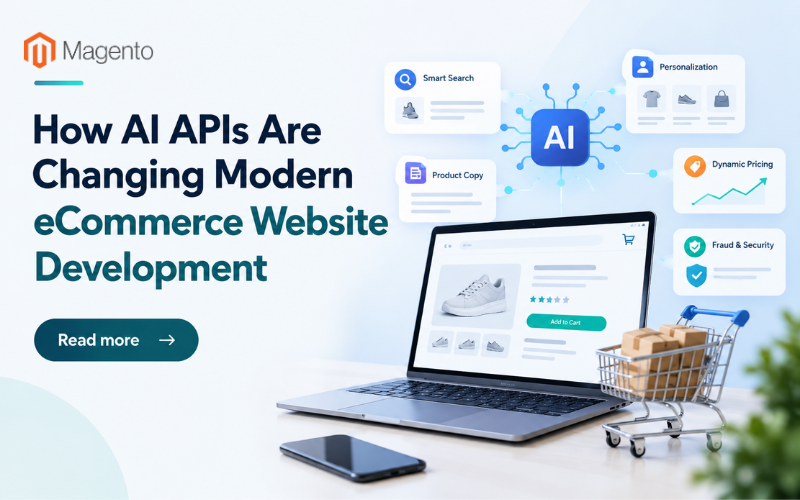
Commerce storefronts once needed dedicated model training and data science work to add capabilities such as generated copy, image classification, and conversational search. Now, the same functions can fit into an existing commerce stack through a request and response, changing how sites are scoped and shipped.
The calls themselves are becoming easier. However, decisions around cost, speed, reliability, and vendor choice are not. A modern build therefore has to consider where an AI API belongs, how API integration affects production, and what trade-offs follow when hosted models become part of storefront infrastructure. This shift changes development planning before implementation begins.
What an AI API Actually Does in a Commerce Stack

An AI API uses an authenticated request-and-response cycle. The storefront sends a prompt with relevant product or customer data, and the hosted provider returns generated text, a structured JSON object, or an image classification. Billing usually follows per-token or per-call usage.
ChatGPT is a consumer application, while the OpenAI API gives developers programmable access to the underlying models. Commerce teams use natural language processing (NLP) for search and summaries, generative AI for copy, computer vision for image analysis, and speech-to-text for voice and call handling. Multimodal input can combine text, images, audio, or video in one request.
More importantly, structured outputs constrained by a JSON schema let applications validate responses before writing them into a catalog instead of exposing raw model output to shoppers.
Where AI APIs Earn Their Place on a Storefront
Model calls now appear in on-site search, recommendation modules, product copy workflows, review summaries, visual search, support chat, and content or fraud moderation queues. These surfaces carry different consequences when an answer is wrong. An inaccurate product tag can be reviewed later, while incorrect delivery information from a chatbot reaches the shopper immediately.
Search, Discovery, and Recommendation Feeds
Traditional keyword search struggles when shoppers describe a need rather than name a product. Natural language processing and embeddings can connect “something warm for a rainy commute” with waterproof coats, insulated jackets, and weather-resistant shoes, even when those words do not appear together in the query.
A recall-first approach changes the results layer itself. Instead of retrieving a narrow, keyword-matched set and asking a model to reorder it, the system first retrieves a broader pool based on meaning. Filters for stock, price, category, and delivery eligibility can then remove unsuitable results.
Recommendation feeds follow a similar pattern. They can move beyond fixed co-purchase rules by interpreting session behaviour alongside product descriptions. However, that only works when the AI API receives useful catalog context. A model that sees clicks but lacks product attributes can detect interest, yet it cannot reliably distinguish between a shopper exploring hiking boots and one seeking waterproof work footwear.
Catalog Enrichment and Review Summaries
Catalog enrichment is usually the lowest-risk starting point for generative AI. A batch job can generate missing attributes, normalize inconsistent supplier descriptions, draft alt text, and classify products using computer vision or image analysis. This work should happen before publication, not while a shopper waits for a page to render.
Batch processing also makes human review practical. Teams can inspect flagged categories, reject malformed structured outputs, and rerun only failed records rather than trusting thousands of generated updates at once.
Review summaries, chatbots, and conversational agents sit closer to the customer. Summaries need safeguards against overstating a minority opinion, while support responses need current product, policy, and order context. When integrating GenAI agents, developers must connect the model to approved data sources rather than let it invent order status, return eligibility, or stock information.
Direct Provider Accounts or a Routing Layer

The selected model matters, but the route used to reach it has longer-term architectural consequences. That route determines how quickly a store can switch when quality drops, pricing changes, a service becomes unavailable, or a provider retires the version used in production.
One Provider, Several, or a Single Endpoint
Direct accounts with the OpenAI API, Anthropic Claude API, Google Gemini API, Mistral, or Cohere provide native SDKs, provider-specific features, and early access to new releases. The trade-off is separate authentication, integration code, monitoring, and billing for each vendor.
A commerce team can reach a frontier model through a direct OpenAI or Anthropic account, Amazon Bedrock behind a single SLA, Azure OpenAI inside an existing Microsoft agreement, or a single-endpoint route such as reaching GPT-6 Astra through ZenMux GPT-6, with the last route allowing model swaps without rewriting the storefront integration.
Amazon Bedrock works naturally with broader AWS AI Services, while Azure OpenAI within Microsoft Foundry fits teams whose identity, procurement, and monitoring already run on Azure. These managed routes simplify vendor administration but can receive new model releases later than direct accounts. Meanwhile, the Hugging Face Inference API provides hosted access to a wider range of models, including those selected for narrower classification or language tasks.
Data Terms, Retention, and Training Opt-Out
Commerce requests can contain names, addresses, support transcripts, and order details. Procurement therefore needs to examine retention windows, default training policies, regional processing, and whether free access tiers carry different data terms from paid accounts.
SOC 2 and ISO 27001 attestations help security teams assess controls, but they do not automatically establish GDPR or HIPAA compliance for a particular implementation. Data minimization, access controls, and request logging still depend on the store’s design. Published generative AI risk management guidance supports treating trustworthiness and risk assessment as part of selection alongside price, speed, and developer experience.
What AI APIs Cost You in Production
Model deprecation and retirement happen on the provider’s schedule, not the store’s release calendar. Every production integration therefore needs a named fallback model, timeout rules, and controlled retry behaviour. Without them, a routine retirement notice can turn generated descriptions, search features, or moderation workflows into broken dependencies.
Keeping AI Calls Off the Checkout Path
Even a fast model call adds latency and performance uncertainty. Network travel, queueing, generation time, and retries can add hundreds of milliseconds at best, with longer delays under load. Checkout, cart updates, pricing, and inventory validation should not depend on a generated response.
Instead, search suggestions, descriptions, and review summaries should be pre-computed, generated asynchronously, or cached. Live requests can then serve stored results while background workers refresh them.
Rate limits often cause more immediate failures than usage-based pricing during a sales peak. Batch endpoints and queued jobs keep catalog enrichment from competing with shopper-facing requests. Priority queues can reserve capacity for support or search while delaying non-urgent alt-text generation until traffic falls.
Per-Token Costs Across Thousands of SKUs
Per-token pricing looks inexpensive when viewed as one prompt. Across 50,000 SKUs, repeated catalog passes, retries, and multiple generated fields change the calculation. Teams should estimate the cost of one complete catalog run, including input tokens, output tokens, validation failures, and regeneration, rather than comparing providers by the price of a single call.
The context window also limits how much catalog data can accompany each request. Sending an entire taxonomy wastes tokens when a product only needs its category branch and attribute rules. Prompt caching reduces repeat spending when many requests reuse the same policy, schema, or catalog context, while smaller prompts make usage-based, pay-as-you-go costs easier to forecast.
Where This Leaves Your Next Build
The hard part of commerce AI is no longer gaining access to a capable model. It is designing the architecture around the AI API so responses arrive at the right surface, in the right format, without exposing conversion paths to unnecessary delay or failure.
A sensible API integration starts where a wrong answer is cheapest, keeps generation away from the critical request path, and uses an access route the store can leave without rebuilding its core services. That flexibility matters more than chasing whichever model currently leads a benchmark.
Related Posts
- Evaluating the Benefits of Shopify Plus for Enterprise Growth
- How AI APIs Are Changing Modern eCommerce Website Development
- Why Configuration Management Matters for Magento and Cloud-Hosted Stores
- Best AI Website Builder in 2026: Tested, Ranked, and Compared
- Why Customer Service Calls Are Getting Answered by AI Agents
- How to Choose the Best Data Quality Tools for E-commerce and Software Teams