


Launching a Magento mobile app is not as difficult as it once was. Learn how to turn your Magento store into an app easily, fully synced with your site.
Magento brands have a particular relationship with the question of mobile apps. Most have been told for the last decade that an app is a six-figure custom development engagement, six to twelve months long, on a parallel codebase that they will then need to maintain forever. That framing was accurate when it was set, and it's the reason most Magento sites still don't have an app.
It's also outdated.
The custom-build path still exists, and it's still expensive. But the realistic options for a Magento brand that wants a real mobile app are wider now than they were five years ago.
This is a walkthrough of why a Magento brand should have an app, what "turning your site into an app" means when the underlying platform is Magento, and the practical ways to get there at a fraction of the cost of from-scratch development.
Why Magento Brands Should Have a Mobile App
The merchants running Magento and Adobe Commerce are not, on the whole, small stores. Many of them are mid-market and enterprise brands, B2B distributors, multi-region retailers, manufacturers selling direct, and DTC operators whose catalogs and checkouts are too complex for off-the-shelf SaaS.
HanesBrands, Catbird, and Coca-Cola's En Tu Hogar D2C all run on Adobe Commerce. So do most of the brands you see referenced in serious B2B and enterprise ecommerce case studies.
That profile makes the business case for a mobile app stronger than for simple catalog stores.
A few reasons.
First, the customers of a Magento brand tend to be more valuable on average. Higher AOVs, more repeat purchases, longer customer lifecycles. The retention upside from an app, which is largely a function of how often a customer comes back and how much they spend each time, compounds harder when each repeat purchase is worth more.
Second, B2B and complex commerce workflows live on Magento for a reason: the platform handles them. Those same workflows benefit disproportionately from a native app surface.
Third, the cost of customer acquisition for the kind of brand that runs on Magento has climbed at least as fast as it has for everyone else. The Magento merchant tends to have a high-effort acquisition motion (long sales cycles for B2B, premium-brand marketing for DTC).
Anything that increases the value of the loyal customers you've already won is sharply more valuable when winning the next one is expensive. An owned mobile channel is one of the higher-leverage moves available there.
The case for an app on Magento isn't fundamentally different from the case for an app on Shopify. The case just lands harder because of who's running Magento in the first place.
What Turning Your Magento Site Into an App Means
A mobile app for your Magento store doesn't have to be a separate product. It can be a lot of the same experience that lives on your site, connected to the same backend, but delivered as a native app your customers can download on their phones.
Whatever you've built in Magento (the multi-region storefronts, the customer-group pricing, the complex catalog logic, the checkout customizations, the integrations with your ERP and OMS and PIM) is the foundation. The app sits on top of that and inherits it.
You don't rebuild the storefront. You give your customers a different way to access it.
That's the simplest version. From there, you can add native-specific features: push notifications, app-only experiences, app-specific home screens for repeat buyers, deep linking from email and SMS into the app. Most Magento brands eventually run a meaningful share of their reorder and B2B re-order traffic through these features. None of them have to be in version 1.
For Magento brands specifically, the value of this framing is that it preserves the work you've already done. The platform choices Magento merchants make (Hyvä for performance, custom checkouts for B2B logic, headless front-ends for multi-channel) were made for reasons that still apply on mobile. The right mobile app strategy doesn't ignore them or duplicate them. It extends them.
How to Launch a Native Mobile App for Magneto Brands
The Magento mobile app market isn’t as broad as it is for other ecommerce platforms, like Shopify. There are a few no-code app builders built for Magento, but the off-the-shelf ecosystem is smaller and more fragmented, mostly because Magento's customization depth makes a generic templated app product hard to build.
For most Magento brands, the options to build a mobile app for your store realistically come down to two.
Custom Native Development (The Default, Historically)
This is the path most Magento brands have been quoted. A development agency or in-house team builds a native iOS and Android app from scratch, using Swift, Kotlin, React Native, or Flutter, with custom connectors to your Magento backend.
The output is a fully bespoke app tailored to your business. The cost is what makes the default broken. A from-scratch native build for an ecommerce brand typically costs $150,000 to $500,000 for the initial version, with another six-figure annual spend to keep the app functional as Apple and Google push out platform updates, as your website evolves, and as integrations change underneath the app.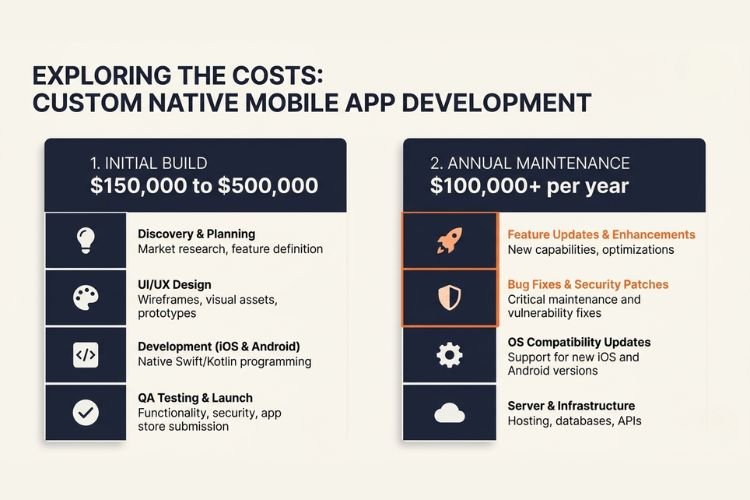
The deeper structural cost is the codebase. A custom app means a second front-end to maintain in parallel with your Magento storefront forever. Every change to your website needs to be ported to the app. Every Magento upgrade has to be tested against the app. The native engineering team you didn't need before is now a permanent line item.
For brands with the budget and operational depth to absorb this, custom dev is a real option. It produces the highest-fidelity app of any path. But the dollar and time cost is what it is, and for most Magento brands the math no longer makes sense when alternatives exist.
A Managed App Service Like MobiLoud (The Modern Default)
A custom mobile app service like MobiLoud is a more modern alternative to building a custom app from scratch.
Both are built to give you a custom mobile app. But this option doesn’t build the app separately to your website. Instead, it builds on top of your existing website, using the same features, integrations, extensions and backend as your existing Magento site.
It also means you can launch an app no matter how custom your site, or whatever form of Magento you’re on - Magento 2, Magento Open Source, Adobe Commerce, or even with a headless build.
This is the new way to build ecommerce mobile apps. Not as a separate build, but one that leverages all the hard work and investment put into your website.
The result: an app that costs less, launches faster, and is much easier to manage, because you’re not constantly juggling duplicate work, managing your website and app side-by-side.
API-Driven Magento App Builders
There are a handful of third-party tools aimed at Magento merchants that work by exposing the Magento REST or GraphQL APIs to a templated mobile app.
For a Magento merchant whose store is genuinely standard (clean checkout, conventional catalog, no B2B logic, no multi-region, no significant customization), they can produce a workable app.
The reality, for most Magento brands, is that the "standard Magento store" doesn't really exist at the scale where an app investment makes sense. Magento merchants chose Magento because they needed the customization. The templated mobile output then becomes an awkward fit. Most brands that try this path end up either heavily compromising the app's fidelity or layering enough custom work on top of the template to wipe out the cost advantage.
It's worth knowing the option exists. It's rarely the right answer for the kind of brand that ended up on Magento in the first place.
How Long It Takes to Launch a Magento Mobile App
The typical launch time is another reason why custom “from scratch” development is no longer the best way to build a Magento mobile app.
A managed mobile app service can get you live, from square one through your app getting published in the App Stores, in 1-2 months.
Compare that with a custom app, which typically takes 6 months to build and launch, at a minimum - and can stretch as long as a year or more.
All in all it depends on the complexity of your site, and by extension, the complexity of your app.
A simple app could go live in just a few weeks. For a more complex app, with more unique features, you could go live in around 6-8 weeks. 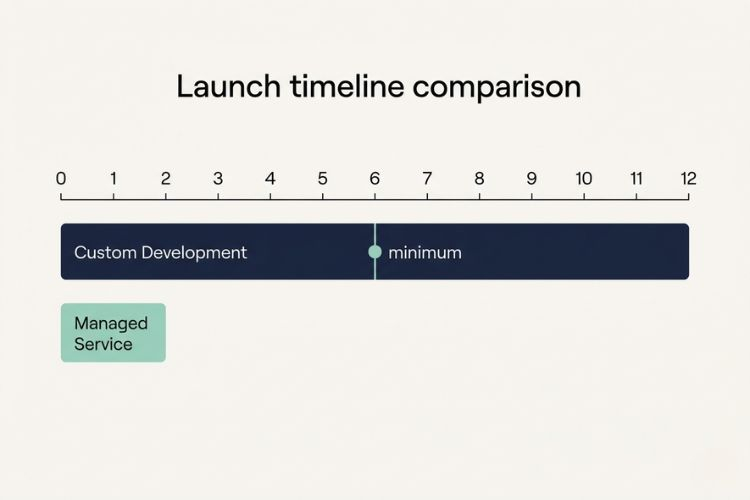
That’s a timeline that’s much more attractive; giving you a tangible result for your investment in the near future; not sometime next year.
How to Get Your Magento Customers to Install the App
Once you’ve launched your Magento mobile app, the final question is: how are you going to get downloads.
The install playbook for a Magento brand looks broadly like the playbook for any ecommerce brand, with a couple of adjustments specific to the kind of customer base Magento sites tend to carry.
• Email and SMS announcement to your existing list, framed around what changes for them (faster reorder, push for order status, app-only experiences, easier B2B workflows if applicable)
• Site banner or smart popup on mobile web prompting visitors to install. For Magento sites, this typically converts well because the mobile traffic is weighted toward returning customers.
• Checkout and account-page nudges for engaged customers
• Post-purchase flow with an app install prompt in order confirmations
• For B2B brands specifically, your sales team and customer success team are your biggest install levers. Building app installation into customer onboarding (or rep training) pays off faster than any marketing channel.
After launch, sustained engagement compounds through push notifications, app-exclusive offers, reorder flows tuned for the app, and loyalty integration if you run one.
The key part to understand is that you don’t need every customer on your app. The app is a surface for your best customers, the top 5-10% who are most likely to come back and buy again. That’s who you’re targeting with the app - and just 5% of your customers using it is more than enough for your app to be a success.
Where to Start
The Magento mobile app conversation has been stuck on the same answer for too long. "Custom development is your only option" was true once. It hasn't been true for a few years, and the gap between what's possible and what most Magento brands are doing keeps widening.
The realistic question for a Magento merchant today isn't whether an app is feasible. It's whether you want one this quarter or next year, and which approach you're going to take.
For most brands, the answer is a managed service like MobiLoud, which lets you launch an app that’s built on top of the store you already run, and all the extensions and customizations that make your website powerful.
The customers buying from you are spending more of their time inside apps every year. The brands they buy from regularly will increasingly be the ones who meet them there. The reasons not to launch have mostly evaporated. The reasons to launch keep getting stronger.
Related Posts
- What an AI Performance Agent Does With Your Shopify Ad Account
- 5 Latest E-Commerce Trends to Watch Out For in 2026
- How Retail Automation Is Transforming Magento Stores Through Smarter Inventory and Order Management
- Wearable Technology and the Future of E-Commerce
- Migrating to Shopify? Here's How to Protect Your Search Rankings
- How to Hire and Manage a Remote Development Team for Your Magento Store