



Learn how composable commerce helps Magento merchants improve speed, flexibility, and customer experience without replacing Magento entirely.
Magento merchants are familiar with the task of creating effective online stores. A Magento store can include a range of things like products, categories, checkout, customer accounts, promotions, and numerous other capabilities all at once. For years, it was perfectly logical.
However, e-commerce has evolved significantly. Now people are shopping not only via website or app but also via marketplace, social media, emails, loyalty program, and even in-store screens. They are looking for quick-loading sites, easy checkout, convenient search, and individual offers. One solution simply cannot meet all of these needs.
And this is where composable commerce is getting so much attention. This approach allows merchants to use various systems together instead of relying on one universal solution. This can be very beneficial for Magento merchants as well, but only if it is applied consciously.
The Meaning of Composable Commerce
Composable commerce involves developing an e-commerce solution using several pieces of technology. A merchant does not necessarily have to rely on one single platform to perform all the necessary tasks.
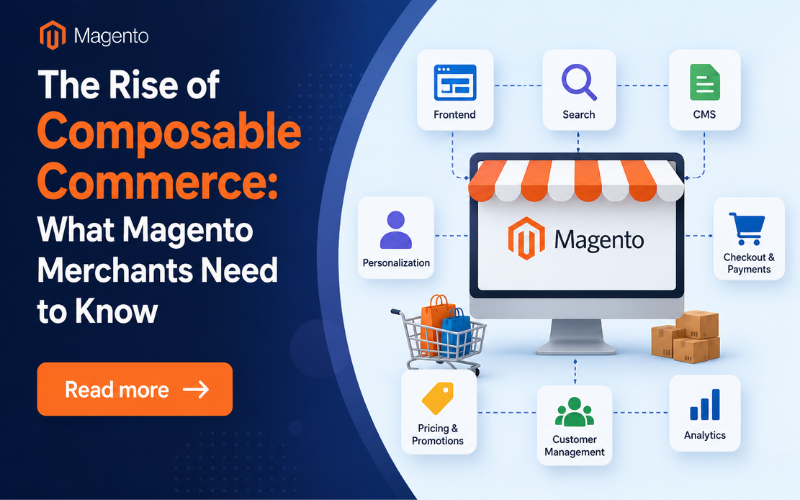
While Magento can handle product information, orders, prices, and checkout procedures, a merchant can use an alternative frontend, search engine, CMS, loyalty solution, payments provider, and personalization engine. All these components can be integrated through APIs.
Students majoring in e-commerce, web development, or digital business usually require some time to grasp this architecture, since it is not only a technological trend. It impacts customer experience, store performance, costs, and team collaboration. In case of tight deadlines, students can always use an argumentative essay writing service EssayHub and dedicate their time to researching Magento platforms, comparing commerce solutions, and finding out reasons for such a change.
An appropriate official source to refer to is the Adobe guide describing the ways Adobe builds composable commerce and what it means to use an API-first, modular, and service-oriented approach.
Why Magento Merchants Are Listening to Composable Commerce
Being highly flexible from the very beginning, Magento, now called Adobe Commerce in its enterprise version, appealed to merchants who could easily customize it. However, there is also a dark side to deep customization.
The shop can be initially simple and acquire over the years multiple extensions, custom codes, checkout modifications, integration with ERPs, analytics scripts, page builders, payment solutions, and themes. Gradually, the platform can become slow and inflexible.
Composable commerce opens another way: you do not need to fit all your requirements into Magento core anymore.
This is useful in the following situations:
• when the storefront is underperforming and requires a faster front end
• the marketing department requires more control over landing pages
• the search functionality isn't very effective
• the checkout process is lacking payment functionality
• B2B buyers require specific workflows
• different international stores require various localized features
• and when developers don't dare to modify something because it would break something else
The latter situation is very important. When the store is highly integrated, any modification will cause issues elsewhere in the store. In a composable structure, however, it is desired that changes can be made without affecting the entire environment.
Composable Doesn’t Equal “Magento Replaced”

Many sellers get the term "composable commerce" and take it to mean "replace Magento." This isn't always the case.
For a lot of online stores, Magento can still be the commerce engine. It will continue to manage catalog, pricing, promotions, orders, customer groups, and administrative workflows. The only difference here is that Magento doesn’t need to perform all customer-facing tasks on its own.
A seller can take advantage of Magento for what it is good at and add new tools in addition. This approach is often more realistic than building something from scratch.
For instance, a fashion retailer can use it for products and orders while having a headless frontend for a faster mobile experience. A B2B company can stick with it for customer pricing while adding an advanced search engine. Food and beauty brands can integrate their CMS so marketers can run their campaigns without developing anything.
The important thing is not "Should we go composable?" It is "What part of our current solution limits us the most?"
Start With The Challenges, Not Tools
This is where most of the merchants get things wrong. They come across something like composable commerce, then start searching for tools without understanding the challenge.
It will soon become too costly for you.
Rather, list down your largest challenges first. Assess your store both from a user perspective and a team perspective. Where are the difficulties for them? What takes a lot of effort? Where do you see losses occurring?
For instance, a Magento merchant must first assess the following:
• Mobile page loading speed
• Quality of search results
• Checkout process drop off
• Content publishing speed
• Accuracy of product information
• Conflicts of extensions
• The load of developers
• Order and inventory synchronization
• Personalization
• Multistore
Then pick just one challenge and improve it. There is no need to redo everything at once. Composable commerce is most effective if all changes have their purpose.
E-commerce educational specialist Ryan Acton believes that composable commerce is important for those times when the merchants “Stop worrying about the perfect single platform and start focusing on getting the pieces to work correctly together.” This is the central point. Composable commerce is not about adding tools for entertainment purposes; it is about selecting components that will help solve specific business challenges.
When a Headless Frontend Is Appropriate
With headless commerce, there is a separation between the front end, which is visible to customers, and the back-end commerce platform. This approach might appeal to Magento sellers due to the benefits it offers in terms of speed, flexibility in designing, and a mobile-friendly experience.
However, headless commerce is not a miracle cure either. This approach increases costs and requires good programmers, API development, testing, and project ownership.
It may be appropriate if the website experiences heavy traffic, has many custom pages, poor mobile experience, and the marketing team requires more freedom. It is inappropriate if the existing website is small, uncomplicated, and efficient enough.
Before making the decision about headless commerce implementation, Magento merchants should answer the question of whether it is worth the cost increase for increasing sales, speed, customer experience, and workflow.
If the answer is vague, start small.
Main Risks Magento Merchants Need to Be Aware of

Composable commerce can be powerful; however, it is not always an easy concept. Having many tools means having many suppliers, many contracts, many APIs, and many opportunities to go wrong.
Magento merchants need to be wary of:
• using too many tools without an adequate strategy
• selecting vendors who lack integration
• underestimating the developer effort
• forgetting about the data security and privacy
• having a slow process due to poorly implemented APIs
• complicating admin workflows for employees
• not testing the new changes before implementing them
Composable commerce needs to simplify the business rather than complicate its operations.
Closing Thoughts
The demand for composable commerce is growing because e-commerce is no longer easy. Consumers want quick, personalized, flexible shopping via numerous channels. Magento vendors require solutions that can adapt without disrupting everything.
However, composable commerce does not mean following new trends. It means addressing challenges with the appropriate solutions. Magento can still be the core of the store, while additional solutions enhance search, content, frontend performance, payments, personalization, or analytics.
Related Posts
- What an AI Performance Agent Does With Your Shopify Ad Account
- 5 Latest E-Commerce Trends to Watch Out For in 2026
- How Retail Automation Is Transforming Magento Stores Through Smarter Inventory and Order Management
- Wearable Technology and the Future of E-Commerce
- Migrating to Shopify? Here's How to Protect Your Search Rankings
- How to Hire and Manage a Remote Development Team for Your Magento Store