



Discover the essential software solutions businesses need to scale in 2026, from CRM and cloud platforms to AI automation, analytics, and cybersecurity.
Growing a business has never been simple, but technology has dramatically changed how companies approach expansion. In 2026, organizations face increasing competition, evolving customer expectations, and rapidly changing market conditions. Businesses that want to scale successfully can no longer rely solely on manual processes, spreadsheets, and disconnected systems. Instead, they need software solutions that improve efficiency, support collaboration, automate repetitive tasks, and provide valuable insights for decision-making.
The modern business environment is increasingly digital. Customers expect faster service, employees require flexible work tools, and business leaders need access to real-time information. As companies grow, managing operations becomes more complex. Teams expand, customer data increases, workflows become more complicated, and communication challenges emerge.
This is where software solutions play a critical role. The right technology stack can help businesses streamline operations, improve productivity, strengthen customer relationships, and support sustainable growth. Rather than simply solving short-term challenges, modern software platforms provide the foundation companies need to scale effectively.
As we move through 2026, several categories of software have become essential for businesses seeking long-term success. These tools are helping organizations work smarter, make better decisions, and remain competitive in a digital-first economy.
Why Software Matters More During Business Growth

In the early stages of a business, many processes can be managed manually. Small teams often rely on simple tools because communication is direct and workloads are manageable.
However, as a business grows, complexity increases significantly. More customers mean more support requests. More employees create greater communication needs. Expanding operations generate larger amounts of data and require stronger coordination across departments.
Without the right software solutions, growth can actually create inefficiencies. Teams may struggle with duplicated work, inconsistent information, delayed decision-making, and operational bottlenecks.
Modern business software helps eliminate these challenges by creating standardized processes, improving visibility, and enabling automation. Instead of spending valuable time on administrative tasks, employees can focus on activities that drive growth and innovation.
The most successful companies understand that software is not simply a business expense—it is a strategic investment that supports scalability.
Cloud Computing Platforms: The Foundation of Growth
Cloud technology has become the backbone of modern business operations.
In the past, companies often relied on expensive servers and on-premise infrastructure. These systems required significant maintenance and limited flexibility. Cloud platforms have changed this model by providing businesses with scalable access to computing resources, storage, and applications through the internet.
One of the biggest advantages of cloud-based software is flexibility. Employees can access systems and data from virtually anywhere, making remote and hybrid work environments easier to support.
Cloud platforms also allow businesses to scale resources as needed. Instead of investing heavily in infrastructure upfront, organizations can expand their capabilities gradually as demand grows.
This flexibility is particularly important for growing businesses that need technology capable of supporting future expansion without major disruptions.
Customer Relationship Management Software
Customer relationships become increasingly difficult to manage as businesses grow.
A Customer Relationship Management (CRM) system provides a centralized platform for tracking customer interactions, managing sales activities, and maintaining communication across teams.
Without a CRM, important information often becomes scattered across emails, spreadsheets, and individual employee records. This can lead to inconsistent customer experiences and missed business opportunities.
Modern CRM platforms help businesses maintain detailed customer profiles, track engagement history, and automate communication processes.
These systems also provide valuable insights into customer behavior, helping organizations identify sales opportunities and improve retention strategies.
As competition increases, businesses that understand and nurture customer relationships effectively are often better positioned for long-term success.
Project Management Software for Growing Teams
As businesses scale, coordinating projects becomes more challenging.
Multiple teams may be working on different initiatives simultaneously, making it difficult to maintain visibility and accountability. Project management software helps organizations organize workflows, assign responsibilities, track deadlines, and monitor progress.
These platforms create a centralized environment where teams can collaborate more effectively and stay aligned with organizational goals.
Growing businesses often experience communication breakdowns when projects are managed through disconnected tools or informal processes. Project management systems reduce these risks by providing transparency and structure.
In 2026, businesses increasingly rely on project management software not only for execution but also for strategic planning and resource allocation.
Communication and Collaboration Tools
Effective communication becomes more important as organizations expand.
Employees may work from different locations, departments may operate independently, and projects may involve multiple stakeholders. Communication software helps bridge these gaps and ensures information flows efficiently throughout the organization.
Modern collaboration platforms combine messaging, video conferencing, file sharing, and team coordination into a single environment.
These tools improve productivity by reducing communication delays and making it easier for employees to access information when needed.
Strong communication systems are especially important for remote and hybrid work models, which continue to be common in 2026.
Businesses that invest in collaboration technology often experience stronger teamwork, faster decision-making, and improved operational efficiency.
Financial Management and Accounting Software
Financial complexity increases significantly as businesses grow.
Managing invoices, tracking expenses, monitoring cash flow, and generating financial reports manually becomes increasingly difficult and time-consuming.
Modern accounting and financial management platforms help businesses maintain accurate records while automating many routine financial tasks.
These systems provide real-time visibility into financial performance, allowing leaders to make informed decisions based on current data rather than outdated reports.
Growing businesses benefit from improved forecasting, budgeting, and compliance management through financial software solutions.
Access to accurate financial information is essential for sustainable growth and long-term stability.
Business Intelligence and Data Analytics Platforms
Data has become one of the most valuable assets available to modern organizations.
Every customer interaction, sales transaction, marketing campaign, and operational process generates information that can support decision-making. However, collecting data is only the first step.
Business intelligence and analytics platforms help organizations transform raw information into actionable insights.
These tools allow leaders to identify trends, measure performance, forecast outcomes, and uncover opportunities for improvement.
For example, a retailer may analyze purchasing behavior to optimize inventory management, while a service-based company may track customer satisfaction metrics to improve retention.
Data-driven organizations often outperform competitors because they make decisions based on evidence rather than assumptions.
Artificial Intelligence and Automation Software
Artificial intelligence is becoming one of the most important technologies for business growth.
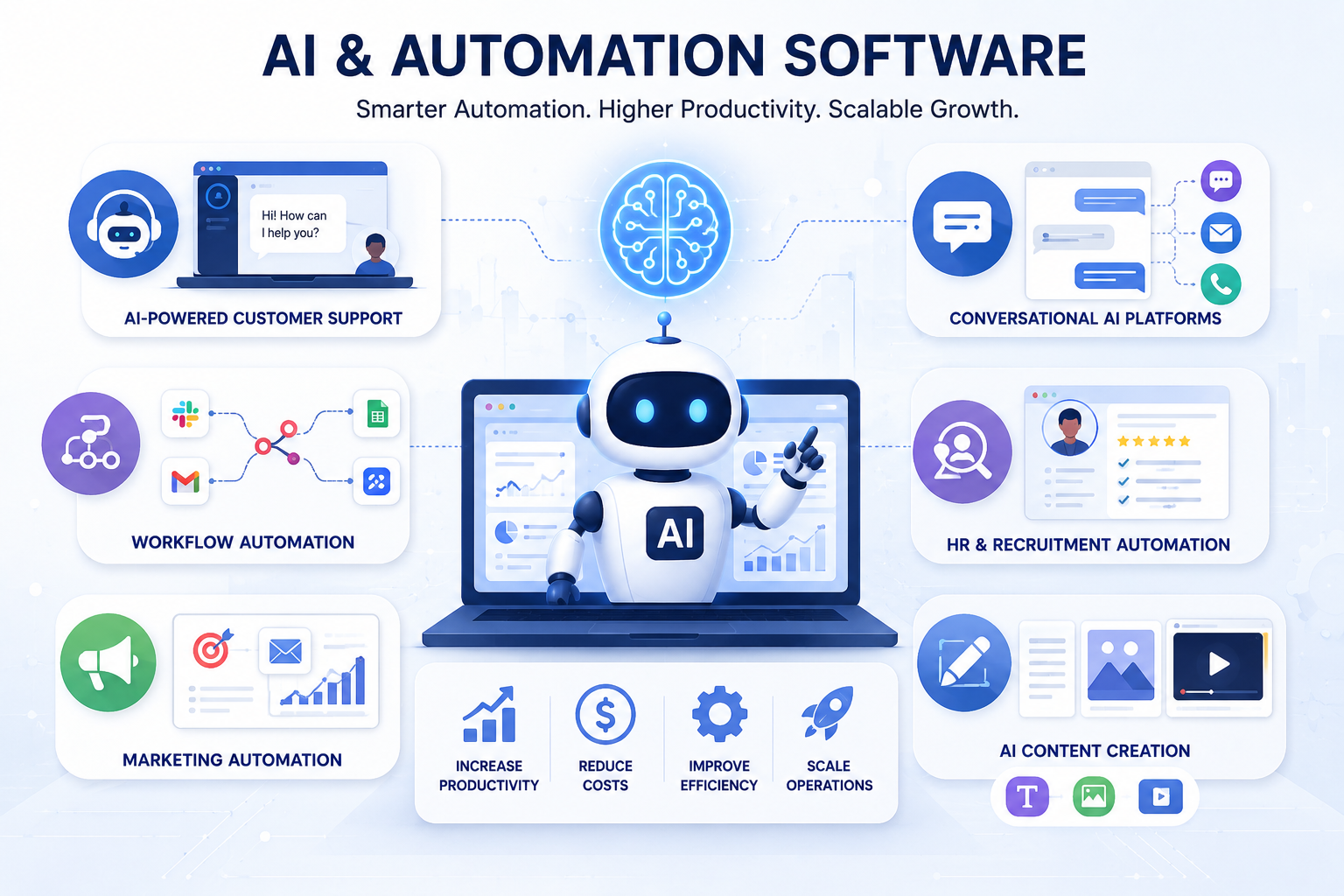
AI-powered software tools help organizations automate repetitive tasks, improve customer service, analyze large datasets, and optimize business processes.
Practices of n8n Automation are particularly valuable because it allows businesses to scale operations without increasing workloads proportionally.
For example, AI-powered customer support systems can answer common questions instantly, reducing pressure on service teams. Dedicated conversational AI platforms go further, enabling businesses to deploy intelligent assistants across chat, email, and voice channels, handling complex customer interactions while integrating with CRM and support systems. Marketing departments can automate campaign management, while HR teams can streamline recruitment processes.
AI is also influencing content creation. Businesses increasingly use AI-powered writing tools, design platforms, and AI animation tools like Invideo Agent to create marketing materials more efficiently.
These technologies help organizations increase productivity while reducing operational costs.
Human Resource Management Systems
As businesses grow, managing employees becomes more complex.
Human Resource Management Systems (HRMS) help organizations handle recruitment, onboarding, performance management, payroll, benefits administration, and workforce planning more effectively.
These platforms reduce administrative workloads while providing valuable insights into employee performance and engagement.
Recruitment software helps businesses identify qualified candidates more quickly, while workforce analytics tools support better staffing decisions.
Employee experience has become increasingly important in competitive labor markets. Organizations that invest in HR technology often improve retention, productivity, and workplace satisfaction.
For growing companies, effective workforce management is essential for maintaining momentum and supporting expansion.
Marketing Technology Platforms
Marketing plays a crucial role in business growth, and modern marketing technology helps organizations reach audiences more effectively.
Marketing platforms support activities such as email campaigns, social media management, search engine optimization, advertising, and customer engagement.
These tools allow businesses to track campaign performance, analyze audience behavior, and optimize strategies based on data.
Artificial intelligence is making marketing software even more powerful. Businesses can now create personalized customer journeys, automate communication, and improve targeting accuracy.
AI-generated video content is becoming particularly valuable for marketing teams. Companies can produce promotional videos, product demonstrations, and social media content faster and more cost-effectively than traditional production methods.
As digital competition increases, marketing technology continues to be a critical component of business growth strategies.
Cybersecurity Solutions for Growing Businesses
Growth often brings increased cybersecurity risks.
As businesses collect more customer data and rely more heavily on digital systems, protecting information becomes increasingly important.
Cybersecurity software helps organizations detect threats, monitor network activity, secure sensitive data, and respond quickly to potential incidents.
Modern security platforms use artificial intelligence and machine learning to identify unusual behavior and prevent attacks before significant damage occurs.
Businesses that neglect cybersecurity may face financial losses, operational disruptions, and reputational harm.
Investing in strong security solutions is essential for maintaining customer trust and ensuring business continuity.
Integration Platforms and Workflow Management
One challenge many growing businesses face is managing multiple software applications simultaneously.
Different departments often use separate tools for sales, marketing, finance, customer support, and operations. Without proper integration, information becomes fragmented and workflows become inefficient.
Integration platforms help connect various systems and automate data sharing between applications.
This creates a more unified technology ecosystem and reduces the need for manual data entry.
Workflow management tools further improve efficiency by automating approvals, notifications, and routine business processes.
Businesses that prioritize integration often experience smoother operations and better visibility across departments.
Choosing Software That Supports Long-Term Growth
Selecting the right software involves more than evaluating features.
Business leaders should consider scalability, ease of use, integration capabilities, security, and long-term value. A solution that works well for a small team may not support future growth effectively.
Organizations should also recognize that selecting the right software is only one part of sustainable growth. Many businesses use IT strategy consulting to define a clear IT strategy that aligns technology investments with business goals, risk tolerance, and compliance requirements. Through structured assessments, organizations can identify system gaps, prioritize modernization initiatives, and develop an actionable technology roadmap that improves resilience, governance, and long-term return on investment.
The most successful software investments align with strategic goals and provide measurable improvements in productivity, customer experience, or operational efficiency.
Technology should support growth rather than create additional complexity.
Final Thoughts
Scaling a business in 2026 requires more than ambition and hard work. It requires the right software solutions to support growth, improve efficiency, and enhance decision-making. Cloud platforms, CRM systems, project management tools, analytics software, AI-powered automation, cybersecurity solutions, and workforce management platforms have become essential components of modern business operations. As competition continues to increase and customer expectations evolve, organizations that invest in scalable and integrated technology will be better positioned to grow sustainably, adapt to change, and achieve long-term success in an increasingly digital business landscape.
Related Posts
- Top 5 Enterprise Laptop Return Shipping Solutions for Remote Workforce Asset Recovery
- International Link Building for E-commerce Brands: A Practical Guide
- Server Refresh vs Third-Party Maintenance: Which Option Makes More Sense?
- The Best Funnel Builder for Coaches and Course Creators
- How Magento Powers Modern eCommerce Businesses
- How to Price an Online Course Without Leaving Money on the Table?