



Review the best legacy modernization firms helping SalesTech businesses in Europe replace outdated systems, improve performance, and accelerate product innovation.
SalesTech modernization in Europe boils down to picking the right partner, migrating to cloud-native architecture, and embedding AI and analytics without breaking day-to-day revenue operations. This guide compares five leading providers, maps common bottlenecks, shows what to look for in a vendor, and outlines the tech stack that will dominate 2026-2030.
Introduction
European SalesTech executives, CTOs, and digital transformation leads are facing a practical dilemma. Their teams already rely on video-first selling, AI prospect scoring, and self-serve CPQ, yet the codebase under those innovations often dates back a decade. Moving fast while tied to brittle on-premise components creates a growing gap between roadmap ambition and platform reality. Budgets remain tight, compliance complexity keeps rising, and every fiscal year ends with more of the IT budget channeled into “keep-the-lights-on” tasks instead of new revenue features.
A focused modernization program addresses these problems, but only when led by specialists. Throughout this article, you will see exactly how legacy system modernization services for sales tech companies overlap with SalesTech needs, why cloud migration is only a first step, and which criteria separate a tactical refactor from a strategic platform reboot.
Why Legacy Systems Limit Growth in Modern SalesTech
Even advanced companies with strong ARR find that outdated components restrict predictable scaling. The issue is not nostalgia for mainframes; it is cost, latency, and compliance exposure.
What Legacy Software Means for SalesTech Platforms
Legacy in SalesTech generally refers to three technical characteristics:
1. Monolithic architecture that tightly integrates UI, business logic and data access with no ability to scale or update independently.
2. Point-to-point integration that is hard-coded and fails with partner API updates.
3. Siloed data stores where schema changes demand lengthy, coordinated releases.
A revenue-operations director trying to activate real-time lead scoring cannot wait for a quarterly release of the whole monolith. The same lead, if scored ten minutes late, may already be buying from a competitor.
Why European SalesTech Companies Modernize Legacy Infrastructure
Regulatory requirements move faster than ever. The GDPR fines exceeded €1.2 billion in 2025, according to DLA Piper, and the World Economic Forum confirms that the AI Act will have strict regulations, beginning in August 2026. Log retention/renewal deals at risk are due to outdated log retention/explainability of models. Modernization brings audit logging, role-based access control, and encryption at rest as defaults, rather than bolt-ons.
Equally important is commercial agility. A cloud-native, microservices-based quoting engine can absorb pricing rule changes in an afternoon. A legacy PL/SQL batch script often needs weeks of QA. When public markets reward net expansion rate, delay is more expensive than wrong pricing; speed wins renewals.
Key Bottlenecks Caused by Outdated Sales Platforms
Before turning to solutions, let us quantify the most common blockers:
• With batch processing of pipeline metrics, the data latencies average 90 minutes, so same-day changes to outreach strategy are not possible.
• The integration expenses exceed €100,000 per year due to the need for middleware and custom adapters to integrate the marketing automation, CPQ, and support portals.
• Idle redundancy and comatose servers waste up to 30 percent of on-premise infrastructure.
Modernization targets each of those cost centers. By lowering latency, reducing bespoke integrations, and auto-scaling infrastructure, revenue leaders translate technical gains directly into margin protection and expansion.
Modernization Strategies for Legacy SalesTech Systems
Successful initiatives rarely rely on a single tactic. Instead, they combine targeted cloud migration, code refactoring, and incremental rebuilds, chosen after a diagnostic on architecture diagrams, cost reports, and compliance constraints.
At a high level, there are five recognized strategies. Each tackles a distinct pain point while lowering downstream risk of vendor lock-in.
Cloud Infrastructure Migration
Cloud migration improves availability, elasticity, and security. For SalesTech stacks, the most popular pattern is re-platforming: move services to managed Kubernetes in AWS or Azure, then switch storage to serverless data warehouses.
The payback is rapid because license costs for old database appliances disappear immediately, and back-office teams gain built-in observability (CloudWatch, Azure Monitor, or GCP Operations Suite).
Yet migration alone seldom solves tight coupling. For that reason, the top legacy system modernization companies treat lift-and-shift as an opening gambit, not the championship move.
Legacy Application Refactoring
Refactoring focuses on carve-outs. A quoting sub-module with volatile pricing logic is isolated from the monolith, wrapped in a REST or GraphQL API, and redeployed as an independent container. The benefit is twofold: the new service can scale horizontally when many reps generate quotes, and developers can iterate it faster without retesting the whole platform.
A typical SalesTech modernization refactors 20-40% of total code lines across the first twelve months. That ratio balances risk: deep enough to accelerate releases, shallow enough to avoid rewriting everything.
API & Integration Modernization
In 2026, the average mid-market SalesTech vendor integrates with 15 external SaaS tools. Loose coupling, therefore, is mandatory. Modernization introduces an enterprise API gateway running rate limiting, and OAuth 2.0. New integrations use event-driven patterns (webhooks, Kafka topics) instead of nightly CSV exchanges.
Business outcome: partner onboarding time drops from weeks to days, enabling marketplace revenue share models that add 3-5% to ARR. Integration modernization also keeps support tickets under control because standardized authentication and versioning reduce breaking changes.
CRM and Data Architecture Transformation
A majority of European vendors still store CRM data in one large transactional schema and replicate it nightly to a reporting database. Modernization splits read/write concerns, introduces change-data-capture pipelines, and syncs contact or opportunity records to Snowflake or BigQuery in near-real time.
Sales leadership then gains dashboards with sub-second latency. Gartner confirms aligned sales analytics make teams 2.3 times more likely to achieve high forecast accuracy. For SalesOps, CDC pipelines also minimize full-table replication, reducing monthly warehouse spend compared to brute-force ELT.
Rebuilding Core Sales Platforms
Complete rebuilds are still the worst-case scenario, but at times the only option. Some of the indicators are the failure to patch to meet industry standards or proprietary languages, where available engineers are retiring, and the security frameworks are so obsolete. In such cases, the teams take the strangler-fig approach, where a thin layer of federation proxies the requests to the new or old service. With the passage of time, the old gradually gets reduced to nothing.
A rebuild delivers the cleanest architecture for AI adoption. Without legacy constraints, data lineage, explainability, and MLOps CI/CD integrate from day one.
What to Look for in a SalesTech Modernization Partner
The difference between a smooth transformation and an eighteen-month headache frequently boils down to vendor selection. Pricing rates and case-study logos matter, but capability fit and engagement model matter more.
Before reviewing the shortlist of providers, identify internal success criteria. Do you need a firm specializing in legacy system modernization with 24/7 support windows across EMEA and North America? Or is the priority deep domain expertise in CPQ and embedded finance? Clear answers upstream simplify RFP scoring downstream.
Experience With SaaS and SalesTech Products
Insist on references from recent SalesTech projects. For example, a vendor that stabilized a lead-routing engine handling 300 requests per second shows real-world concurrency skills. Domain familiarity reduces discovery time and avoids misalignment on user stories.
Expertise in Scalable Cloud Architecture
Look for certifications at the organizational level (AWS Premier Tier Partner, Microsoft Solutions Partner-Digital & App Innovation). These badges do not replace due diligence, but they confirm proven reference architectures and direct escalation paths inside the hyperscalers.
AI, Automation & Analytics Capabilities
Generative AI use cases, such as automatic call summaries or personalized enablement content, now rank top three in modernization goal lists. Evaluate MLOps pipelines, vector database knowledge, and explainable AI tooling. A vendor should demonstrate how fine-tuning, monitoring, and rollback work in production, not just PoC demos.
Integration With CRMs and Enterprise Tools
The average rep toggles between CRM, email, CPQ, and contract management. A partner must handle packaged application customization, whether Salesforce Flow, Dynamics 365 plugins, or SAP Sales Cloud extensions, alongside custom microservices work. This ensures smooth integration with Salesforce Automation Software and other core sales systems.
Experience Modernizing Operational Platforms
Finance-grade uptime and audit trails separate SalesTech from lighter martech. Vendors regularly selected as best legacy system modernization partners for operational company in SalesTech in Europe carry controls for transaction data, GDPR scope, and ISO reporting. Those competencies translate into smoother sales compliance audits.
Top Legacy System Modernization Companies for SalesTech in Europe
Every vendor profiled here is a legacy system modernization company with documented SalesTech success, pan-European delivery, and verifiable security credentials.
1. Techstack
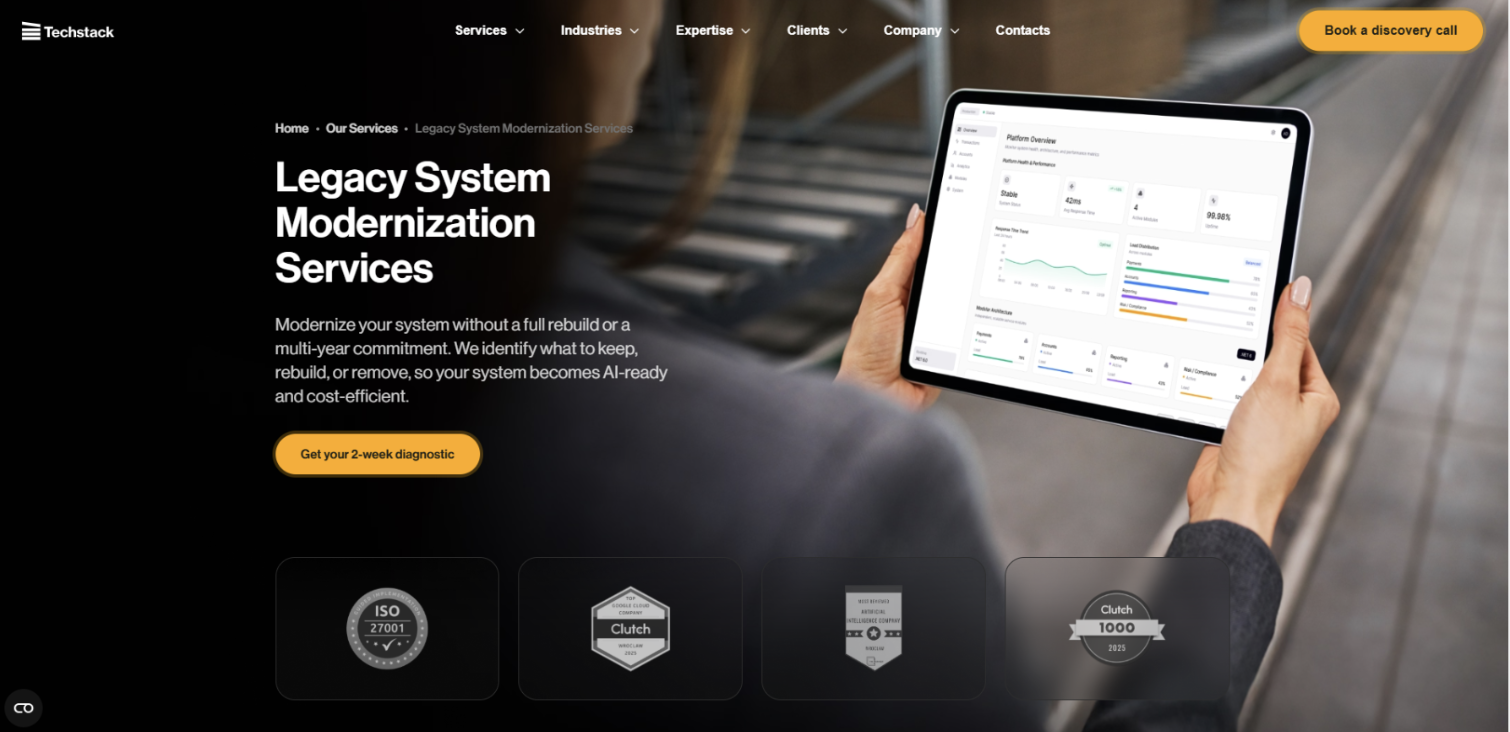
When quarterly OKRs start slipping because the CRM costs more to patch than to innovate, Techstack steps in. Their two-week diagnostic identifies what to keep, rebuild, or remove, so your system becomes AI-ready and cost-efficient. Instead of dictating a default cloud migration, Techstack weighs three tracks - AI Integration, Cloud Migration, or Full Modernization - and shows ROI projections for each scenario.
Techstack transformed a monolithic system into modular services, reduced downtime, and implemented AI-powered meeting summaries and opportunity success predictions during a five-year journey with a five-star Sales Enablement leader in California. With better deployment and monitoring processes, they were able to have more frequent and stable release cycles. With ISO 27001/27701 certification and GDPR-compliance, buyers can have peace of mind when completing the vendor due diligence questionnaire.
Techstack brings together SalesTech domain expertise, enterprise-grade engineering, and a battle-tested modernization methodology. Their engineers have worked hands-on in Sales, Marketing, and Support Intelligence environments, including rebuilding a fragmented legacy platform for a California-based sales enablement leader into a modular, AI-enabled system that delivered 3× faster analytics, 90%+ system stability, and support for 1,000+ enterprise users across a 5+ year engagement. Named to the Clutch 1000, Techstack fields dedicated, non-rotating teams who know the codebase and stay through the full life of the project.
2. Mind Studios
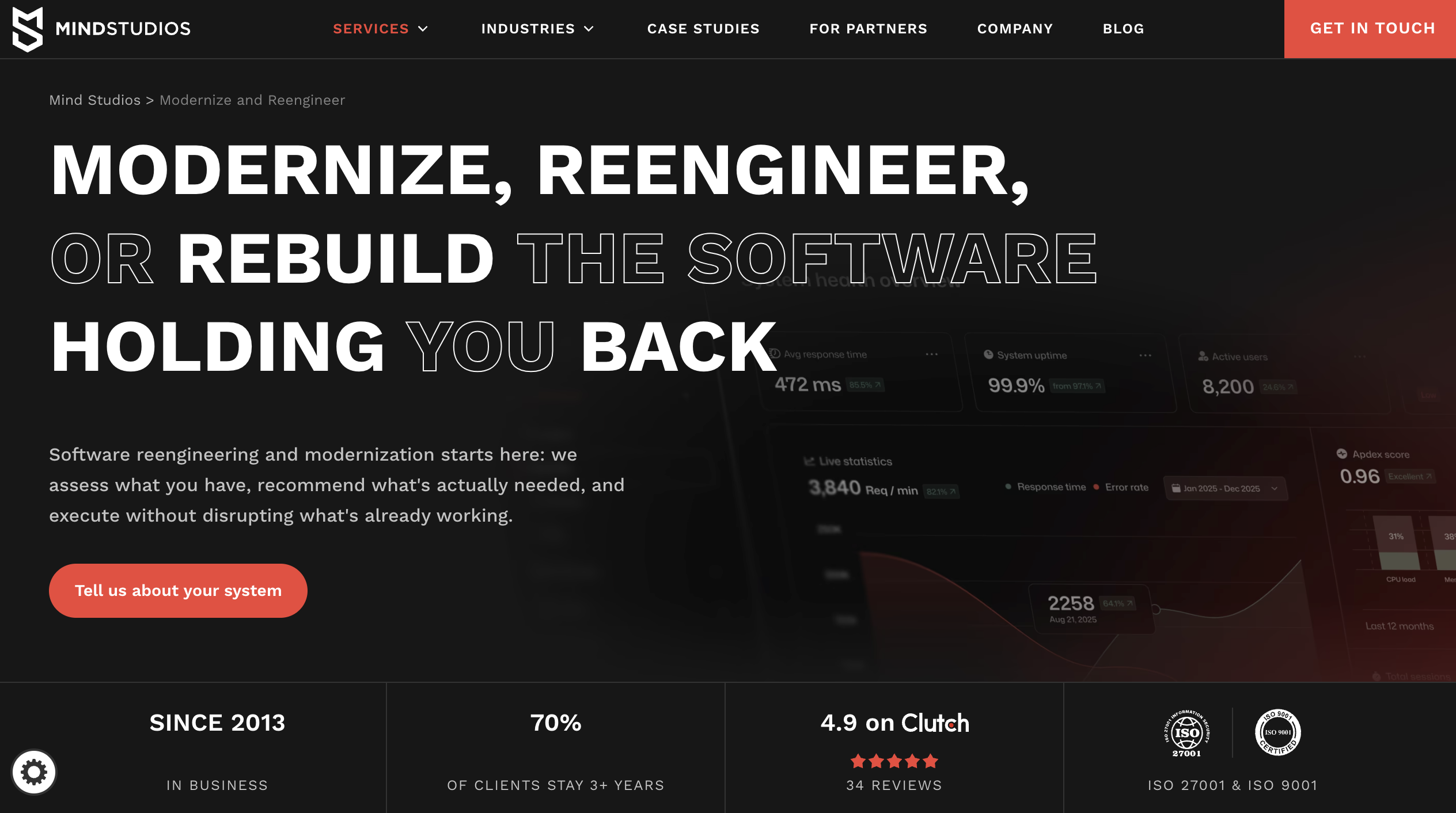
Founded in 2013, Mind Studios runs software reengineering and modernization programs with 100+ specialists across offices in Europe and the US. Engagements open with an audit of the codebase and architecture, followed by a phased plan that sequences modules by business risk instead of technical age.
On SalesTech platforms the scope typically covers decomposing pricing and quoting logic out of the monolith, rebuilding API layers for CRM and marketing automation integrations, cloud replatforming, and database redesign for near-real-time reporting.
AI features are layered into existing workflows where a full rebuild is not justified. The same engineers stay on a project through delivery and post-launch support, with fixed-price, time-and-materials, or dedicated team models applied per phase.
3. N-iX
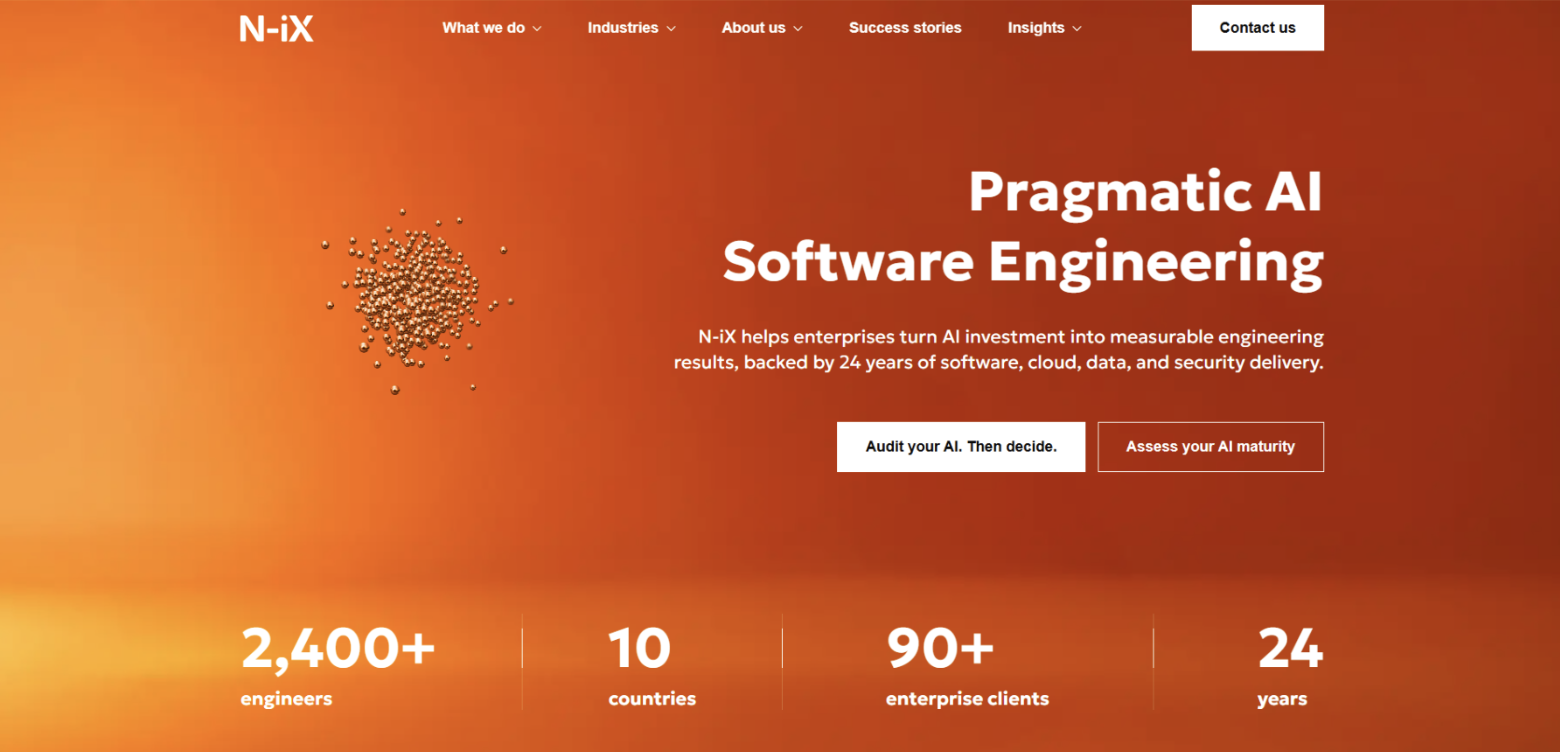
With the headquarters in Malta and engineering centers all over Central and Eastern Europe, N-iX has 23 years of delivery discipline and 2,400+ specialists. They have the maturity of 400 cloud projects and are AWS Premier Tier. At SalesTech companies, N-iX breaks down on-premise CRMs into microservices, migrates analytical data to Snowflake, and provides CI/CD pipelines with GitHub Actions and ArgoCD.
N-iX’s GenAI R&D team and the Engineering Management CoE speed up PoC execution 2-3 times, helping customers quickly move from assessment to tangible progress. The vendor has an Engineering Management Center of Excellence that provides a consistent project governance structure, which is ideal for public clients who require status reporting.
4. Andersen
Andersen differentiates through CRM depth. The firm employs Salesforce-certified architects, Creatio consultants, and SAP implementation engineers under one umbrella. That blend allows Andersen to modernize legacy customizations, migrate orgs to Lightning Web Components, or integrate on-prem SAP pricing with cloud CPQ.
Andersen frequently engages when modernization involves both code refactoring and large-scale data migration between packaged applications. Clients value the one-vendor accountability model: one statement of work covers API extensions, custom Apex, and microservices in Node.js or .NET.
5. Ciklum
Founded in 2002 and headquartered in London, Ciklum's AI-augmented engineering approach uses code-analysis agents to refactor low-risk modules automatically. The vendor claims to save up to 40% of delivery time for their clients by having their skilled engineers work on complex logic. There is a business-centric ROI framework that accompanies each epic, and payback is measured in terms of subscription upgrades or churn reduction.
Ciklum’s modernization projects include AI-assisted code refactoring, monolith application decomposition into microservices, cloud modernization, and real-time data pipelines for batch-to-streaming conversion and fresh data for sales forecasting and analytics applications. We cover Europe with Denmark, Germany, Switzerland and the UK due to the close proximity to the client product owners.
6. Software Mind
Software Mind uses a proprietary AI agent ecosystem to translate codebases (e.g., Visual Basic, COBOL, Oracle Forms, PowerBuilder) into modern Java or C#. The tooling orchestrates multiple agents: one analyzes data structures, another handles control flow, and a third translates legacy code instructions while validating each other's results through iterative self-improvement cycles. Throughout the process, experts from Software Mind review, refine, and supervise the process, guaranteeing that business logic is maintained and the output is production quality.
Often, SalesTech engagements will include custom dialers or tele-sales platforms that have embedded workflow rules. Software Mind saves domain logic during migration and thus prevents disruptions to business. Central-European delivery keeps rates balanced between premium Western European consultancies and low-context offshore models.
How to Select the Right Legacy Modernization Company
Procurement teams can avoid analysis paralysis by dividing evaluation into four phases:
1. Discovery workshops. Each shortlisted vendor runs a two-week architecture and code review.
2. Pilot sprint. Vendors provide a production-ready microservice or integration.
3. Scorecard comparison. Evaluate on basis of fit in architecture, security position, cultural fit and expected ROI.
4. Contract and Governance setup. Explain what exit clauses, SLAs, and what the joint steering committee cadence are.
The second criterion, which is sometimes missed, is the rigor in knowledge transfer. Modernization should enable internal teams to support and build on the new architecture without needing to retain external consultants.
Technologies Driving SalesTech Modernization
The following table shows a mapping of core technologies to business outcomes that may help in the context of making strategy decisions.
Technology | Primary Benefit for SalesTech | Typical Vendor Stack | Maturity in 2026 |
Managed Kubernetes (EKS, AKS, GKE) | Horizontal scaling during quarterly close peaks | Terraform, Helm, ArgoCD | Mainstream |
Serverless Functions | Event-driven lead enrichment at sub-second latency | AWS Lambda, Azure Functions | Mainstream |
Stream Processing | Real-time pipeline health dashboards | Kafka, Confluent, Pulsar | Rising |
Vector Databases | Semantic search across call transcripts | Pinecone, Qdrant | Early Majority |
MLOps Platforms | Continuous deployment of AI forecasts | MLflow, Vertex AI | Mainstream |
Cloud-Native Infrastructure
Elastic clusters make sure that when 2,000 reps log in to the sales portal at the same time on the very last day of the quarter, they do not cause it to time out. Built-in autoscaling features turn off the unused nodes at midnight, reducing opex.
Microservices & API-First Architecture
API-first design makes partner integration easier and provides a key element to legacy modernization salestech: composability. They are contract-versioned endpoints for each domain (pricing, catalog, entitlement), which are decoupled from changes to the downstream UI.
AI-Powered Sales Automation
Generative-AI assistants generate follow-up emails, summarize calls, and bring up cross-sell suggestions. Interaction data pipelines are added as a feature of the LLM stack to increase win rates. Techstack’s AI Integration track, for example, overlays language models without a full rebuild.
Real-Time Data Processing
Streaming pipelines power dynamic leaderboards and territory health dashboards. Moving from batch ETL to streaming previously required heavy engineering. Now, managed Kafka and schema registry services lower the barrier, making real-time insights part of almost every legacy salestech application modernization scope.
Business Benefits of Legacy SalesTech Modernization
A mature program returns value across four domains:
• Revenue growth. Reps act on live data, improving conversion percentages and reducing time-to-quote.
• Cost efficiency. This automatically scales down and deploys unused instances to. cut compute costs by 70 percent.
• Risk mitigation. Modern authentication, encryption, and logging reduce the chances you’ll experience a breach and the compliance penalties that follow.
• Talent attraction. Engineers prefer modern stacks, lowering time-to-hire and retaining scarce expertise.
Two additional, often under-publicized gains arise: first, partner-solution revenue via APIs (marketplaces can add 5% of top-line within 18 months); second, pre-packed AI models that open cross-selling into customer success or marketing operations.
Emerging Trends in SalesTech Platform Modernization
European boards now ask whether modernization budgets should include new AI products or remain infrastructure-only. Current market practice leans toward a blended roadmap because delaying AI after tackling tech debt leads to duplicate work.
AI Assistants for Sales Teams
Functionality extends beyond call summaries to on-the-fly battle-card generation, objection-handling guidance, and recommended actions surfaced inside CRM interfaces. Techstack’s roadmap includes multilingual coaching and automated follow-ups, aligning with Microsoft’s Copilot push.
Composable SaaS Architectures
Packaging pricing as a microservice, quote generation as another, and contract lifecycle as a third let customers replace only problematic components. This reduces rip-out anxiety, accelerating deal cycles for modernization vendors.
Low-Code & Workflow Automation
As more SalesOps users build their own lead routing or enrichment flows, modernization projects bake in Power Platform or Mendix connectors. That move shrinks IT backlogs, freeing engineering to focus on differentiating features.
Revenue Intelligence Platforms
By unifying activity, pipeline, and customer-health signals in real time, these platforms shift management focus from retrospective dashboards to proactive coaching. Ciklum, Andersen, and N-iX already integrate recorded call metadata with forecasting models during legacy salestech application modernization engagements.
Conclusion
Legacy constraints in SalesTech no longer merely slow feature delivery - they now threaten regulatory compliance and margin targets. Choosing among legacy system modernization firms is, therefore, a mission-critical decision. Most distinguished are Techstack, N-iX, Andersen, Ciklum, and Software Mind with tested SalesTech expertise, depth in cloud architecture, and measurable business outcomes. By aligning modernization scope with revenue goals upfront, and by favoring incremental yet decisive changes, European SalesTech leaders protect today’s pipeline while building tomorrow’s growth engine.
FAQ
How long does legacy SalesTech modernization usually take?
Targeted cloud migrations complete in three to six months. A comprehensive legacy salestech application modernization that decomposes a monolith, rebuilds integrations, and embeds AI averages 12-24 months with phased deployments.
Which companies specialize in SaaS and SalesTech modernization?
Techstack, N-iX, Andersen, Ciklum, and Software Mind remain the legacy system modernization companies most cited by analysts. Each is a firm specializing in legacy system modernization with dedicated salestech portfolios.
What technologies are commonly used in SalesTech modernization?
Between 2026 and 2030, most roadmaps include cloud-native infrastructure, container orchestration, event streaming, GraphQL APIs, vector databases and managed MLOps pipelines.
Should SalesTech companies rebuild or modernize legacy systems?
The call is based on cost-benefit analysis. A strangler fig routing approach can be a better way to achieve a cleaner architecture and lower run cost when refactoring more than 70% of the codebase, which would exceed greenfield costs.
How much does SalesTech platform modernization cost in Europe?
Initial costs are €250,000 for a single service refactor, increasing to €5 million+ for multi-year transformations with 5+ services, complex compliance, and AI capabilities.
Related Posts
- Top 5 Enterprise Laptop Return Shipping Solutions for Remote Workforce Asset Recovery
- International Link Building for E-commerce Brands: A Practical Guide
- Server Refresh vs Third-Party Maintenance: Which Option Makes More Sense?
- The Best Funnel Builder for Coaches and Course Creators
- How Magento Powers Modern eCommerce Businesses
- How to Price an Online Course Without Leaving Money on the Table?