


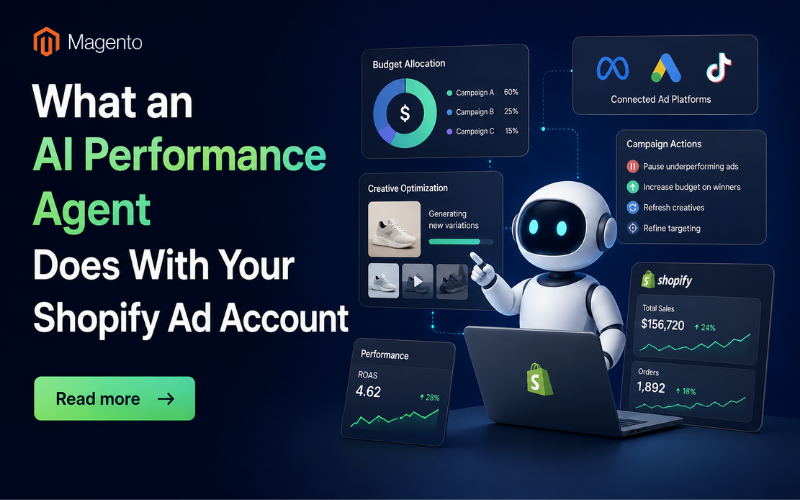
An AI performance agent connects directly to your Shopify store and your ad platforms, reads the sales data flowing between them, and then makes the routine media buying decisions that a human would otherwise make by hand. That means pausing losing ad sets, shifting budget toward the ones producing profitable orders, generating new creative variations when fatigue sets in, and adjusting targeting based on which products are actually converting. It works continuously rather than in the two or three check-ins a day most operators manage.
The important distinction is that it acts on outcomes rather than platform metrics. Meta and Google will happily optimize toward whatever event you feed them, and if your pixel is firing on add-to-cart or reporting inflated attributed revenue, the algorithm will chase the wrong thing for weeks. A performance agent pulling order data straight from Shopify sees the real number: what the order was worth, what it cost to acquire, whether the customer came back. That gap between reported ROAS and actual contribution margin is where most Shopify ad budgets quietly leak.
How an AI performance agent connects to Shopify and your ad platforms
Setup usually runs somewhere between twenty minutes and a couple of hours, depending on how tidy your accounts already are. You authorize access to your Shopify admin, then link the ad accounts you want managed, most commonly Meta, Google, and TikTok. The agent pulls historical order data, typically ninety to a hundred and eighty days, so it has a baseline for average order value, repeat purchase behavior, product level margins if you provide them, and seasonal patterns.
The messy part is almost never the software. It is the state of your tracking. If your Conversions API is half configured, your UTM parameters are inconsistent across channels, or half your catalog feed is missing GTINs, the agent inherits that mess. Most tools will flag the gaps during onboarding, but fixing them is still your job or your developer's. Stores that skip this step get worse results and blame the automation.
Once connected, the agent runs in a read-only or advisory mode for a short period on most platforms, usually seven to fourteen days, before it starts executing changes. That window exists so it can learn what normal looks like for your account instead of overreacting to a slow Tuesday.
What the agent actually changes in your campaigns day to day
Budget reallocation is the most frequent action. Instead of a human checking dashboards in the morning and evening, the agent evaluates spend against contribution margin on a much shorter cycle, moving money away from ad sets that have burned through a meaningful sample without converting and toward the ones clearing your target. On accounts spending a few thousand a month, that alone tends to be where the first measurable improvement shows up.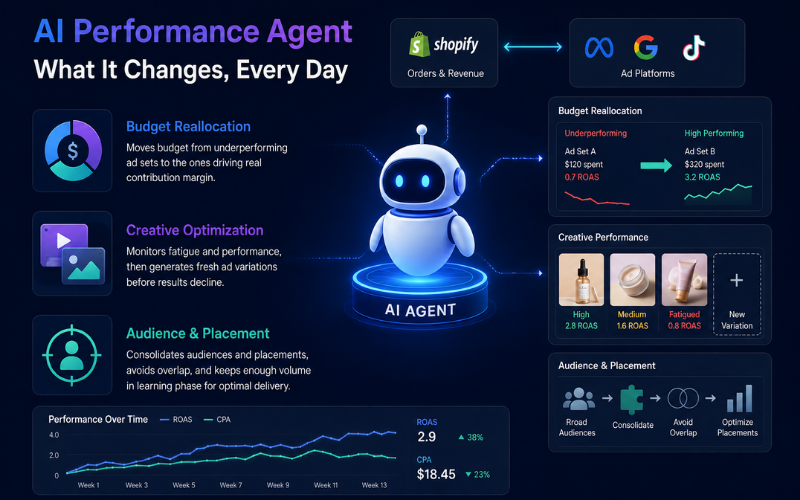
Creative is the second lever, and increasingly the more valuable one. Ad platforms have absorbed most of the targeting decisions already, which means the variable you still control is what the ad says and shows. A performance agent tracks how long each asset holds performance, watches frequency and cost per result climbing together, and produces fresh variations before the decline turns into a plateau you have to dig out of. Some tools generate the video and static assets themselves from your product pages, others queue briefs for your designer.
This is the point where teams start comparing tools seriously, and it is worth being honest about what you are buying. Creatify positions its offering as a solution for media buying teams that already understand their numbers and want the execution layer handled, which is a different product than a dashboard that just tells you what went wrong last week. If you have no one who can interpret the output, automation will not save you.
Audience and placement adjustments happen too, though with a lighter touch than most people expect. Broad targeting with strong creative outperforms narrow interest stacking on most Shopify accounts now, so the agent's job there is often restraint: consolidating fragmented ad sets, avoiding overlap, and keeping enough volume in each learning phase to make the platform's own optimization work.
What results look like in the first ninety days
The honest answer is that the first two to four weeks often look flat or slightly worse. The agent is gathering data, campaigns are being restructured, and the platforms need to re-enter learning. Anyone promising immediate lift is selling you the exception.
From roughly week five onward, improvements typically show up in efficiency rather than raw revenue. Industry data suggests the biggest gains come from waste reduction, meaning spend that would have gone to underperforming ad sets simply does not go there. Stores frequently see cost per acquisition move in a useful direction while total spend stays flat, which reads as a modest ROAS improvement on paper and a much larger difference in actual profit.
Pricing sits in a few tiers. Entry level tools often run in the low hundreds per month or take a small percentage of managed spend, mid-market platforms land in the high hundreds to low thousands, and enterprise arrangements are negotiated. Compare that against the hourly cost of the person currently doing this work manually, and the math usually favors automation somewhere above ten to fifteen thousand in monthly ad spend. Below that, the agent has too little data to make confident decisions and your money is better spent on creative production.
How this differs depending on your store type and category
A single product store with one price point and a short consideration window is the easiest case. The signal is clean, the conversion event is unambiguous, and the agent can act fast. Fashion and beauty stores with hundreds of SKUs and heavy return rates are harder, because gross revenue overstates performance badly. If you sell apparel with a thirty percent return rate and do not feed that back, the agent will optimize toward the products that sell well and come back most.
Subscription and consumable brands need lifetime value data to be worth anything at all. First order profitability is often negative by design, so an agent judging on immediate ROAS will strangle exactly the campaigns you want scaled. Feed it repeat purchase rates and payback period targets instead.
High ticket categories, furniture, jewelry, equipment, sit at the other extreme. Low order volume means statistical confidence takes far longer to reach, and the agent should be configured to act more slowly with wider thresholds. Regional differences matter here too. A US store running across several states behaves differently from a UK or EU brand dealing with VAT thresholds and narrower audience pools.
Where the agent stops and you still decide
Positioning, offer, pricing, and brand are not automation problems. If your product is undifferentiated or your landing page converts at under one percent, no amount of budget shuffling fixes that, and a good agent will surface the symptom without being able to solve the cause.
Before you sign anything, decide what number you actually want optimized and make sure you can measure it accurately. Most disappointing outcomes trace back to that one unglamorous step rather than the technology itself. Get your margins, return rates, and repeat purchase data into a usable state first, then hand over execution, and give it a full quarter before you judge it.
Related Posts
- What an AI Performance Agent Does With Your Shopify Ad Account
- 5 Latest E-Commerce Trends to Watch Out For in 2026
- How Retail Automation Is Transforming Magento Stores Through Smarter Inventory and Order Management
- Wearable Technology and the Future of E-Commerce
- Migrating to Shopify? Here's How to Protect Your Search Rankings
- How to Hire and Manage a Remote Development Team for Your Magento Store