


Discover how retail automation transforms Magento stores with smarter inventory visibility, automated reservations, order routing, and omnichannel fulfilment.
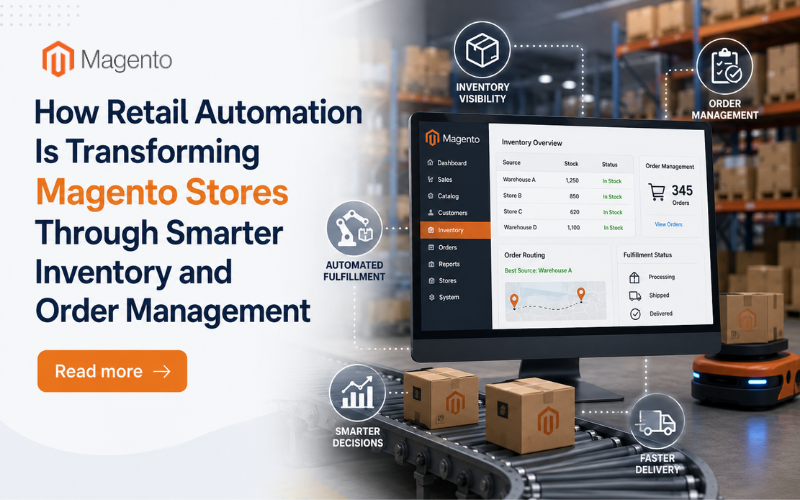
Retail businesses today are dependent on correct inventory management, effective order fulfilment, and synchronized order management systems, particularly Magento and Adobe Commerce retailers who deal in several warehouses, retail outlets, marketplaces, and online platforms. Errors in manual inventory management and lack of synchronization in the process result in inventory discrepancies, late delivery, overselling, and higher expenses for the business. The solution to these problems lies in integrating all aspects of inventory management, order management, and fulfilment decisions through retail automation for Magento merchants.
The Growing Role of Automation in Retail Operations
A bigger picture of the retail automation industry is an evolution of retailing that is technology-oriented. It involves different aspects including inventory management, warehouse management, order management, demand forecasting, and fulfilment optimization. With about 6 billion people around the world accessing the internet (which is close to three-quarters of the world’s population), the increase in digital connectivity has led to a rise in the use of e-commerce and the complexities involved in order processing and stock management. Automation in the retail sector will make it possible to minimize the amount of repetitive work done manually by the retailers and ensure operational effectiveness by making it easy for workers to access the business data.
The idea of automation is especially important for those companies using Magento or Adobe Commerce as their platform because this system allows for managing inventory from multiple places like warehouses, shops, pickup points, distribution centers, and drop shipping. This way, companies will not need to use spreadsheets for managing inventory, but instead set up automated rules for order fulfilment based on inventory.
Smarter Inventory Visibility Across Multiple Locations
The most prominent advantages of retail automation include increased visibility of the inventory at various points. The Inventory Management feature of Magento has the distinction of sources, which are considered to be physical locations of inventory, while stocks are considered to be groups of sources used for certain sales channels. Aggregate quantities of salable products and the use of reservations, where products are allocated to customer orders, are accounted for. The use of such a method is highly beneficial for those businesses using multiple warehouses and stores, as through automation, they can determine inventory availability and make quick decisions.
Benefits associated with retail automation include the ability for merchants to keep accurate inventory levels, minimize the risk of over-selling products, ascertain available inventories before taking orders, synchronize inventories between warehouses and stores, and gain insights on committed inventories that are yet to be shipped. Inventory quantity adjustments in Adobe Commerce are done through various processes such as purchases, shipping, returns and stock transfers, among others.
Automated Reservations Help Prevent Overselling
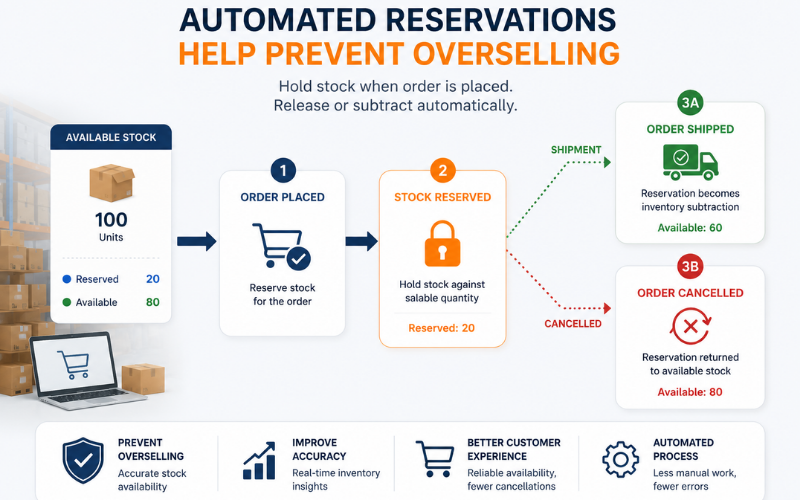
Inventory accuracy involves not only measuring the physical number of units but also the amount of stock that is available to sell. The feature of inventory reservation in Magento allows keeping that balance by holding inventory reservations against salable quantity in case of order placement rather than subtracting the physical unit count from the stock. In case of shipment, the inventory reservation is turned into inventory subtraction, while in case of unshipped cancellation of the order, the reservation gets returned to the available inventory. This automated system reduces the chances of over-selling and provides a more accurate stock availability rate in case of high demand for the product.
More Efficient Order Routing and Fulfilment
Automated retailing will assist Magento retailers in selecting an optimal location for fulfilling their orders based on analysis of inventory locations, quantities, and priorities. This will save time and effort in the process of allocation.
Automated routing can consequently contribute to:
• Faster Fulfilment Decisions: Faster recognition of appropriate fulfilment options, minimizing the time spent analyzing inventory availability manually and allocating orders.
• Better Utilization of Distributed Inventory: Companies can use their inventory from different warehouses and retail outlets without relying on a single source of fulfilment.
• Fewer Manual Allocation Errors: Automated order routing eliminates human errors in order fulfilment, thus avoiding wrong deliveries and delays.
• More Consistent Fulfilment Procedures: Automation rules guarantee a standardized order fulfilment process.
• Improved Coordination Between Online Orders and Physical Inventory: Automation improves the coordination between e-commerce orders and the physical inventory.
Connecting Order Management with the Broader Retail Technology Stack
The use of Magento in combination with other technologies, such as ERP systems, warehouse management systems, shipping systems, accounting systems, and customer service solutions, makes the automation process more efficient. Yet, proper planning needs to be done since various order and inventory management systems might have different compatibility specifications. Before the process of automation is started, the retailers need to determine which system will manage their inventory, orders, shipping, returns, and operational documentation.
The Relationship Between Automation and the Retail Automation Market
The growth of the automation market within the retail sector comes from the necessity to operate complicated sales and distribution networks effectively. Automation is no longer just about point-of-sale and warehouse machinery, but rather a process-based automation through software which takes into account inventory management, orders, fulfilment, and customer availability. The adoption of automation, process optimization and making supply chain-related decisions based on data is also relevant for logistics processes.
Automation is helpful for Magento stores as it enables merchants to cope with the complexity of the ecommerce landscape by taking care of routine operations related to inventory and orders and leaving strategic decisions to merchant teams. Nevertheless, automation is not enough to make a difference if inventory practices are poor. The accuracy of product data, configuration of sources, correct stock availability, and proper integrations are necessary for success.
What Magento Merchants Should Consider
Before introducing additional automation, retailers should evaluate several operational areas:
• Inventory Structure: Find out whether your inventory management is centralized through one source or distributed through different warehouses, stores, or sources of fulfilment.
• System Ownership: Know which is the main system that will keep track of the correct inventory level, order status, and other operations.
• Order Routing: Create an effective set of rules to choose the best warehouse or store for fulfilling the order.
• Integration Quality: Make sure that the integrated Enterprise Resource Planning (ERP), Warehouse Management System (WMS), shipping systems, etc., share consistent data.
• Exception Handling: Establish a procedure for handling cancellation requests, refunds, discrepancies in inventory, payment failures, and split orders.
• Performance Measurement: Measure key performance indicators like accuracy of inventory, order processing time, inventory turns, and many more.
This structured way will make sure that the automation does not become just another form of inefficient manual process embedded in a computer program.
Building Scalable Omnichannel Operations Through Magento Retail Automation
Magento stores are being revolutionized through retail automation which allows for better management of inventory and orders in terms of reactivity, coordination, and informativeness. Multi-source inventory, reservations, salable quantities, and source-selection rules offer a solid base for the automation of various retail processes. Merchants can use these native functions to achieve higher inventory visibility, smarter order allocation, reduced delivery time, and more robust processes across different sales channels. As the retail automation market expands, automated inventory and order management become essential for merchants who want more efficient business operations.
According to the Pristine Market Insights, instead of looking for separate automation tools, Magento merchants are supposed to focus on the integration of operational systems. The point here is not to automate, but to establish connected workflows where all decisions regarding the availability of products, routing of orders, and delivery will be made based on reliable information. This will allow expanding retailers to gain greater precision and efficiency in order management in complex omnichannel commerce environments.
Related Posts
- What an AI Performance Agent Does With Your Shopify Ad Account
- 5 Latest E-Commerce Trends to Watch Out For in 2026
- How Retail Automation Is Transforming Magento Stores Through Smarter Inventory and Order Management
- Wearable Technology and the Future of E-Commerce
- Migrating to Shopify? Here's How to Protect Your Search Rankings
- How to Hire and Manage a Remote Development Team for Your Magento Store