




A purchase order lands, and the must-arrive date already feels too close. Use this quick planning math:
• 1–4 weeks when the dieline, artwork, and case labels are locked
• 3–8 weeks to adapt a DTC pack for store shelves
• 8–14 weeks to develop a new shelf-ready tray
• 14–22+ weeks when custom tooling, specialty finishes, or ocean freight enter the mix
These ranges widen because packaging is only one of four ticking clocks: retailer milestones, packaging work, finished-goods production, and EDI/logistics data. Retailer rules also update twice a year, and Walmart’s Supply Chain Packaging Guide is the standing proof. The sections below unpack each clock so you know exactly where to shave days, not lose them.
The four clocks that control retail readiness
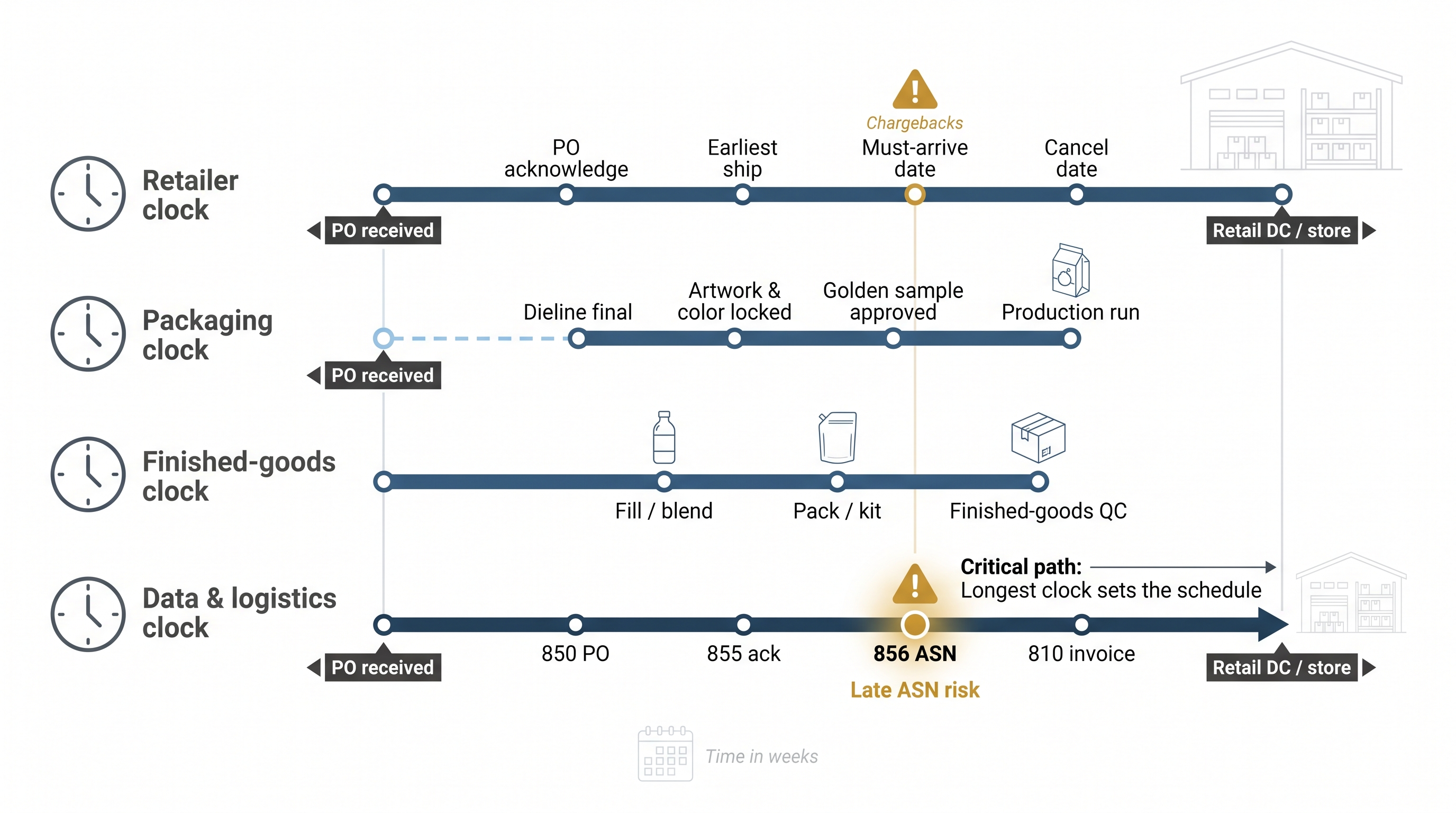
Four timers start the moment a buyer hits “send,” and packaging is only one of them.
1. Retailer clock. The PO sets hard dates: acknowledge, earliest ship, must-arrive, cancel. Miss one and chargebacks follow.
2. Packaging clock. Time begins only after the dieline, artwork, color targets, and samples are final. Until then, a printer’s “ten-day turnaround” is theoretical.
3. Finished-goods clock. Bottles still need filling, pouches sealing, kits assembling. A perfect carton means nothing while product is still on the line.
4. Data & logistics clock. EDI traffic (850 PO, 855 acknowledgment, 856 ASN, 810 invoice) must mirror every physical move. SPS Commerce’s order-to-fulfillment map shows how a late ASN can erase flawless packaging.
Put the four timelines on one Gantt chart and follow the longest path. A simple case reprint can still stall if a 3PL needs two weeks for EDI certification. Keep the clocks visible, overlap tasks when it’s safe, and the PO shifts from ticking bomb to manageable schedule.
Planning ranges by starting condition
Printers like to tout a “ten-day production” window, but the true clock starts well before and keeps ticking long after those ten days. The PackMojo lead-time planner tells buyers to order custom packaging 4–8 weeks before launch by air freight and 5–10 weeks by ocean. Zenpack’s project FAQ backs this up: its expedited pathway moves PR and swag boxes from initial design through production and global delivery in 4–8 weeks, the same band as PackMojo’s air-freight estimate.
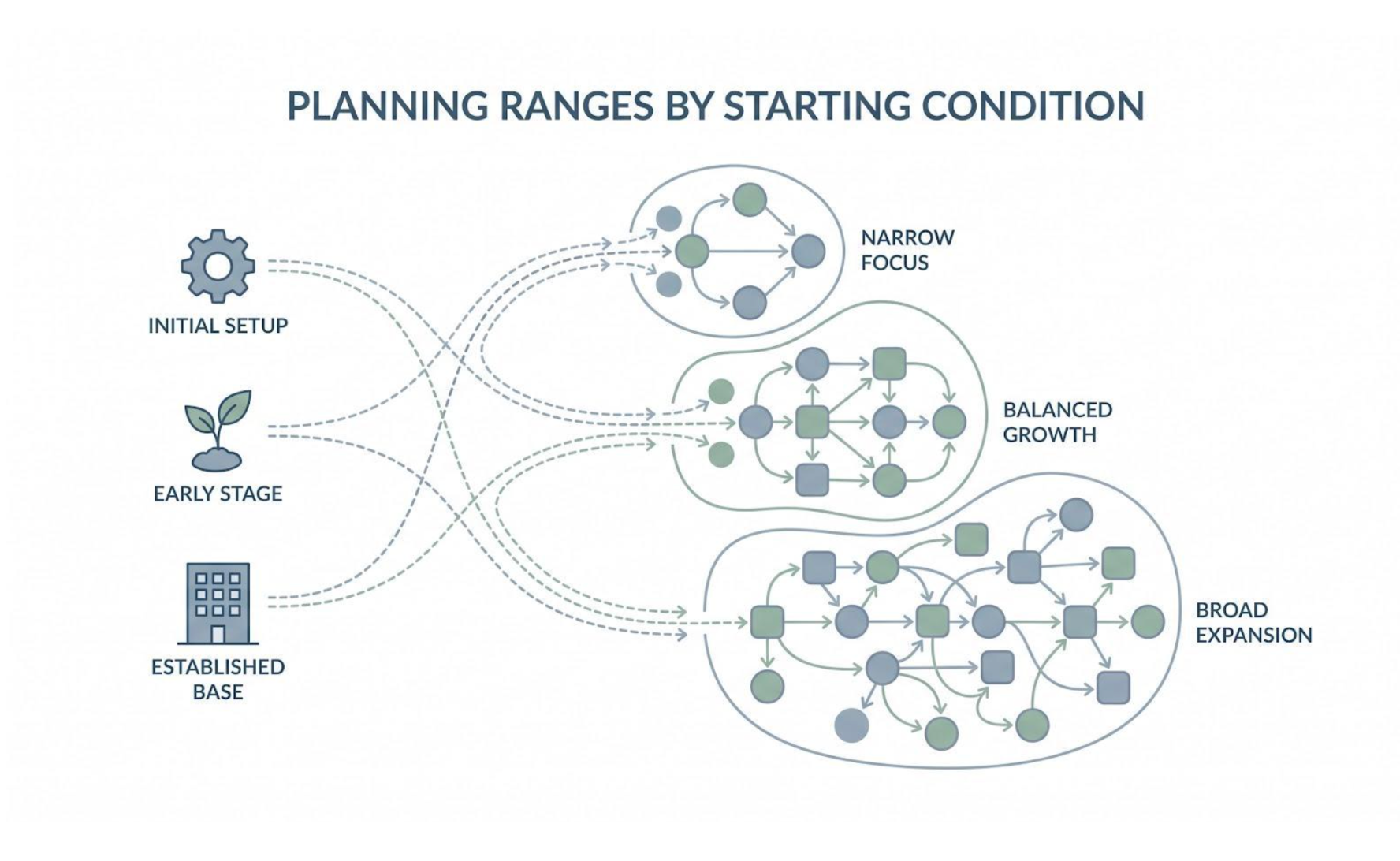
When one carton must survive a DTC drop test on Monday and still face clamp trucks at a big-box DC on Friday, any lag risks inventory rejections and launch delays. Zenpack’s omnichannel packaging solutions cut that risk by unifying structural design, ISTA lab testing, and mass manufacturing so a single dieline clears every channel without adding weeks to the calendar.
Pick the band that matches where you are today, then add a buffer if any approval gate remains open. The guidance below assumes the other three clocks (finished goods, data, and logistics) are already green.
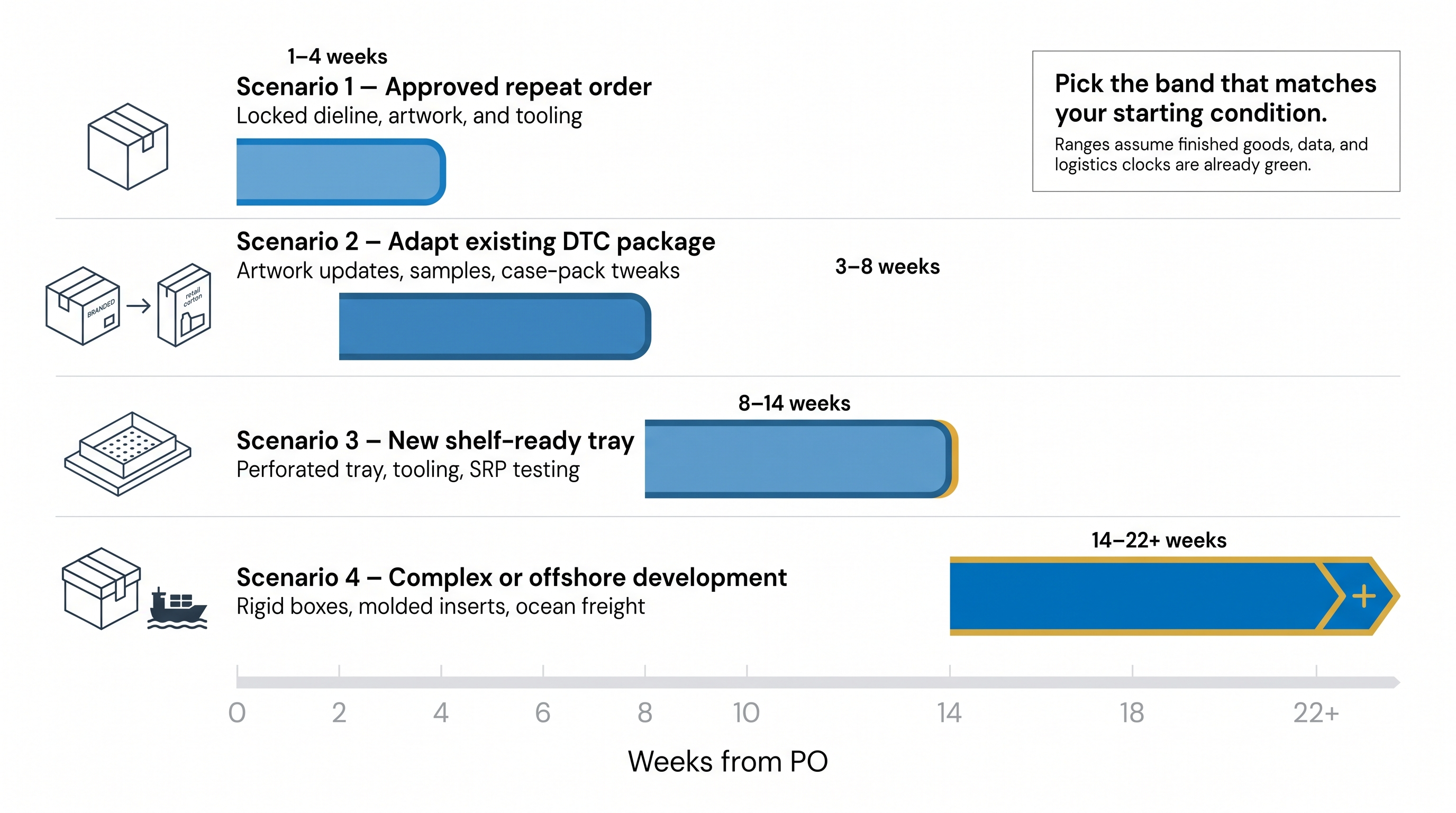
Scenario 1: An approved repeat order
This is the easy one. You already own the dieline, the artwork is locked, tooling sits at the plant, and the case pack has passed a buyer audit. All that’s left is press time, QC, and a truck.
Plan on roughly 1–4 weeks door to door:
• 7–10 business days for a domestic sheet-fed or flexo reprint once plates are on file; several U.S. converters list that window as their standard repeat lead time.
• 2–3 days for slitting, die-cutting, gluing, and compression checks.
• 1–7 business days for domestic LTL or small-parcel freight, depending on distance and lane availability.
Because nothing structural changes, complacency is the hidden risk. Double-check ink drawdowns against today’s brand palette, confirm the UPC hasn’t rolled, and download the retailer’s current case-label spec before releasing the job. Five minutes of scrutiny keeps a repeat order from turning into a chargeback.
Scenario 2: Adapting an existing DTC package
Most first-time retail launches land here. The product ships safely in a branded mailer today, yet store shelves demand a new barcode spot, full ingredients panel, and a sturdier master case. You’re adjusting, not reinventing.
Plan on roughly 3–8 weeks door to door, a window that matches PackMojo’s 4–8-week air-freight timeline and Crateform’s 6–10-week lead time from approved artwork.
Why the calendar stretches:
• Artwork updates. Swapping a Shopify URL for a nutrition block or child-safety warning triggers fresh proofs, and the clock stays frozen until Marketing, Legal, and sometimes the buyer sign off.
• New samples. A white mockup confirms the dieline still folds; a printed comp verifies color and copy before press time is reserved.
• Case-pack tweaks. Changing unit count shifts board strength, pallet pattern, and retailer labels; treat the master case as its own product and lock specs before ordering board.
Keep change control tight with a single chat thread and a hard last-edit date, and the adaptation stays smooth. Let one stray text linger and the schedule swells fast.
Scenario 3: Building a new shelf-ready package
Here you’re creating a perforated tray that ships as a case and converts to a display in seconds. Retailers appreciate the labor savings, but the calendar often stretches. Budget roughly 8–14 weeks. This window sits between Logic Pac’s 6–8-week simple-program and 12–20-week fully custom benchmarks, and runs past PackMojo’s 5–10-week ocean-freight estimate once tooling and testing are added.
Why it takes that long:
• Weeks 1–2: dimensions and white sample. Confirm planogram count, sketch the tear-away, generate CAD, and run drop, vibration, and compression tests.
• Weeks 3–5: artwork and proofs. Balance barcode size with front-panel copy; at least one proof round is almost certain.
• Weeks 4–6: tooling. Perforations and tear tape need custom steel rules; plates follow once graphics lock.
• Weeks 6–8: first production run and QC. Operators pull extra sheets to fine-tune tear lines; QC signs off pallet by pallet.
• Weeks 8–14: freight and receiving. Corrugated trays cube out quickly, so factor in trailer space and potential split loads; ocean freight or long-haul domestic lanes can add the final weeks.
Hit every gate cleanly and you still finish inside the quarter. Miss one and fourteen weeks can feel like tomorrow.
Scenario 4: Complex or offshore development
Rigid gift boxes, molded pulp inserts, and color-matched glass droppers resist shortcuts. Budget at least 14 weeks and keep 22 in reserve, a span that matches Logic Pac’s five-to-seven-month custom-packaging lead time.
Why the calendar stretches:
• Tooling (4–6 weeks). Steel molds, emboss dies, and foil plates ship their own approval samples; each courier round trip adds days.
• Material procurement (2–4 weeks). Specialty boards, foils, or bio-based resins often move mill to factory on fixed cycles; reserve stock early or risk a reset.
• Multi-plant production (4–8 weeks). One converter prints and laminates, another wraps rigid boxes, a third handles hand assembly; every handoff needs inspection and paperwork.
• Ocean freight and clearance (5–6 weeks). Even on steady lanes, port congestion, customs, and inland drayage consume a month or more; air can cut that to a week but at multiples of the unit cost.
Plan long, lock specs early, and note national holidays at both origin and destination. Clear customs with a fortnight to spare and your team will still feel brisk after delivering a premium pack across an ocean.
Stage-by-stage critical path after the PO
The clock you notice first is never the only one that counts. Map every hand-off the same day the PO arrives.
Window | Primary task | Non-negotiable outputs |
First 24–48 hours | PO and compliance triage | Confirm PO dates (acknowledge, earliest ship, must-arrive, cancel). Download the current retailer packaging or routing guide. Assign owners for artwork, testing, and co-packing. Freeze units-per-case and pallet math in a shared sheet. |
Days 1–5 | Retail-readiness gap audit | Measure the consumer pack, case, and pallet against the guide. Flag copy gaps: nutrition, allergens, Prop 65, recycling claims (California SB 343). Verify item file and GTIN hierarchy. Issue a red, amber, or green scorecard that drives the next step. |
Days 2–10 | Structural and graphic development (overlapping) | CAD white sample → shelf and transit simulation → printed comp. Lock barcode quiet zones and legal copy. Set one final-art deadline; any change after this date restarts prepress. |
Week 1–3 | Sampling and retailer approval | Ship golden sample plus datasheet. Build lab-test buffer: conditioning plus drop or compression often adds 3–5 days regardless of rush freight. |
Week 2–5 | Testing and certification | Lab executes ISTA, ASTM, or retailer protocol; failure triggers a root-cause and retest loop. Archive the stamped report with the golden sample. |
Week 2–6 | Tooling → material → production | Sharpen dies, engrave plates, release board or film PO. Typical first SRP run: about 10 working days for corrugated; multi-component rigid pack: 3–4 weeks. |
Freight and inbound | Book freight and delivery appointments | Domestic TL or LTL = 1–7 days; trans-Pacific ocean = 21–42 days in transit (PackMojo planner). Book appointments before cargo sails; a late ASN can erase every upstream gain. |
Finished-goods pack-out | Fill, assemble, inspect, ship | Packaging available → product fill or assembly → QC → retailer shipment |
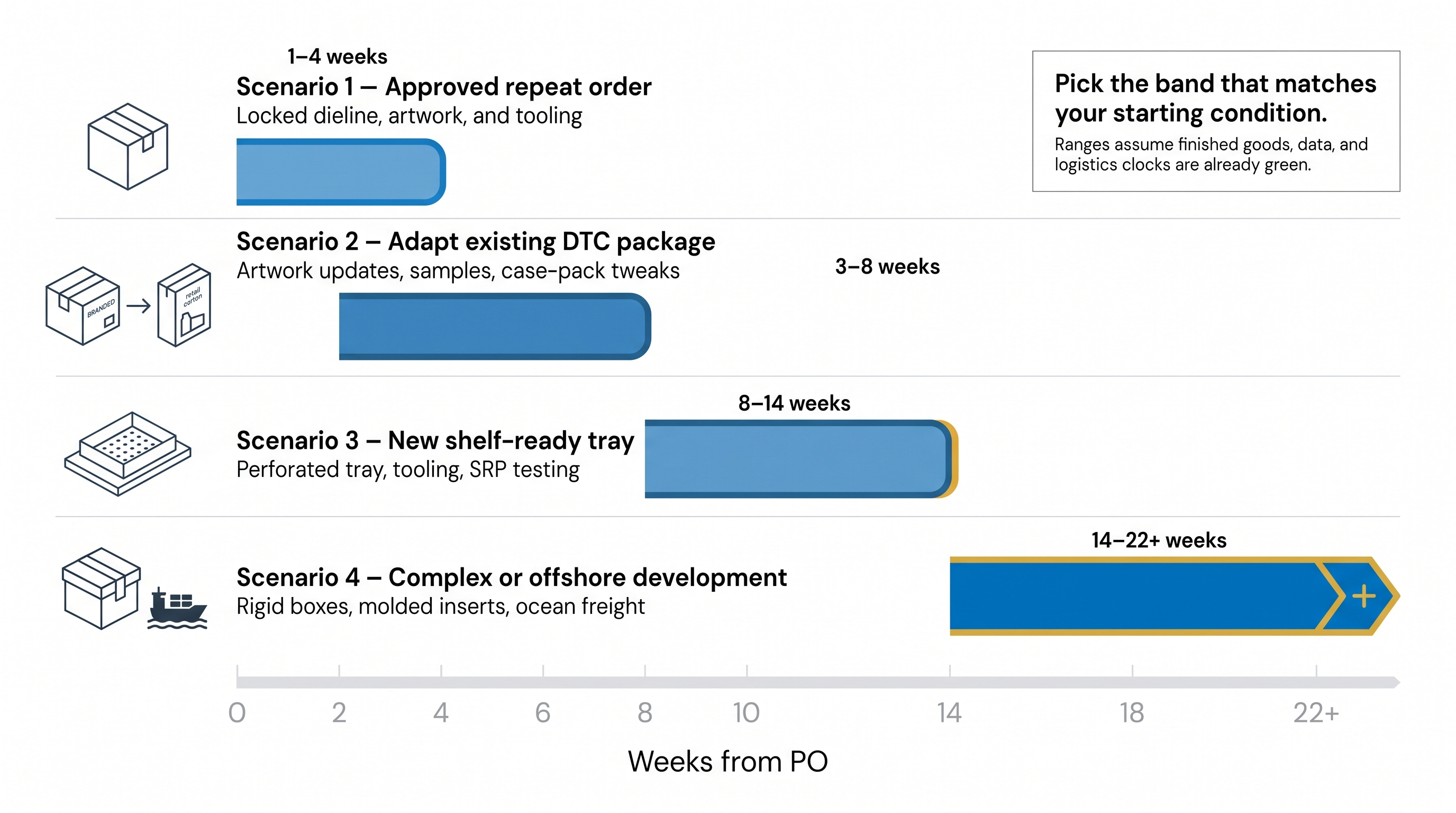
Why a visual? Parallel streams of packaging, finished goods, and EDI rarely finish together by chance. A one-page Gantt chart lets the longest bar set the pace.
Packaging readiness at PO receipt
Lead time is won or lost on day one. When your PO lands, ask one question:
Are our packaging files production-ready or still conceptual?
Production-ready means every box below is green:
• Structural drawing and dieline
• Print-ready artwork (correct rev code)
• Barcode and quiet zone verified
• Legal copy and claims approved (e.g., recycling icons, Prop 65)
• Color targets locked
If all five are green, the plant can book press time as soon as funds clear. If even one is yellow, engineers chase CAD tweaks, Marketing hunts hex codes, or Regulatory waits for lab data; each gap ripples through proofs, samples, and freight.
The math is simple: one unanswered field on day one multiplies into days lost down the line. Clear the checklist now and the schedule holds; leave it open and the timeline stretches fast.
Package type
Format | Why it’s faster or slower | Typical extra time* |
Folding carton | Runs on high-speed sheet-fed or web lines; minimal manual touch | +0–3 days |
Corrugated SRP / PDQ tray | Needs fresh steel rule die and clamp or compression validation | +1–2 weeks |
Flexible pouch | Lamination must cure 24–48 hours between layers; valves or zippers add machine passes | +2 weeks |
Rigid box plus insert | Multiple components, hand wrapping, curing, and assembly across plants | +4–6 weeks |
*Indicative ranges; confirm them with your converter.
The lesson: a lighter package is not always quicker. Pick the slowest component in your system and let that step define the critical path; otherwise the calendar will do it for you.
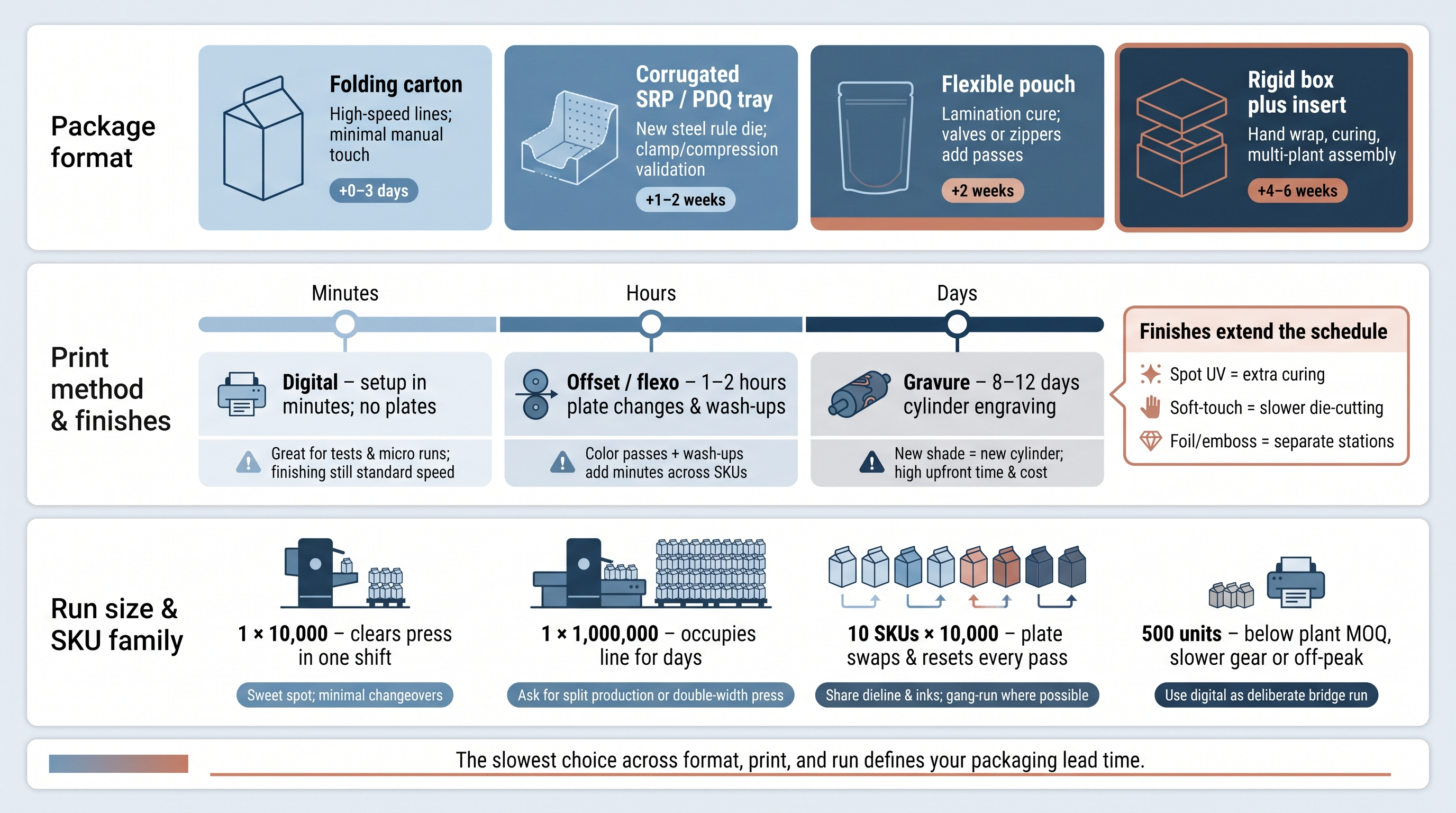
Print method and finishes
Process | Setup time* | Best for | Watch-outs |
Digital | Minutes; no plates | Tests, small runs, bridge orders | Unit cost climbs at scale; finishing still follows normal cadence |
Offset / flexo | 1–2 hours for plate change and wash-ups | Mid- to high-volume cartons, SRP | Each color pass plus wash-up adds minutes that multiply across SKUs |
Gravure | 8–12 working days to engrave and chrome-plate cylinders | Very long-run pouches, foil packs | New shade equals new cylinder; high upfront cost |
Finishes extend the schedule as well. Spot UV needs extra curing, soft-touch coatings dull blades and slow die-cutting, and foil or embossing adds separate stations with tight registration checks. Stack too many layers and a job that could ship in days slides into weeks. Choose the lightest finish that still wins at shelf.
Quantity and SKU count
Scenario | Why it slows the clock | Practical counter-move |
1 × 10 000 cartons | Clears the press in one shift; minimal changeovers | Ideal sweet spot; book an uninterrupted slot |
1 × 1 000 000 cartons | Occupies the line for days and bumps smaller jobs | Request split production or a double-width press |
10 SKUs × 10 000 each | Plate swaps, wash-ups, and color resets on every pass | Share the dieline and ink set; gang-run where possible |
500-unit micro run | Falls below the plant’s economic MOQ; ends up on slower digital gear or off-peak window | Use digital print as a planned bridge run |
Once a long run occupies a press for most of a shift, the smaller orders queued behind it slip. At the other extreme, micro runs under 1 000 units can wait days for a filler slot because they do not justify a plate change.
Keep your SKU family synchronized (same dieline, shared inks, aligned approval dates) and the press crew spends time printing, not juggling plate swaps.
Approval speed
Internal proofs often sit idle far longer than the sheets on press. Cway’s Packaging Artwork Approval Benchmark 2026 puts the average artwork-approval cycle at 24 calendar days. Trim that lag and you gain time no machine can create.
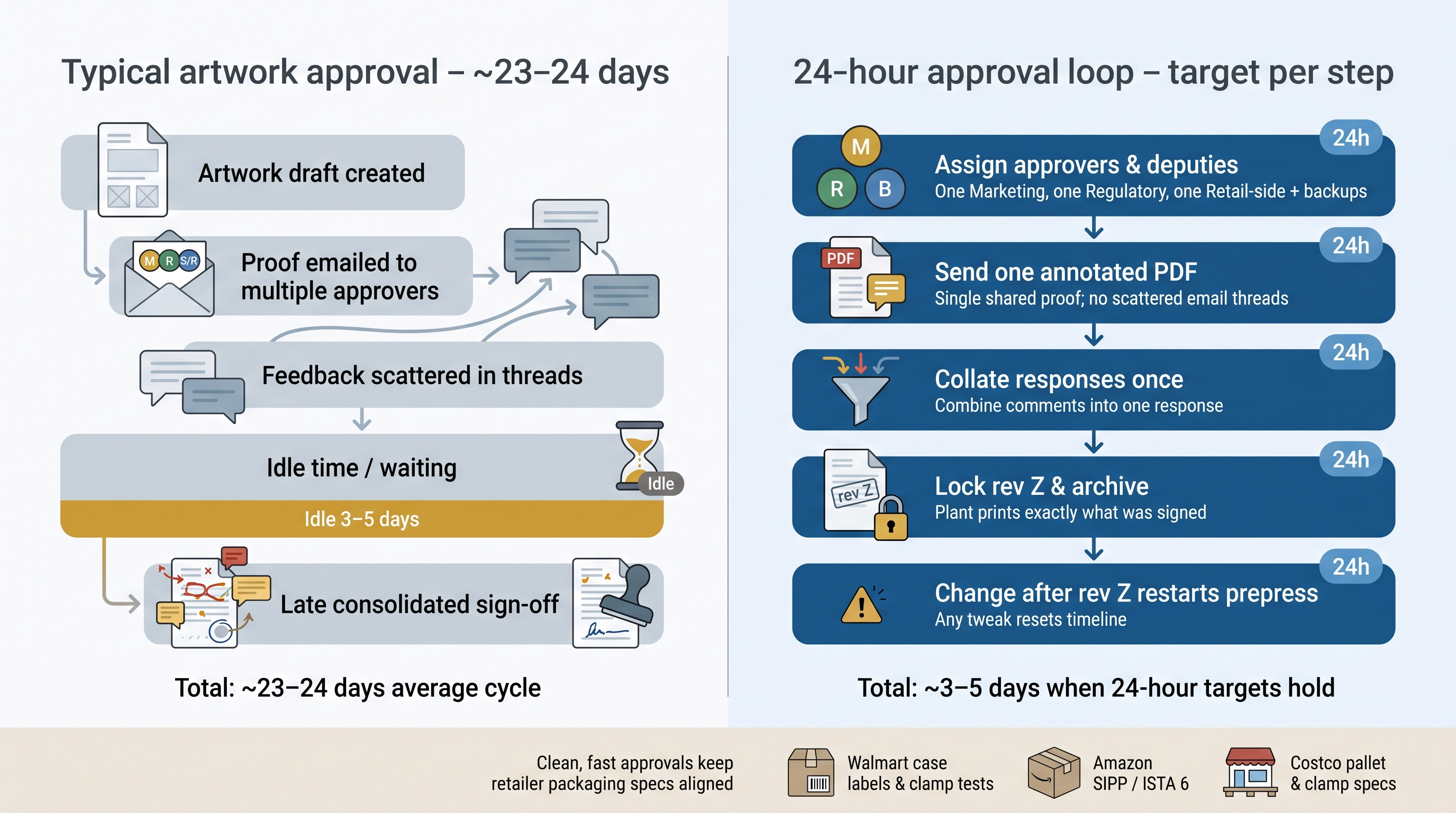
Make approvals a 24-hour sport
Step | Action | Backup plan |
Assign one Marketing, one Regulatory, and one Retail-side approver | Set a written 24-hour turnaround target | Name a deputy with authority to sign |
Circulate one annotated PDF (or online proof tool) | Collate comments into a single response | Escalate if silence exceeds 24 hours |
Lock changes into “rev Z” and archive | Plant prints exactly what was signed | Any post-rev tweak restarts prepress |
*Walmart
Walmart publishes a Supply Chain Packaging Guide twice a year, and each edition can change case-barcode, clamp-test, hazard-marking, RFID, and pallet-height rules. Before you commission plates:
• Download the current guide from Supplier Academy / Retail Link.
• Verify case-barcode placement and quiet zone.
• Check clamp-test dimensions and pallet-height maximum.
• Confirm whether your category now requires RFID.
• Lock those specs first and you avoid OTIF deductions later.
*Amazon
Amazon’s Ships in Product Packaging (SIPP) program (formerly SIOC) rewards cartons certified to ISTA 6 (self-test for most items, lab test for fragile or liquid products) with lower FBA and MCF fees. Your brick-and-mortar buyer, however, may not know or care about SIPP.
• Certify once for Amazon to avoid over-boxing and claim the fee discount.
• Then confirm that the same pack also meets the store guide: case labels, pallet pattern, shelf-facing graphics, and, if it’s Walmart, clamp-test performance.
Coordinate early so one design serves both channels; assuming overlap risks a last-minute reprint.
*Costco
Costco sells straight off the pallet, so your secondary pack is the display. Before you quote, make sure you:
• Visit Costco’s large-item handling and packaging page for clamp pressure, stacking, pictogram marks, and pallet specs.
• Run a compression plus clamp test that matches their forces; standard ECT is not enough.
• Keep graphics legible from 6 ft / 1.8 m because shoppers view the pallet, not the unit.
• Measure pallet height carefully; go an inch over and the load gets rebuilt on the dock.
Treat Costco as its own planet: stronger corners, tidy tear-aways, and shelf-distance legibility come first.
Rescue options when the deadline is impossible
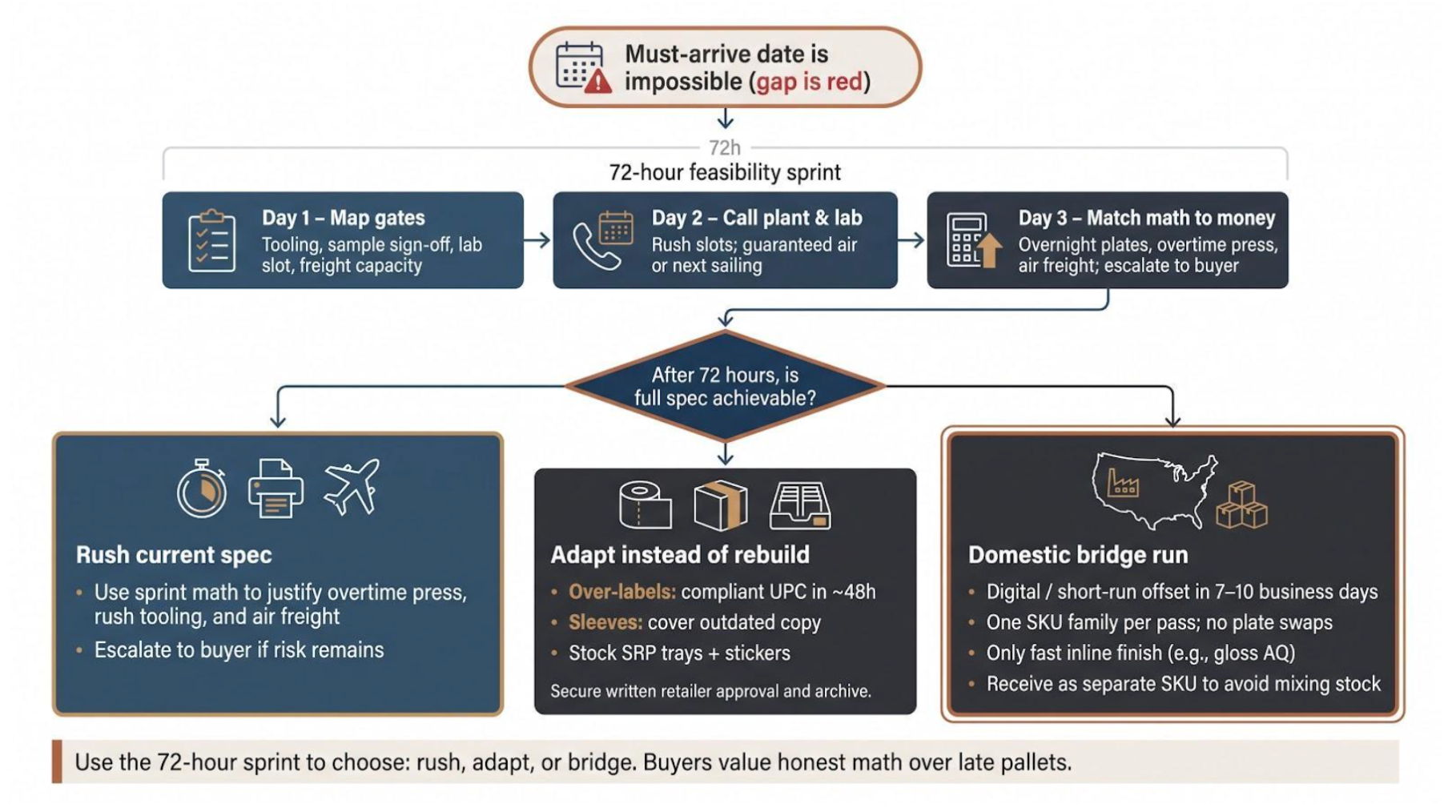
1. Run a 72-hour feasibility sprint
Day | What to confirm | Why it matters |
1 | Map every remaining gate: tooling, sample sign-off, lab slot, freight capacity | Turns panic into a data-backed critical path |
2 | Call the plant scheduler and lab for rush slots; ask the forwarder for guaranteed air or next sailing | Removes calendar fiction |
3 | Match math to money: overnight plates plus overtime press plus air freight; escalate to the buyer if the gap stays red | Decide whether to proceed, bridge, renegotiate, or decline |
2. Adapt instead of rebuild
• Over-labels add a compliant UPC in 48 h; many digital printers quote same-day proofs and 24-hour production for fewer than 5 000 labels.
• Sleeves cover outdated copy without touching the core box.
• Stock SRP trays with printed stickers pass a compression test and ship weeks sooner than custom dies.
• Secure retailer email approval first and archive it.
3. Order a domestic bridge run
Digital or short-run offset lines in the United States can ship cartons in 7–10 business days after art approval. Treat this as paid insurance, not the new norm.
• One SKU family per pass; no plate swaps.
• Only inline finishes the plant can run fast (for example, gloss AQ).
• Receive into a separate SKU so the 3PL does not mix costly bridge cartons with cheaper import stock.
Five FAQs every brand asks
1. How long does retail-ready packaging take after a PO?
Plan on 1–4 weeks for an exact reorder, 3–8 weeks for an artwork tweak, 8–14 weeks for a new shelf-ready tray, and 14–22-plus weeks when tooling, testing, or ocean freight join the project. These ranges bracket PackMojo’s 4-to-10-week planner and Logic Pac’s five-to-seven-month custom-packaging lead time.
2. Can my DTC mailer ship to stores?
Only if it passes clamp tests, carries a scannable UPC where the buyer wants it, and lands in a case pack that fits the planogram. Most brands add a secondary pack or tray instead of gambling on deductions.
3. Does Amazon SIPP certification satisfy Walmart or Target?
No. SIPP proves the box can ship without an Amazon over-box, but physical retailers judge shelf presence, case labels, pallet pattern, and sometimes RFID. Useful overlap; still separate approvals.
4. Is digital printing always faster?
Usually, but not always. Digital removes plate lead time and shines on small runs, yet lamination, die-cutting, and gluing follow normal factory cadence. Speed is real, just not magical.
5. What if the retailer’s must-arrive date is impossible?
Run a 72-hour feasibility sprint. If the math still fails, offer a bridge run, over-label, or revised ship window, backed by data. Buyers value honesty more than late pallets.
Conclusion & next step
Retail-ready packaging lead time is flexible but never infinite. After receiving a retailer purchase order, plan within four realistic timelines: 1–4 weeks for repeat orders, 3–8 weeks for DTC packaging adaptations, 8–14 weeks for new shelf-ready packaging, and 14–22+ weeks for complex projects.
To reduce packaging lead time and meet retail packaging requirements, lock specifications early, streamline approvals, and track the four critical timelines: retailer milestones, packaging production, finished goods, and logistics.
Want a clear view of your retail-ready packaging timeline? Build a simple PO-to-retail critical-path sheet, enter your key dates, and identify potential delays before they affect delivery. A well-planned packaging process helps ensure your products reach retail shelves on time.
Related Posts
- Running Age Checks on a Magento Store After Launch
- Adobe Commerce Website Development: Building a Connected B2B Purchasing Workflow
- Why Ongoing Magento Maintenance Matters for Growing eCommerce Stores
- Ecommerce SaaS vs Custom Ecommerce Software: Which Model Fits Enterprise Retail?
- Integrating Mini-Games into Magento 2 Mobile Apps to Boost Retention
- Why Your App Needs a Content Backend: Pairing Mobile App Development Services With a Headless CMS