



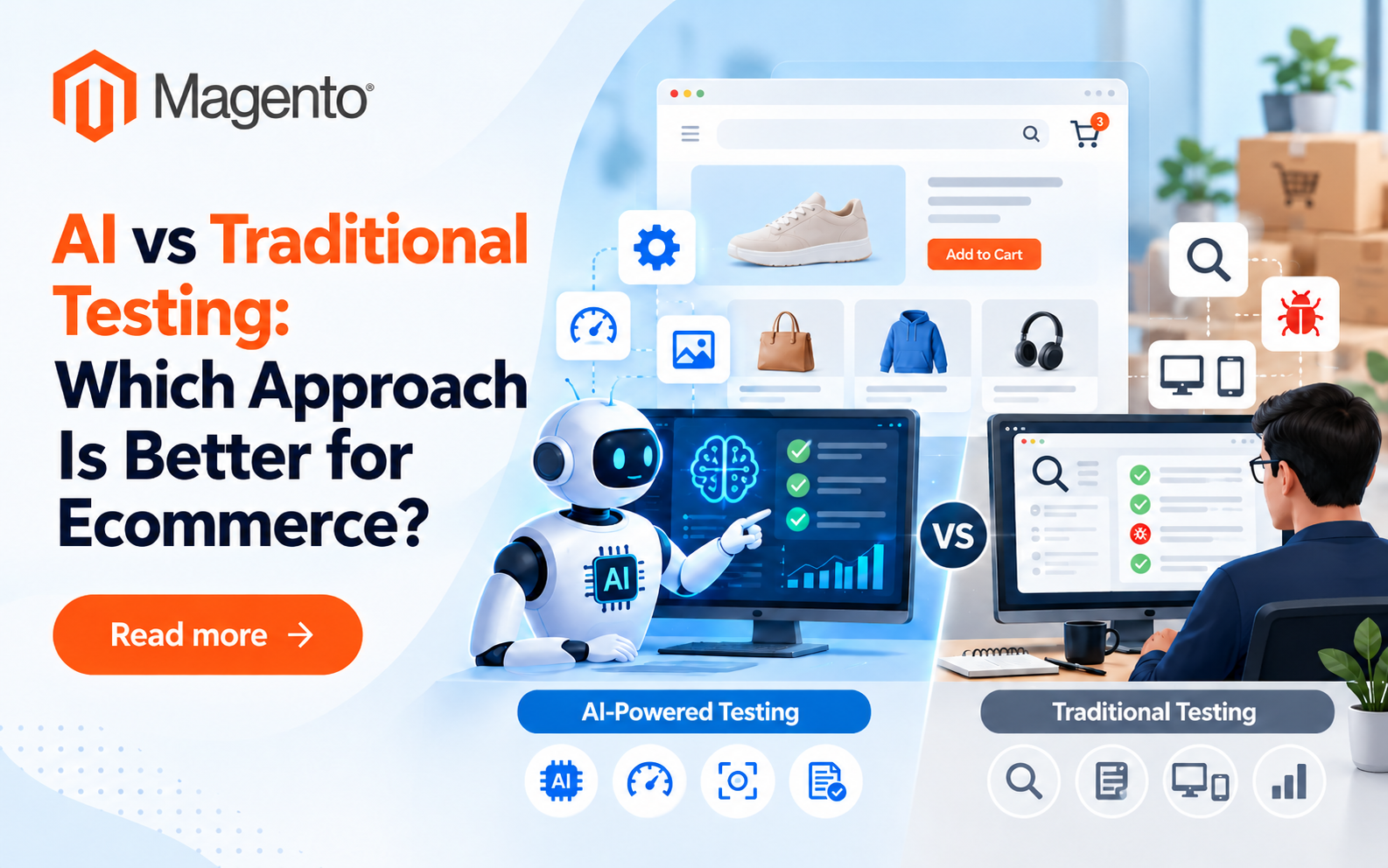
AI vs traditional testing is an important consideration for ecommerce teams because online stores combine predictable business rules with complex, constantly changing customer experiences. Ecommerce systems are awkward to test for one simple reason: some parts of the platform are completely predictable, while others are not.
A tax calculation should return the same result every time. A recommendation engine will not. Checkout has to behave consistently across browsers, devices, currencies, payment methods, shipping rules, and third-party integrations. Then there are promotions, inventory updates, account states, and all the edge cases that show up only when real users start clicking around.
That is why AI testing vs traditional testing is not really a winner-takes-all discussion.
Traditional testing is still the better fit for anything that needs a precise, repeatable outcome. AI becomes more useful when teams are dealing with too much variation, too many test combinations, or too much test data to review manually.
Traditional Testing Still Owns the Predictable Stuff
A large part of ecommerce quality assurance is still straightforward rule validation.
Say a promotion applies 15% off orders above $100. You test $99.99, $100, and $100.01 and check the expected result. The same applies to payment totals, tax rules, refunds, stock updates, order statuses, authentication, API responses, and coupon eligibility.
There is no real advantage in making those checks probabilistic.
If the expected total is $82.50, the test needs to confirm $82.50. If inventory should drop from five units to four after a purchase, that is exactly what should happen.
This is where traditional functional, integration, regression, and API testing remain hard to beat. They give teams clear evidence that core business logic is behaving as intended.
For software testing for ecommerce, that kind of certainty still matters a great deal.
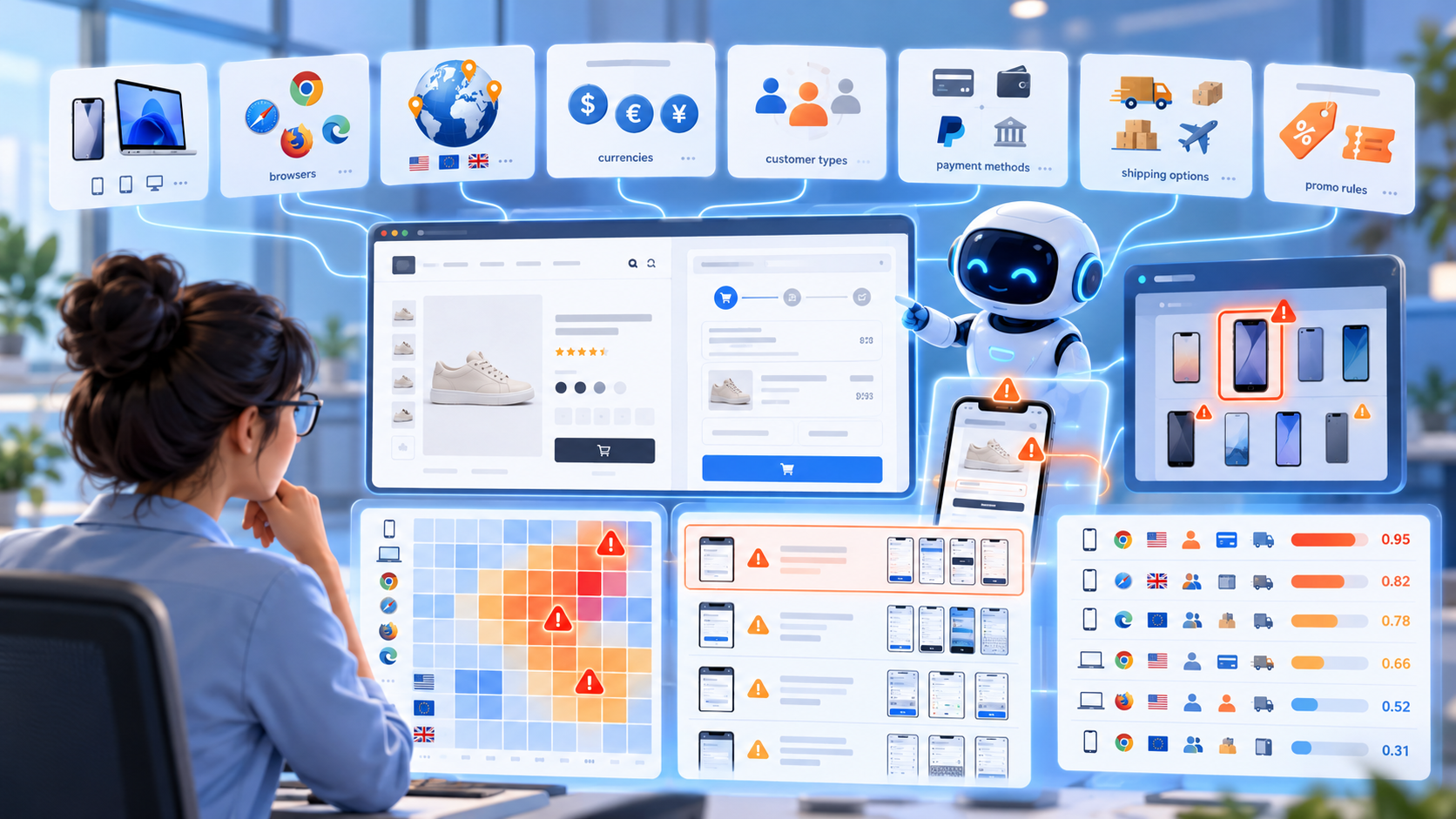
The problem starts when the number of possible combinations gets out of hand.
A large ecommerce platform may behave differently by device, browser, region, currency, customer type, payment method, shipping option, and promotional rule. Nobody has unlimited time to test every combination with the same level of attention.
This is where AI testing for ecommerce becomes genuinely useful.
Instead of trying to increase test volume for its own sake, AI-based tools can help identify where the risk is likely to be higher.
If previous checkout defects have clustered around guest users on mobile Safari using a particular payment provider, that pattern is worth knowing before the next release.
That is a much more useful application of AI than simply generating hundreds of additional test cases.
Test Design Is Faster, but It Still Needs a Tester
AI-assisted test generation is useful because it can widen the field quickly.
A tester looking at a loyalty feature might start with valid rewards, expired rewards, minimum spend, and discount caps.
A generative tool may also surface combinations involving gift cards, returns, currency changes, stacked promotions, or loyalty-tier upgrades.
Some of those suggestions will be worth keeping. Others will not.
The important part is that a tester still has to understand which scenarios reflect real business risk. More test cases do not automatically mean better coverage.
AI is useful here because it reduces the blank-page problem and speeds up scenario discovery. It does not replace product knowledge.
Regression Testing Has More of a Maintenance Problem Than a Coverage Problem
Most mature ecommerce teams already have regression suites.
The problem is that those suites grow.
New payment options arrive. Checkout logic changes. Search is updated. Product templates are redesigned. Promotions come and go. Tests that were stable six months ago may now fail because a selector changed or because an integration behaves differently.
This is one area where AI can save meaningful time.
It can help identify which tests are most relevant to a code change, flag flaky tests, group similar failures, and highlight areas of the suite that are producing more noise than value.
That fits well into a broader enterprise ecommerce quality engineering model, where testing is tied to release risk, integrations, performance, customer journeys, and production quality rather than treated as a last-minute checkpoint.
Visual Testing Is Where AI Makes Immediate Sense
Ecommerce is visual by nature, and visual defects are often surprisingly expensive.
A missing image, a hidden CTA, a broken mobile layout, or a price overlapping another element can damage conversion even when the underlying functionality is working perfectly.
Traditional screenshot comparison can catch these issues, but it tends to be noisy. Small pixel changes can trigger failures even when nothing meaningful has broken.
AI-based visual testing is better suited to separating harmless variation from genuine UI problems.
That is especially useful for storefronts running across multiple devices and browsers, where layout differences are expected, but serious rendering issues still need to be caught.
Exploratory Testing Is Harder to Automate Than It Looks
Some of the best ecommerce bugs come from questions nobody wrote into the test plan.
What happens if inventory changes while a shopper is checking out?
What if they apply a coupon, switch currency, and then apply it again?
What if the same cart is open on two devices?
What if payment succeeds, but order confirmation fails?
These are not complicated because the tools are difficult to use. They are complicated because they require context.
Experienced testers understand how the business works, how customers behave, and where systems tend to break. AI can suggest edge cases, but it does not always know which ones would actually matter to the business.
That makes exploratory testing one of the areas where human judgment still carries a lot of weight.
Security Still Needs Clear Answers
Security is another place where teams should be cautious about overusing probabilistic approaches.
Authorization, session handling, account isolation, payment controls, and API permissions need straightforward answers.
Can one customer access another customer's order? Yes or no.
Can a user perform an action outside their role? Yes or no.
AI may help generate attack scenarios, identify suspicious patterns, or prioritize findings. But the controls themselves still need repeatable technical validation.
For ecommerce systems handling customer and payment data, that distinction is important.
Performance Testing Is More About Interpretation
Load and stress testing already give teams objective data: response time, throughput, error rate, resource usage, and concurrency limits.
The harder part is often figuring out what caused the slowdown.
In a distributed ecommerce environment, one performance problem may involve several services at once. AI can help correlate logs, identify recurring patterns, and point teams toward likely bottlenecks faster.
That is a good example of AI in software testing working as an analysis layer rather than replacing an existing testing practice.
So, Which Approach Works Better?
It depends on what you are testing.
Traditional testing is still the stronger choice for exact calculations, business rules, security controls, API behavior, and repeatable regression checks.
AI is more valuable where teams need help with prioritization, visual analysis, large test spaces, failure clustering, or test-suite maintenance.
Teams looking at where these capabilities are heading can also review current AI trends in software testing, particularly around intelligent test selection, defect analysis, and maintenance.
For ecommerce teams, the smarter strategy is not to force AI into every part of QA.
Use it where scale and complexity create friction. Keep conventional methods where precision and repeatability are non-negotiable.
That usually leads to a much stronger testing setup than trying to replace one approach with the other.
Related Posts
- AI vs Traditional Testing: Which Approach Is Better for Ecommerce?
- What Does a Remote Software Engineering Intern Actually Work On?
- Best Software Marketing Tools Every SaaS Company Should Know
- What Developers Should Understand Before Moving an Ecommerce Store to the Cloud
- RWA Tokenization Platform Development Trends 2026: Technologies, Benefits, Costs & Business Opportunities
- What Essential Tools Do You Need for Road Trip Vlogging?