



Explore a step-by-step guide to AI MVP development for enterprises, including validation, budgeting, technology selection, and scaling strategies.

In today's world, the pressure to implement artificial intelligence in the main processes of enterprise workflows is immense. But in most cases, deploying at full scale often results in significant financial losses. That is why AI MVP development services are in high demand. In fact, the RAND Corporation study shows that 80% of enterprise AI initiatives fail to deliver the value they seek because they lack the necessary foundations.
To reduce these risks, many smart companies build AI MVPs to create lean prototypes that test business hypotheses before making a major investment, allowing them to determine the operational feasibility based on real-world data rather than projections.
What Is an AI MVP in Enterprise Product Development?
An AI MVP is a product developed to test a specific machine learning hypothesis and strategically limited in scope to avoid significant capital investment. The AI MVP development strategy differs from the traditional approach. Traditional software is developed using deterministic logic, and AI systems deal with probabilistic results, data pipelines, and ongoing model improvements.
This validation step is increasingly important. According to McKinsey & Company, 88% of organizations use AI, but only 33% have successfully scaled it beyond the pilot stage.
The system needs to have a user interface (UI) that is both business value-oriented and built on top of a secure data ingestion infrastructure. For instance, an e-commerce enterprise can create an MVP that is just for predicting stocking or routing support without automation. This initial scope is limited to design teams and stops them from over-engineering complex architectures without verifying real market demand.
Step-by-Step Process to Build an Enterprise AI MVP
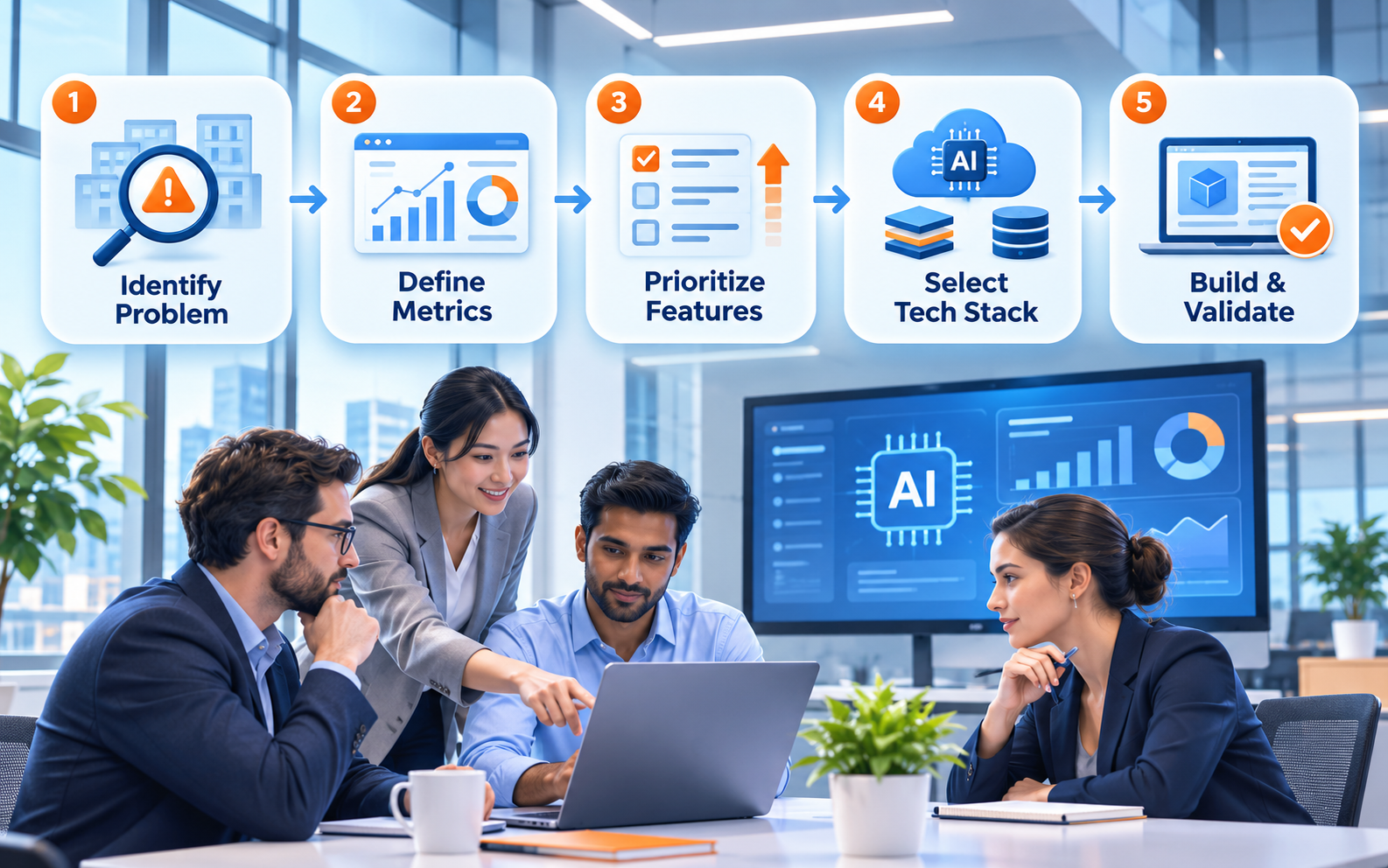
To ensure your validation phase doesn't lead to technical debt, it is essential to have a structured & repeatable framework. In enterprise settings, data governance, infrastructure scalability and business alignment have to be carefully considered from the get go.
Identify High-Impact Business Problems
The starting point for an effective AI project is to define a challenging business process with an existing pain point that is suitable for automation, prediction, or generation. Organizations often pick a problem that is too big to solve in an MVP or too simple to solve and not worth investing in.
Prioritize areas with enough historical data and where cognitive automation can significantly reduce the operational overhead. Similarly, using intelligent systems in customer touchpoints changes user interaction. For instance, specialized AI and Chatbots in eCommerce Customer Service have proven effective in handling intricate data pipelines and automating high-volume customer interactions for live production environments.
Define Success Metrics
Before you start coding anything, set clear metrics to measure the prototype’s performance. These metrics should measure engineering parameters and other business outcomes in order to give a comprehensive picture of the effectiveness of the system.
• Technical Metrics: The data latency, model inference speed, precision, recall, and F1-score need to be defined at acceptable levels for enterprise workloads to ensure that the technical infrastructure does not suffer from system degradation.
• Business Metrics: This includes measurable cost savings related to the operations, reductions in employee time on repetitive tasks, impact on retaining the users, and direct improvements in customer satisfaction scores.
Prioritize Core AI Features
Feature bloat is the biggest enemy when creating an MVP AI infrastructure. All potential capabilities should be classified based on prioritizing techniques such as the MoSCoW method (Must have, Should have, Could have, Won't have). The core functionality should focus on the main problem identified in the first step, and the secondary functionality and advanced visual dashboard should be documented for subsequent phases of development. By maintaining the initial scope, time-to-market is accelerated, and engineering teams can focus on the core algorithmic thesis.
Select AI Technology Stack
You need the best foundational technologies for your product to scale better in the future. The typical tools and services that most companies use to create an AI MVP are cloud infrastructure, machine learning frameworks, and data management tools.
• Amazon Web Services (AWS) and Google Cloud Platform (GCP) offer infrastructure to develop managed artificial intelligence (AI) solutions.
• Businesses tend to use large language models like OpenAI, Anthropic, and Cohere for AI capabilities or opt for frameworks like PyTorch, Hugging Face Transformers, and Scikit-learn for custom workflows.
• To support retrieval-augmented generation (RAG) and real-time data access, organizations also use vector databases like Pinecone, Milvus, or Weaviate to store embeddings and retrieve relevant information efficiently.
Build Prototype and Validate
The engineering team sources the stack, constructs the basic pipeline, links the user interface to the model endpoints, and then makes a controlled release. Validation should be done in a structured way, starting from the internal stakeholders and then to a closed set of trusted enterprise clients.
Collect both quantitative and qualitative data relating to usability, model drift & edge case exceptions. This feedback loop is most important to determine if the product needs a new structural change, also a slight tuning of the algorithm or a go/no-go decision for full scale development.
Cost Breakdown of Enterprise AI MVP Development
The first step in creating an AI MVP is to comprehend the budget involved to make the idea a reality. The prices of enterprise AI MVPs vary from $30,000 to $100,000 or even higher, depending on the complexity of the solution. With AI's continued expansion, Gartner projects that global AI spending will hit $2.52 trillion, and AI development cost planning is a key consideration for any AI project.
The majority of the budget for AI MVPs goes into these key categories:
Preparing data for the project can typically take up 25% of the budget. This involves arranging information from various sources, cleaning up data, removing sensitive information when required, and creating secure systems to store and manage data in line with GDPR and CCPA regulations.
40% of the budget is typically spent building the solution itself. That includes the effort put in by AI experts, software developers, and technical architects to build this MVP, integrate it with the business system, fine-tune its functionality, and build the first user experience. This is when the concept becomes a tangible item and can be a major portion of the investment.
The rest of 20% goes towards infrastructure. AI applications can be quite resource-intensive to train, test, and deploy, necessitating a considerable amount of cloud computing, storage, and processing power.
Project Management and Quality Assurance takes 15% of the budget. This covers full management of the product to meet initial business requirements, including complete security audits, integration tests, and agile structured project delivery.
By investing in these early phases, businesses can avoid costly AI implementations that may not yield the desired results. This also provides a better base level for future development. It's like Proactive Growth with AI Predictive Analytics, where enterprises begin with small-scale predictive models and grow them into more comprehensive and impactful solutions over time.
Conclusion: Why AI MVP Development Services Matter
By adopting professional AI MVP development services, modern enterprise organizations have a guided path with low risk towards successful digital transformation. The MVP approach allows teams to test the technical architecture, gauge customer interest, and set realistic budget limits with actual information. This prevents investing millions in an unverified and broad AI solution.
Enterprises can do this by leveraging key business friction points, adopting an agile technology stack, and sticking closely to the metrics for success. So that they can take their AI initiatives from proof-of-concept to production-grade, transformative applications.
Related Posts
- How to Choose the Right iOS App Development Company
- AI MVP Development for Enterprises: A Guide Before Full-Scale Launch
- Best Email Marketing Agencies for Established Fashion and Apparel Brands
- Product Video for a Magento Catalogue From One Still: Nine Tests With Seedream 5.0 Pro and Veo 3.1 on a Table Lamp
- How Digital Booking Systems Are Modernizing Wedding Transportation
- AI in Logistics: Practical Ways to Improve Supply Chain Efficiency