



Discover how AI in logistics improves supply chain efficiency through demand forecasting, route optimization, warehouse management, and predictive maintenance.
Logistics has always been a coordination problem.
A shipment can leave the warehouse on time and still arrive late because of traffic, weather, port congestion, or a missed handoff. A warehouse can hold enough stock overall and still run out of the one item customers suddenly want. A carrier may have available capacity, but poor planning can leave trucks running half-empty.
These are not new problems. What has changed is the amount of data available to manage them.
That is where AI in logistics is becoming useful. Rather than replacing planners, dispatch teams, or warehouse operators, AI helps them make faster decisions using demand data, shipment histories, traffic conditions, inventory movements, and operational patterns that would be difficult to process manually.
The biggest gains usually come from applying AI to specific bottlenecks rather than treating it as a broad automation project.
Better Demand Forecasting Means Fewer Inventory Surprises
Forecasting is one of the most practical uses of AI in supply chain management.
Traditional forecasting often relies heavily on historical sales averages and seasonal trends. That works reasonably well until demand changes suddenly because of promotions, weather, regional events, pricing changes, or shifts in customer behavior.
AI-based forecasting can consider more variables at the same time and update predictions as new data arrives.
For example, a distributor may use historical order volume, lead times, regional demand, promotions, and supplier performance to estimate how much stock each location will need over the next few weeks.
That improves supply chain optimization in two ways: fewer stockouts and less unnecessary inventory.
The value is not just in predicting demand more accurately. It is in giving planners earlier warning that something is changing.
Route Planning Can Be Updated While Vehicles Are Already Moving
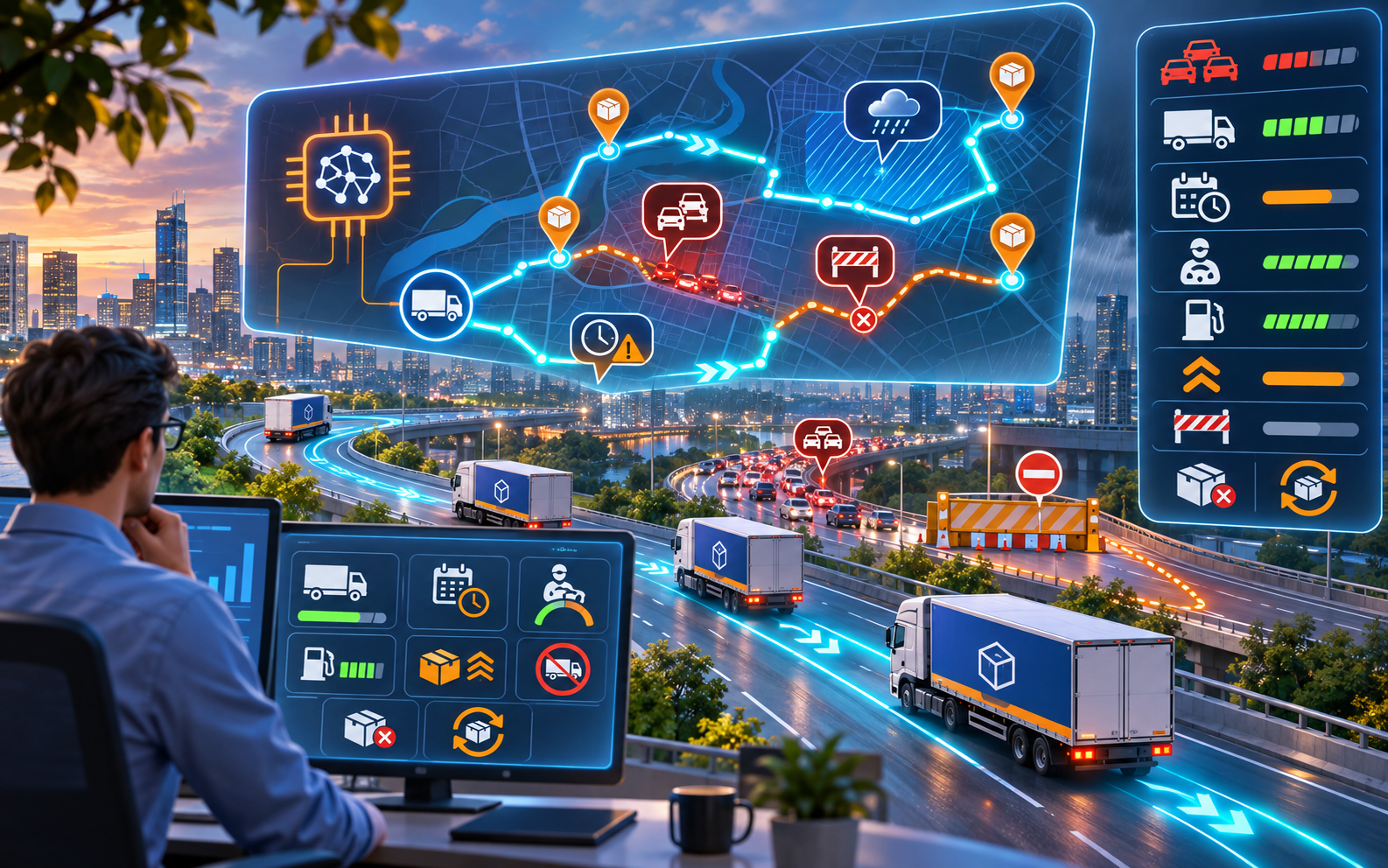
Static route planning has obvious limits.
A route that looked efficient at 7 a.m. may become a poor choice by 10 a.m. because of road closures, congestion, weather, delivery delays, or a customer changing the delivery window.
Route optimization using AI can continuously evaluate those changes and recommend better sequences while deliveries are in progress.
A useful system might consider:
Current traffic
Vehicle capacity
Delivery windows
Driver hours
Fuel consumption
Stop priority
Road restrictions
Failed or rescheduled deliveries
For a fleet handling hundreds of daily stops, even small improvements in route efficiency can reduce unnecessary mileage and improve on-time delivery.
The important point is that the system should optimize for business priorities, not distance alone. The shortest route is not always the best route if it causes missed delivery windows or overtime elsewhere.
Warehouses Can Use AI to Reduce Travel and Waiting Time
A lot of warehouse inefficiency comes from movement.
Workers walk between storage locations. Forklifts travel unnecessary distances. Fast-moving products are stored too far from packing areas. Picking sequences are not always optimized.
Smart warehouse management uses data to improve these decisions.
AI can analyze order frequency, product relationships, storage capacity, picking times, and replenishment patterns to recommend better slotting.
If two products are frequently ordered together, storing them closer may reduce picking time. If an SKU is suddenly moving faster than normal, the system can recommend relocating it to a more accessible area before the next shift becomes overloaded.
AI can also support labor planning by predicting where workload will increase and when additional staff may be required.
These are relatively small operational changes, but across thousands of orders they add up.
Predictive Maintenance Can Prevent Avoidable Disruption
A conveyor, forklift, refrigeration unit, or sorting system does not have to fail completely before it starts creating problems.
Equipment often shows warning signs first: unusual vibration, temperature changes, slower cycle times, increased power consumption, or repeated minor faults.
Predictive analytics in logistics can use this operational data to identify patterns associated with failure.
Instead of maintaining equipment only on a fixed schedule or after something breaks, teams can intervene when the data suggests a component is deteriorating.
That matters because equipment downtime has knock-on effects. A failed conveyor may delay picking, which delays loading, which causes a missed dispatch window.
Predictive maintenance is therefore not only an engineering benefit. It supports broader logistics efficiency improvement by reducing unexpected interruptions.
AI Can Improve Load Planning and Asset Utilization
Trucks, containers, and storage space are expensive when they are underused.
One of the less visible applications of AI in logistics management is better capacity planning.
AI systems can analyze shipment size, weight, destination, delivery priority, vehicle capacity, and available routes to improve load consolidation.
That can help reduce partially filled vehicles or unnecessary trips.
The same principle applies to warehouse space and container usage. If planners can see upcoming demand and shipment patterns more clearly, they can allocate capacity earlier instead of reacting when constraints become urgent.
This is an area where AI-powered logistics software can make a measurable difference because it connects operational planning with real demand and movement data.
Exception Management Is Where AI Can Save Time
Logistics teams spend a surprising amount of time dealing with exceptions.
A shipment is delayed. A carrier misses pickup. Inventory is not where the system expected it to be. A delivery window changes. A customs document is incomplete.
Not every exception needs the same level of attention.
AI can help classify issues by urgency, likely impact, and available response options.
For example, a two-hour delay on a low-priority replenishment shipment may require no action. The same delay on a temperature-sensitive delivery or a production-critical component could require immediate escalation.
Instead of presenting planners with a long queue of alerts, AI can help surface the handful that actually need intervention.
This is often a better use of logistics automation solutions than trying to automate every operational decision end to end.
Supplier and Carrier Performance Can Be Assessed More Accurately
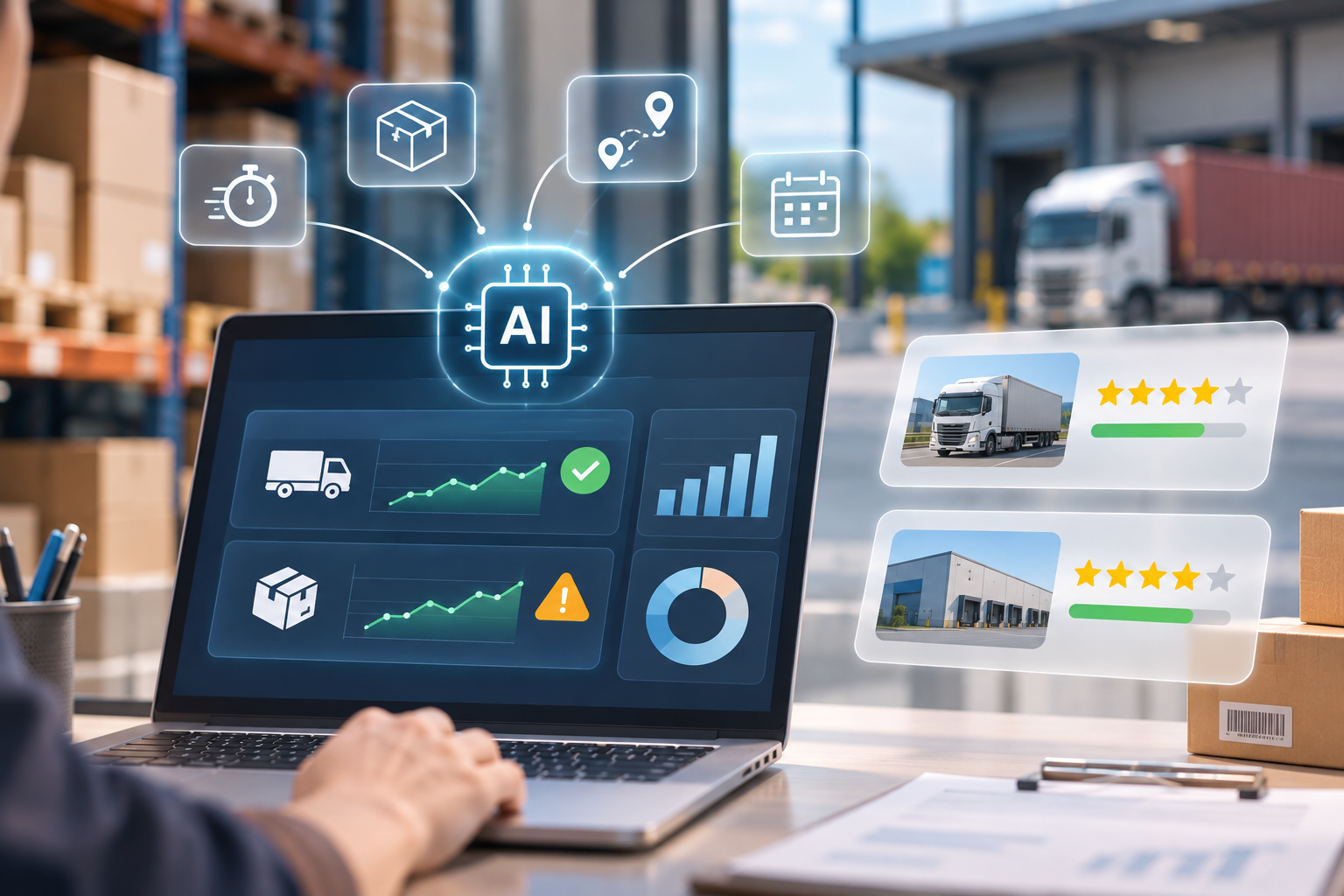
Supplier and carrier evaluation is often based on broad metrics such as on-time delivery percentage.
That number alone can hide important details.
A carrier may perform well on short regional routes but poorly on cross-border shipments. A supplier may be reliable most of the year but consistently struggle during peak season.
AI can analyze performance at a more granular level, including lead-time variability, damage rates, missed pickups, route type, seasonality, and exception frequency.
Procurement and logistics teams can then make decisions based on the type of work being assigned rather than one overall score.
This improves both supplier selection and risk management.
AI Works Best When the Operational Data Is Good
There is an important limitation to all of this.
AI cannot fix poor logistics data.
If inventory records are inaccurate, delivery timestamps are inconsistent, or carrier status updates are missing, the resulting recommendations will be unreliable.
Before implementing AI-powered logistics software, organizations usually need to improve data quality, system integration, and visibility across transportation, warehouse, inventory, and order-management systems.
It is also worth starting with one measurable problem.
Reducing empty miles, improving forecast accuracy, lowering picking time, or reducing delivery exceptions are better starting points than a vague objective to “use AI across the supply chain.”
Clear operational targets make it much easier to judge whether the technology is actually helping.
The Real Value Is Better Decisions, Made Earlier
The strongest use cases for AI in logistics are not necessarily the most futuristic ones.
They are the situations where operations teams already have the data but not enough time to interpret it quickly.
Better forecasts can improve inventory decisions. Dynamic routing can reduce delays. Smarter warehouse planning can cut unnecessary movement. Predictive maintenance can prevent disruption. Better exception handling can keep planners focused on issues that genuinely need attention.
That is where AI contributes to supply chain efficiency.
Not by removing people from logistics operations, but by giving them earlier signals, better options, and more time to act before a small problem becomes an expensive one.
Related Posts
- Product Video for a Magento Catalogue From One Still: Nine Tests With Seedream 5.0 Pro and Veo 3.1 on a Table Lamp
- How Digital Booking Systems Are Modernizing Wedding Transportation
- AI in Logistics: Practical Ways to Improve Supply Chain Efficiency
- E-commerce Testing Checklist: 12 Things to Test Before You Launch
- Wayfront vs Clinked vs Moxo: Best Agency Client Portals
- Running Age Checks on a Magento Store After Launch