



Discover why a business website design agency outperforms a freelancer for complex projects. Learn the key differences, benefits, and what to evaluate before hiring.
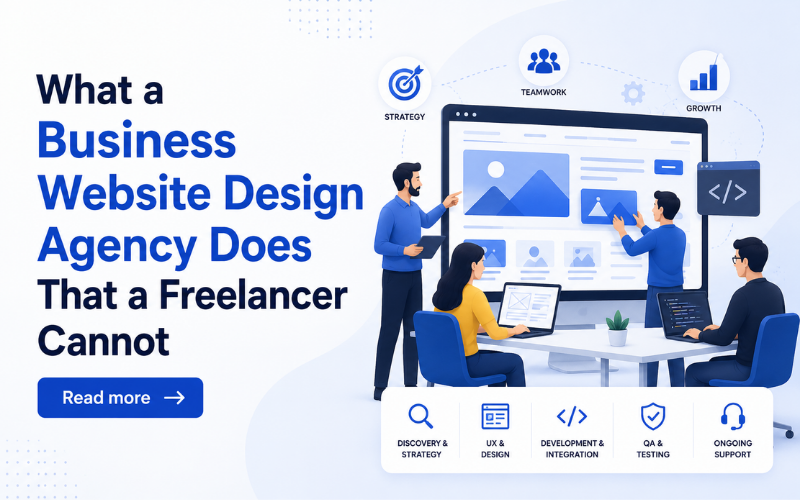
When a company scopes a new website, the decision usually gets framed as a budget question, agency versus freelancer, and which one costs less. But that framing kind of misses the real difference. What actually separates the two isn’t even price so much; it’s structure. It’s the range of abilities in the room, the capacity to run multiple initiatives at the same time, the accountability that’s baked into the process, and what happens after launch when something breaks or when the business suddenly needs to scale up.
A freelancer, even supposing they're very talented, is largely one character with one package of strengths and a constrained, limited variety of hours. A business website design agencyis a system: strategists, designers, developers, QA, and undertakingcontroloperatingin opposition to a shared process. For a landing page or a personal portfolio, that difference barely shows up. For a company site that has to support pipeline generation, credibility, search visibility, integrations, and long-term growth… It matters a lot.
The Real Constraint With Freelancers Isn't Skill, It's Structure
This is an important factor in how to evaluate a business website design agency before signing. Instead of hinging everything on one person’s expertise, a solid agency assembles specialists in strategy, UX, visual design, development, SEO, and project management, so every phase gets handled with the kind of depth and coordination complex sites actually require. That also means predictable trouble spots across most projects, beyond a simple brochure-type setup, include:
Discover why a business website design agency outperforms a freelancer for complex projects. Learn the key differences, benefits, and what to evaluate before hiring.No structured discovery phase
Freelancers often jump from a kickoff call straight to wireframes because “proper discovery” stakeholder interviews, competitive analysis, and information architecture takes time. And at that time, they can’t bill as efficiently as a solo operator, you know.
• No second opinion on decisions
When just one person makes every call, there’s no real internal pushback on weaker choices. Agencies build review cycles on purpose, so ideas get pressure-tested before they ever reach the client.
• Fixed, non-negotiable capacity
If a freelancer gets sick or simply underestimates the scope, the timeline slips, and that’s basically it- no fallback. An agency can shift resources around the team when priorities change.
• Little to no post-launch support
A lot of freelance work wraps up at launch. Bug fixes and the next round of iterations turn into a “new” negotiation instead of being a built-in part of the relationship.
None of this indicates freelancers are a terrible choice, now no longer really. For smaller, low-complexity websites, they are able tofrequentlysupply the quickest and most cost-effective solution, sure. However, the business website design agency versus freelancer for complex projects decision usually tips toward an agency, mainly because there are multiple stakeholders, system integrations, ongoing iterations, or strict brand governance in the mix, and that kind of work needs broader expertise plus coordinated execution.
The Strategic Value a Business Website Design Agency Brings

One of the most important misconceptions is that an employer's price is most effective in layout quality. In reality, what a business website design agency delivers beyond visual output is strategic planning, persona research, stakeholder alignment, technical collaboration, and scalable structures that clearlyhelp long-term growth, now no longersimplyjust visuals.
• Strategic discovery that shapes the entire build
Before any screen even gets designed, a competent agency translates business goals into user behavior, figures out who the site needs to convert, what objections it should pre-empt, and how the whole thing plugs into the broader funnel. That layer sets the structure really early, long before visual design starts, and it’s also the layer freelancers most often squeeze under time pressure.
• Information architecture built for scale, not just launch
Business websites rarely stay still. New product tracesdisplay up, content materialclasses expand, and different departments make new requests. Agencies install the underlying structure, navigation logic, content material models, and templating so it maytake in that boomwhile not having a whole rebuild eighteen months later.
• Design systems instead of one-off pages
Instead of crafting every web page from scratch, many businesses grow to be with a component-based layout machine thingy: reusable pieces, uniform spacing and typography rules, plus a visible vocabulary that continues going throughout dozens of pages without sliding into random inconsistency. That's usually where the gap with freelance work becomes kinda obvious, just not instantly, more like it shows up over time.
• Development that anticipates integration needs
Most business sites eventually have to talk to CRMs, marketing automation stacks, payment services, or even internal tools. Agencies typically assign both front-end and back-end engineers who think about those connections early, not as a “we’ll glue it on later” situation.
• QA is a formal process, not an afterthought
Cross-browser checks, accessibility compliance, and responsiveness across different device sizes - those aren’t optional extras in an agency workflow. When there is pressure, QA is often the first item a solo freelancer squeezes, even if the goal is still good.
• Project management that keeps stakeholders aligned
Business websites rarely have just one decision-maker. Marketing, sales, leadership, and sometimes legal all want to weigh in. Agencies use a more structured set of review loops to gather and consolidate feedback so the project doesn’t stall, whereas a freelancer handling communication alone is usually less equipped for that kind of smooth coordination.
How Arounda Approaches Business Website Design
Arounda works as a design and development partner on modernizing large-scale digital platforms. For over 10 years, the employer has brought 350+ platform tasks for business company teams, SMEs, and Fortune 500 brands, blending methods with layout and engineering in a single room so middle structures get stronger, the person's enjoyment improves, and platform performance remains simpler to run long-term, even at scale. The emphasis throughout the whole thing remains on results you could definitely measure, plus adoption, scalability, performance, and operational impact, now no longer simply the visible output alone.
And yeah, that emphasis shows up in what clients say they got: engagement jumping by as much as 170% thanks to structured user journeys, revenue growing 4.6x after a platform redesign, usability up by 45% inside company settings, and brand trust perception rising 53%. Global names like Universal Music, WordPress, Chalhoub Group, Greif, Myso Finance, and Player's Health have partnered with Arounda to evolve their digital platforms, bit by bit, then all at once.
Arounda’s core knowledge covers product design with a strategic read on future growth, company UX and platform modernization, design systems that work for multiple teams, legacy system redesign plus workflow optimization, brand and interface evolution that supports trust-driven digital platforms, and front-end development along with technical support for scalable web and mobile platforms. What clients end up with from this mix is end-to-end execution, strategy, design, and development as one continuous flow (instead of a handoff between disconnected vendors), plus industry-specific know-how, global insight that matches local market understanding, a stable focus on results tied to business goals, and a longer-term product partner that stays around after launch rather than disappearing right after delivery.
"The biggest difference between working with a single freelancer and a full team isn't speed, it's coverage," says Vlad Gavriluk, CEO & Founder of Arounda. "A freelancer can design a gorgeous page, but what they usually can't do solo is reason about the SEO architecture, the CRM integration, the accessibility requirements, and the content model all together, because that's not one job, it's four or five specialized ones running at the same time. This is the layer businesses tend to underestimate until they’re already mid-project with a freelancer, and then they realize that half of the work was never properly scoped."
For businesses looking at a business website design agency for a bigger or higher-stakes project, Arounda’s process just uses that same strategy-first method it runs across its company platform work: first, it maps business goals and user needs before design starts, then it keeps the same team with you through design systems and development end to end, instead of chopping the project up across disconnected specialists.
When to Hire an Agency Over an In-House Team

Another common question is when to hire a business website design agency over an in-house team. An in-residence organization suits fine whilst a corporation has ongoing, high-extent layout and improvement tasks. But a company is regularly the more budget-friendly route for constructing or redoing a website, due to the fact that it may deliver specialised knowledge without the long-time period overhead that includes hiring and dealing with a full-time team.
A company offers you admission to an entire multidisciplinary team, without the constant fee of retaining all of us in the workforce full-time, which feels more applicable when you're doing a primary remodel or platform modernization. This kind of work needs a wide range of skills for a defined stretch of time, not like a permanent internal group. Once the site calms down and moves into a maintenance rhythm, a lot of companies switch toward a smaller in-house or at least mixed support approach. That’s one reason a longer agency partnership often does better than a one-off project handoff.
What to Look for Before Signing With Any Agency
• Ask to see the discovery process, not just the portfolio
A polished portfolio can show you what the agency creates visually, but it won’t show you how they reason. Ask how they convert business goals into site structure, and how they manage contradictory stakeholder feedback, even when it gets messy.
• Check whether design and development sit under one roof
If the agency farms out development to a different vendor, you often get a coordination gap. That gap shows up as uneven execution or deadlines that slip for reasons that feel “somewhat avoidable”.
• Look for relevant case studies, not just impressive ones
A gorgeous site in an unrelated field is interesting, but it tells you less than a project that tackled the same structural complication you’re facing now, like similar content patterns or navigation constraints.
• Ask what happens after launch
Support after launch, plus how fast they respond when something breaks or underperforms, usually says more about the relationship quality than any slide deck ever will.
• Confirm how they handle multiple stakeholders
Ask how feedback loops are organized and how they resolve conflicting input across teams and departments. If the agency can explain this cleanly, it’s a pretty good sign they’ve dealt with it before.
Jeffrey Zeldman, one of the founding figures of modern web standards, has made the point that a website is never just a visual artifact; it’s really a system that keeps working as content, teams, and business needs shift around. That's the standard a business website design agency with strategy and development under one roof should be evaluated against. By combining strategic planning, UX, design, and technical execution inside one team, organizations are bettergeared up to supply scalable digitalsolutions than a unmarried freelancer running in isolation.
FAQ
When does a business actually need a web design agency over a freelancer?
A business should think about an agency when the work brings in multiple stakeholders, needs more intricate integrations, or depends on long-term growth. If the job is smaller, more straightforward, like a quick build, an experienced freelancer can be the more efficient route.
What does a business website design agency include that freelancers typically skip?
Agencies often cover discovery and strategy, build a design system, handle development, run QA, include accessibility testing, and keep everything organized with structured project management. Those steps usually help with consistency, scalability, and smoother teamwork through the whole effort, even when decisions get “busy”.
How do you evaluate a business website design agency before committing?
Don’t stop at the portfolio. Ask how they run discovery, how their team is set up, what kind of similar projects they’ve done, and what happens after launch. Strong agencies can lay out their workflow clearly, and they’ll share relevant case studies that match your situation.
What is the typical timeline for a business website design project with an agency?
Most custom business website projects land around 8–16 weeks, but it depends on scope and technical complexity. Company builds, especially with multiple integrations and stakeholder groups, usually stretch out longer because the coordination takes time.
How do agencies handle business website design for companies with multiple stakeholders?
They use structured workflows with defined feedback stages, plus a clear approval path. That keeps the project moving and reduces the chances of endless revision cycles. It also helps everyone stay aligned without the process getting chaotic or too scattered across emails and calls.
Related Posts
- What Developers Should Understand Before Moving an Ecommerce Store to the Cloud
- RWA Tokenization Platform Development Trends 2026: Technologies, Benefits, Costs & Business Opportunities
- What Essential Tools Do You Need for Road Trip Vlogging?
- How Do You Choose an Electronics Manufacturing Partner for Your First Product?
- What Documents Should You Request With Custom Electrical Components?
- What Should You Include in a Realistic Budget for a Custom Electronic Product?