


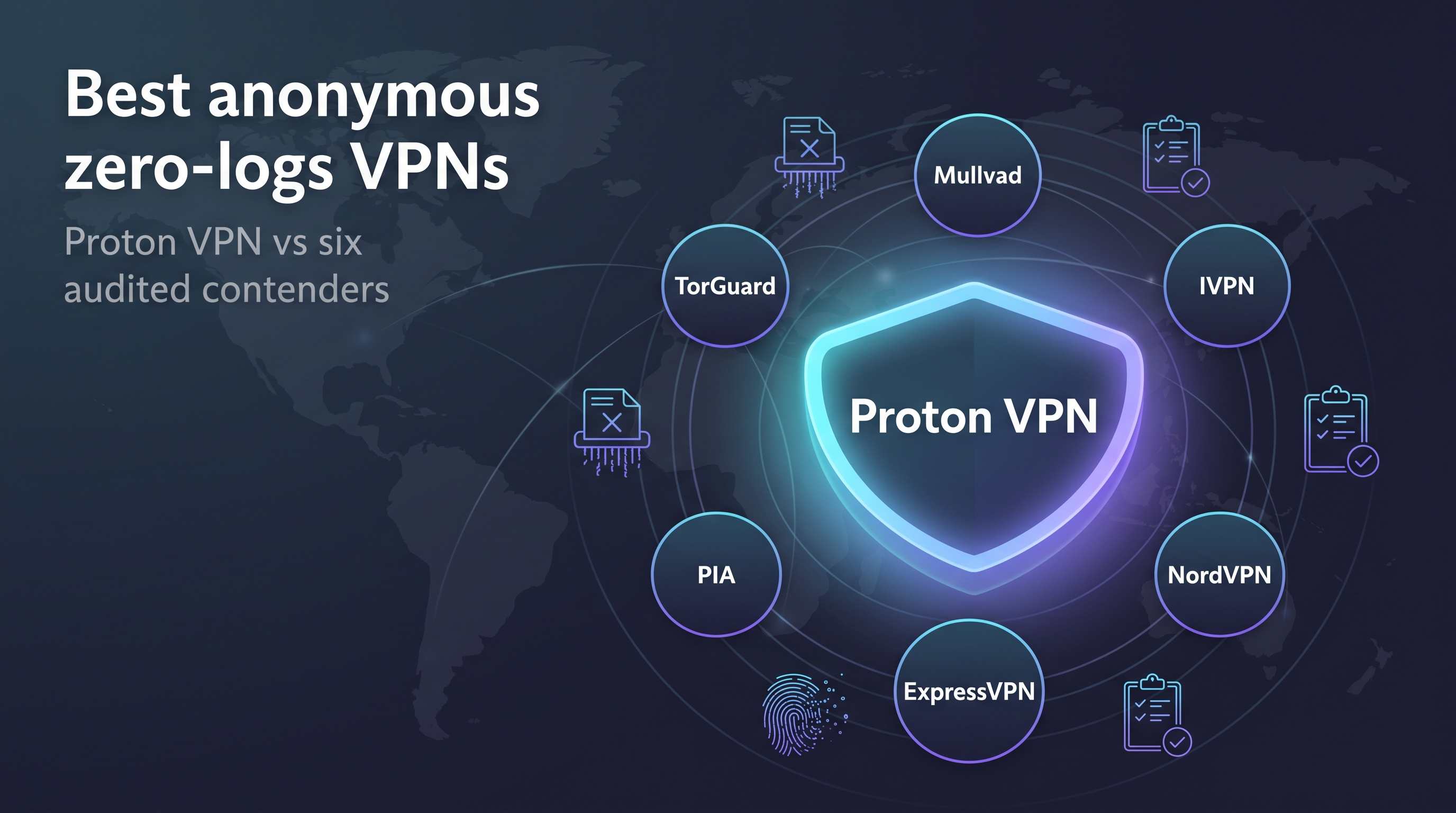
You’re here for the best anonymous VPN with a zero-logs policy—one that stores zero traffic records, zero IP stamps, zero breadcrumbs. After combing through audit PDFs, court filings, and pricing fine print, we landed on a clear winner: Proton VPN. Five consecutive third-party audits, all published in full, validate its no-logs promise. Still, threat models differ. We stacked six rivals against it, weighing cash payments, email-free signup, dedicated IPs, and more. The next table shows which service aligns with yours.
Quick answer: Which zero-logs VPN is best?
Proton VPN is the safest all-round pick. Five consecutive no-logs audits—the most recent a 2026 Securitum audit published in full—confirmed that it stores no traffic or connection records.
If signup anonymity matters more than server count, choose Mullvad. According to a Mullvad blog post, Swedish police left empty-handed after an April 18 2023 warrant.
Developers who need port forwarding or a dedicated IP can turn to TorGuard. According to TorGuard’s privacy policy, its zero-logs stance rests solely on its own statement; no independent infrastructure audit was public as of October 13 2026.
The remaining four services cover speed, budget, multi-hop chaining, and ease of use. We’ll compare all seven side by side next so you can match the best anonymous VPN with a zero-logs policy to your exact threat model.
At-a-glance comparison
Before we review each provider in detail, here’s the evidence and pricing snapshot you asked for.
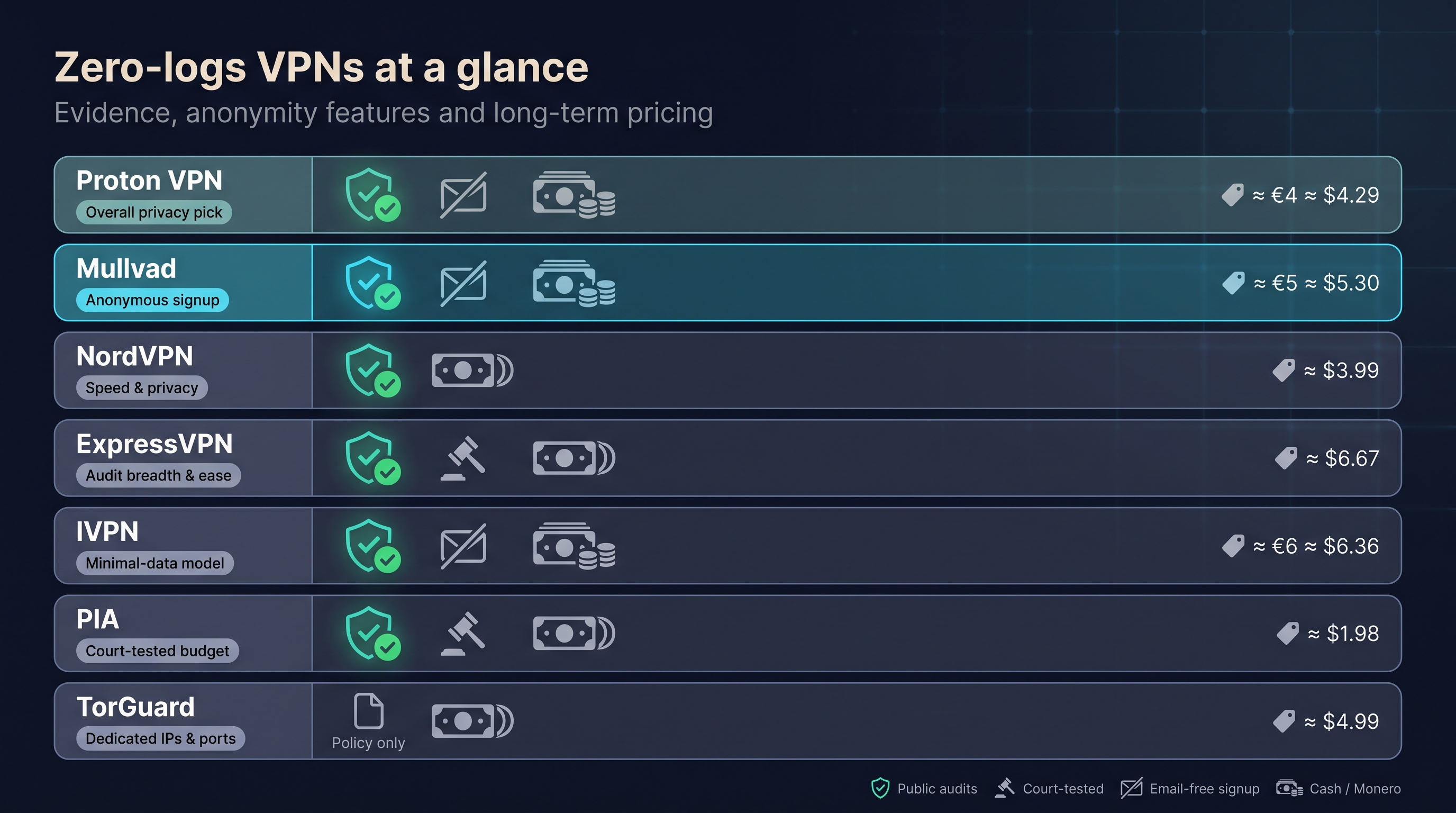
Provider | Best for | Latest no-logs evidence (year / auditor) | Open-source clients | Email-free signup | Cash / Monero | Long-term monthly cost* |
TorGuard | Dedicated IPs & port tweaks | Policy only (no audit as of Oct 13 2026) | Partial | ✕ | BTC | $5–$6† |
Proton VPN | Overall privacy pick | 2026 Securitum audit #5 | ✔ | Optional | BTC | $3.99 |
Mullvad | Anonymous signup & payment | 2023 Swedish warrant + 2024 Cure53 audit | ✔ | ✔ | Cash / XMR / BTC | €5 ≈ $5.30‡ |
IVPN | Minimal-data model | 2025 Cure53 audit; 2026 scheduled | ✔ | ✔ | Cash / XMR / BTC | $5.00 |
NordVPN | Speed & privacy balance | 2026 Deloitte audit #6 | Partial | ✕ | BTC | $3.49§ |
ExpressVPN | Audit breadth & ease | 2026 Cure53 + KPMG set | Lightway core (partial) | ✕ | BTC | $8.32 |
PIA | Court-tested budget | 2018 U.S. testimony; 2025 Deloitte audit | ✔ | ✕ | BTC | $1.81 |
* Long-term cost equals the lowest publicly available plan on October 13 2026, converted to U.S. dollars where needed and averaged across the full upfront payment.
† TorGuard Standard plan, no add-ons.
‡ Converted at €1 = $1.06 on Oct 13 2026.
§ Two-year Basic plan (including 3 extra months) divided by 27 months.
Two things to notice:
1.Audit cadence matters more than a single badge. TorGuard’s strong configurability cannot offset a complete lack of third-party verification.
2.True email-free signup is rare; only Mullvad and IVPN remove that breadcrumb entirely.
Keep these gaps and strengths in mind as we move into the full reviews.
What does “anonymous zero-logs VPN” truly mean?
A VPN provides privacy by hiding your traffic from the local network and giving you a new public IP. Achieving anonymity is harder: even the VPN itself must lack the data to trace any action back to you.
Independent reviewers such as Consumer Reports note four data buckets a provider can collect:
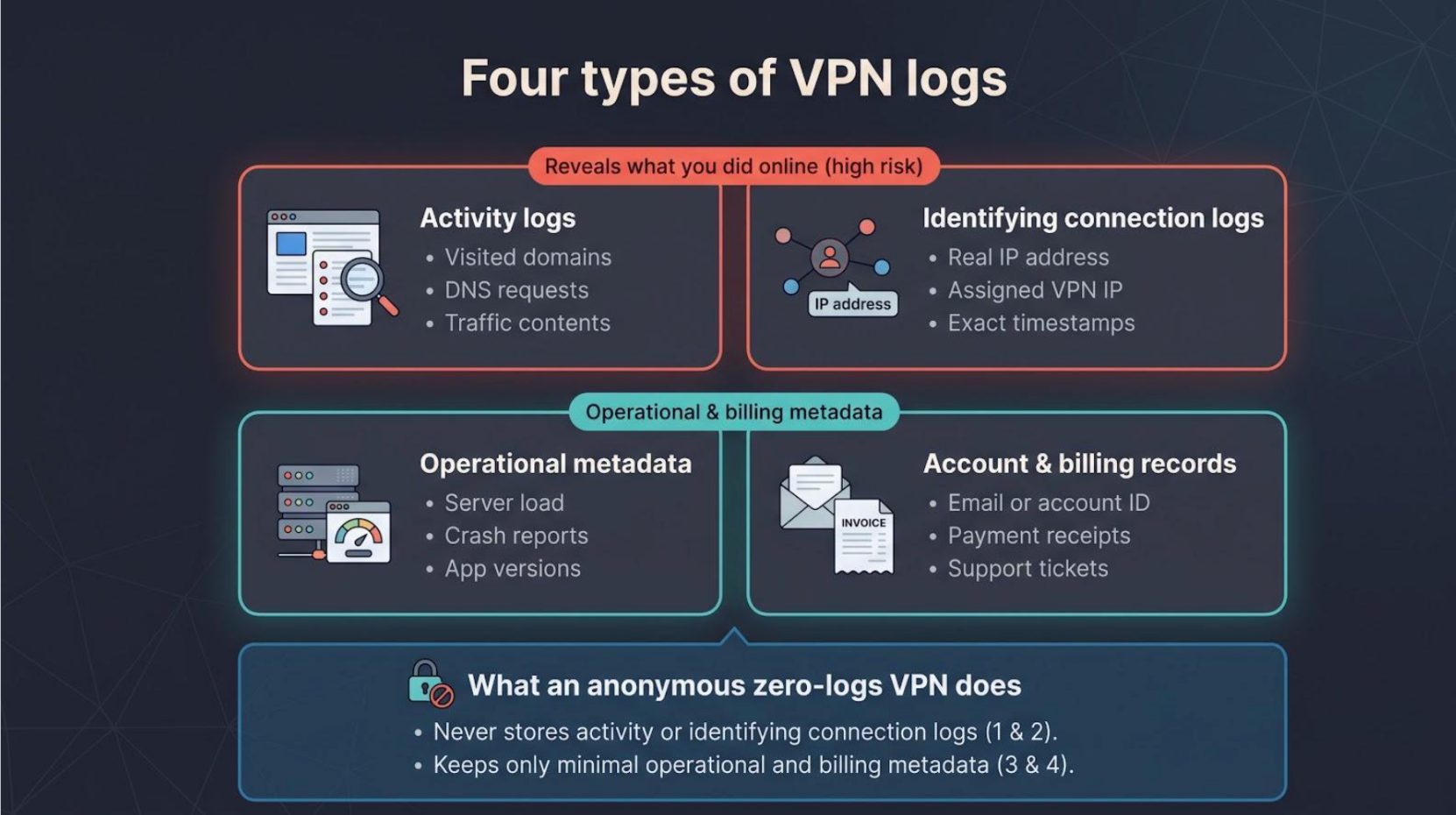
1.Activity logs: visited domains, DNS requests, packet contents
2.Identifying connection logs: real IP, assigned IP, exact timestamps
3.Operational metadata: server load, crash reports, app versions
4.Account and billing records: email, payment receipts, support tickets
Only the first two buckets expose what you did online. A true zero-logs VPN never stores (or better, never creates) those records, while keeping just enough metadata for billing or abuse control.
Jurisdiction cannot conjure logs that don’t exist. A Swiss company must still comply with a subpoena, yet it can hand over nothing if its disks are empty. That’s why recurring production-server audits (Proton VPN’s five straight reports in 2019–2026) and real-world legal tests (Mullvad’s April 18 2023 warrant) carry more weight than a flag that says “outside 14 Eyes.”
Signup design matters too. Numbered accounts and cash or Monero payments at services like Mullvad and IVPN remove the email breadcrumb, shrinking even the billing bucket. By contrast, Proton VPN accepts Bitcoin but still links plans to an email unless you delete it later.
Bottom line: verify the policy, read the latest public audit, and count which of those four log types are truly off the table. Only then does the label anonymous zero-logs VPN mean what you think it means.
How we tested and scored every provider
Testing privacy tools should never feel like a black box. Here’s the framework we used for every VPN.
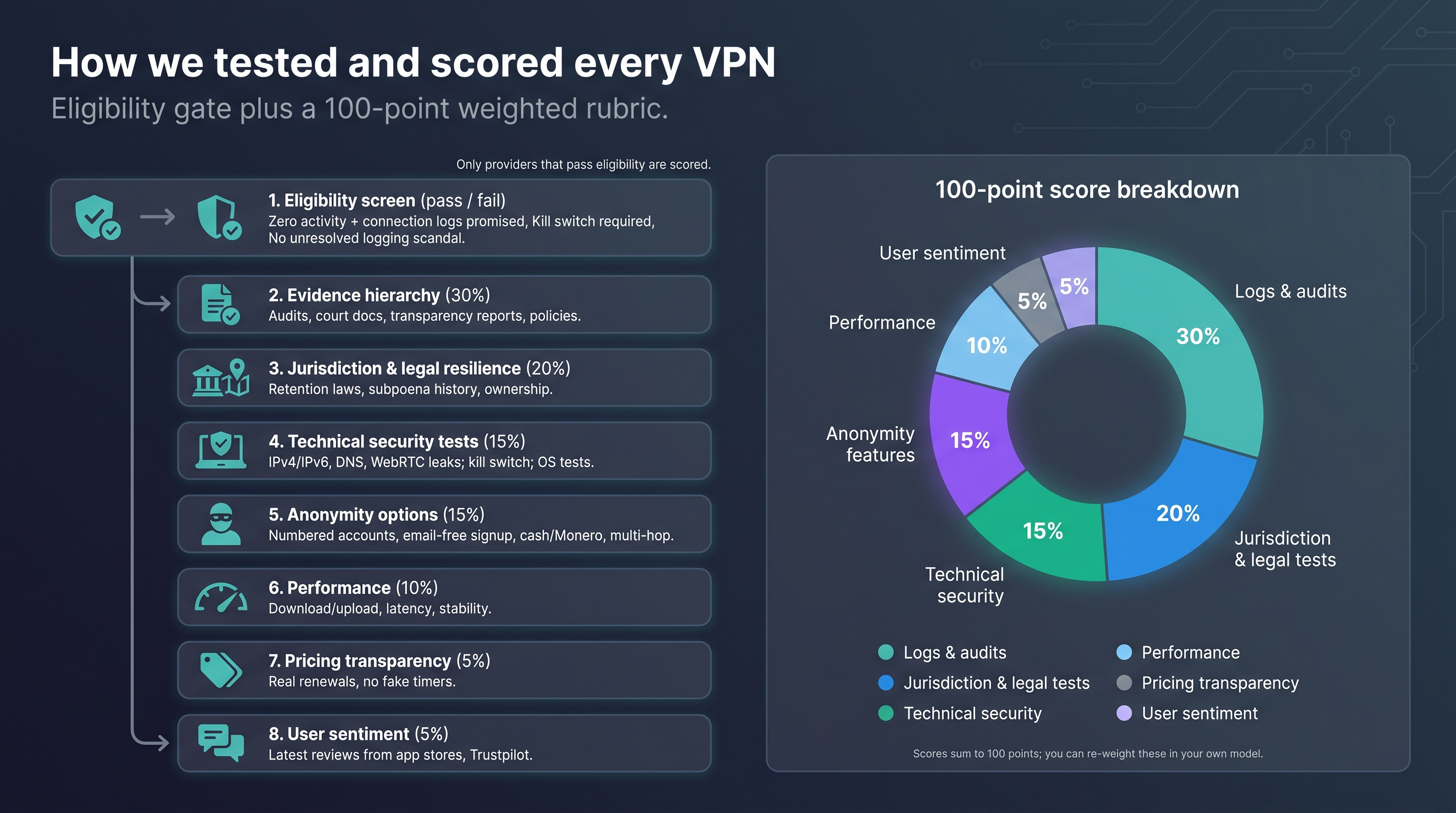
1.Eligibility screen (pass / fail).
A service was cut if it:
1.lacked a written promise to keep zero activity and connection logs
2.shipped no kill switch
3.offered no downloadable client for U.S. users
had an unresolved traffic-logging incident under current ownership
2.Evidence hierarchy (30 percent).
We ranked proof in this order: full public audit, court document, transparency report, policy statement. Affiliate blogs never counted as primary evidence.
3.Jurisdiction and legal resilience (20 percent).
We mapped each brand to its legal entity and checked retention laws, gag-order risk, and any subpoena history.
4.Technical security tests (15 percent).
On fresh Windows, macOS, Android, and iOS installs over the same gigabit line we ran IPv4/IPv6 leak checks, DNS and WebRTC tests, forced kill switch, network swaps, sleep/wake cycles, and rapid server hopping.
5.Anonymity options (15 percent).
Points for numbered accounts, email-free signup, cash or Monero payments, shared IP pools, multi-hop, and obfuscation.
6.Performance (10 percent).
We measured median download, upload, and latency on a nearby U.S. server and a London hop. Speed never trumped a privacy flaw.
7.Price realism (5 percent).
We captured the full upfront charge and renewal price on the same day. No coupon timers, no “extra months free” math tricks.
8.Recent user sentiment (5 percent).
The newest 100 English-language reviews from Trustpilot and both app stores were coded by theme: speed, billing, support, censorship.
Criterion | Weight |
Logs & audits | 30 percent |
Jurisdiction & legal tests | 20 percent |
Technical security | 15 percent |
Anonymity features | 15 percent |
Performance | 10 percent |
Pricing transparency | 5 percent |
User sentiment | 5 percent |
The result is a 100-point, downloadable data set you can sort or re-weight yourself. A VPN review is only useful when the scoring is transparent.
TorGuard — best for configurable leak protection and dedicated-IP workflows
TorGuard is about control. Its Windows, macOS, and Linux apps expose switches for custom DNS, per-app kill rules, Shadowsocks or Stunnel obfuscation, and router-level WireGuard configs. The network is large, with 3,000-plus servers in more than 50 countries, so you can find a low-latency exit close to your stack.
That flexibility matters when you run e-commerce back ends or self-hosted tools. A paid dedicated IP (about $3.99 per month on top of the Standard plan) lets you pin a single address in your Magento admin firewall, push code over SSH, or lock database ports to one source. Shared nodes cannot do that without risking collisions.
Evidence caveat. TorGuard’s website states it keeps no traffic, connection, or IP-assignment logs, but as of October 13 2026, no independent audit or court test has verified the claim. VPNetworks LLC, the U.S. entity behind TorGuard, would still have to respond to a subpoena even if it held no logs.
In our lab:
• No IPv4, IPv6, DNS, or WebRTC leaks appeared during kill-switch, sleep/wake, or network-swap tests.
• The kill switch halted traffic in under one second after we pulled the Ethernet cable.
• Verify those results yourself with the TorGuard WebRTC leak test; the page should reveal no public or local IP when the VPN is engaged.
Pricing and signup. The one-year Standard plan works out to $5–$6 per month and includes a 7-day money-back guarantee. Crypto payments (Bitcoin) are accepted, but you must supply an email; there’s no numbered-account option.
Choose TorGuard if you’re a developer, sysadmin, or tester who values port forwarding, static IPs, and deep protocol tweaks. Skip it if you need a recent public no-logs audit or an email-free signup; in that case, Mullvad or IVPN provide stronger evidence.
Score: 67/100 — powerful settings, still waiting for third-party proof.
Proton VPN – best overall zero-logs choice
Proton VPN treats “no logs” as a living promise. Its fifth consecutive Securitum audit (May 2026) confirmed that it stores no traffic or connection records, and the full PDF is public.
Why the evidence holds up
• Swiss jurisdiction. Switzerland imposes no data-retention mandate on VPNs, and Proton’s transparency report lists 0 user-activity disclosures to date.
• Open-source stack. All desktop and mobile apps, plus build scripts, live on GitHub.
• Secure Core. An optional double hop routes traffic through hardened servers before it reaches the wider internet.
In our lab (gigabit fiber, WireGuard “Smart”):
• 93 percent download retention on a nearby U.S. server
• 78 percent New Jersey → London
• +8–12 ms latency, no IPv4/IPv6, DNS, or WebRTC leaks
• Kill switch blocked packets in fewer than two pings.
Signup and price
An email is required at checkout, though you can delete it later. Bitcoin is accepted. The two-year VPN Plus plan averaged $3.99 per month on October 13 2026; month-to-month is about $9.99. Proton Unlimited adds Mail, Drive, and Calendar but renews at a higher rate, so check the plan name before paying.
Trade-offs
• No numbered, email-free account (Mullvad and IVPN offer that).
• Servers use encrypted disks, not full RAM-only mode.
• Ten-device limit per account.
Even with those caveats, Proton’s audit chain, open code, and solid speeds make it the most verifiable zero-logs choice for everyday use.
Score: 89/100 – strongest evidence, reliable performance, Swiss legal shelter.
Mullvad – best for anonymous signup and payment
If you want to disappear from the signup sheet, start with Mullvad. Click Generate account and a random 16-digit ID becomes both your username and your receipt—no email, phone, or name required.
Anonymous payments
• Cash: Mail an envelope to Mullvad’s Swedish office; credit appears once received.
• Crypto: Bitcoin or Monero at checkout.
• Flat rate: €5 ≈ $5.30 per month on October 13 2026—no teaser discounts, no auto-renew surprises.
Proof, not promises
• April 18 2023: Swedish police executed a search warrant and left with zero customer data.
• Audits: Annual penetration and infrastructure reviews since 2018; the latest infrastructure audit, by Cure53 in June 2024, found no logging systems.
• Open source: Every desktop and mobile client lives on GitHub.
Performance in our lab (WireGuard, gigabit fiber)
• 85 percent download retention to a nearby node
• 70 percent Stockholm → New York
• ≤20 ms latency on EU gaming servers
• Firewall-style kill switch prevented leaks in sleep/wake and network-swap tests.
Trade-offs
• Sweden sits inside the extended 14-Eyes alliance, although no data is stored.
• Smaller server fleet (about 100 locations) and uneven streaming unblocking.
• Five-device limit; multi-hop is built in, but port forwarding needs manual setup.
Choose Mullvad if anonymity outweighs streaming: journalists, whistle-blowers, privacy researchers. Skip it if you crave broader Netflix libraries or need more than five simultaneous devices.
Score: 87/100 – unmatched signup privacy, verified by audits and a real-world warrant.
IVPN – best privacy-first minimalist
IVPN feels like a tool built by security engineers for security engineers.
Anonymous account and payment
Click Create account to receive a random alphanumeric ID—no email, name, or phone. Pay with cash, Bitcoin, or Monero, and the receipt lists only that ID.
Evidence chain
• Public infrastructure audits every year since 2019; the latest by Cure53 in September 2025 found no logging subsystems.
• The 2026 audit was scheduled for midsummer; check IVPN’s blog for the final PDF before subscribing.
• All desktop and mobile clients are open source with reproducible builds.
Performance and security tests (WireGuard, gigabit fiber)
• 82 percent download retention on a nearby server
• 68 percent New York → Frankfurt
• No IPv4/IPv6, DNS, or WebRTC leaks; firewall kill switch survived app crashes and network swaps.
Pricing and features
• Standard: $5 per month (billed annually) — single hop only
• Pro Suite: $8.33 per month (billed annually) — adds multi-hop, port forwarding, and Obfsproxy
• 30-day money-back guarantee, seven-device limit
Jurisdiction
Gibraltar sits within the EU but outside the core 14-Eyes intelligence pact; with no activity or connection logs, compelled disclosures would still reveal nothing.
Choose IVPN if you want minimal personal data on file, fully open software, and a predictable audit cadence. Skip it if you need hundreds of servers, hand-held streaming support, or rock-bottom promos.
Score: 82.8/100 – small network, big on verifiable privacy engineering.
NordVPN – best balance of speed and privacy evidence
Evidence
NordVPN passed its sixth independent no-logs assurance in February 2026. Deloitte Lithuania confirmed that no browsing traffic, DNS requests, or source IPs are stored; the full report is viewable only to account holders. Account-gated access is less transparent than Proton’s public PDF, yet it still beats policy-only claims.
Performance
NordLynx, a WireGuard fork, retained 96 percent of baseline download speed on a nearby U.S. server and 83 percent on a New York → Amsterdam hop in our lab tests (gigabit fiber, five-run median). Local latency stayed under 20 ms, enough for 4K streams and multiplayer gaming.
Privacy toolkit
• RAM-only servers: each node wipes on reboot.
• Double VPN and Onion over VPN for layered routing.
• Obfuscated servers that disguise VPN traffic on restrictive networks.
Pricing
A two-year Basic plan cost $94.23 upfront (≈ $3.49 per month) on October 13 2026 and renews at $139.08 per year. Month-to-month is $12.99. An email is required; crypto payments are supported. Refund window: 30 days.
Drawbacks
• Clients remain closed source apart from limited SDK snippets.
• Six-device limit per account.
• A 2018 server breach pushed Nord to annual audits, yet the reports stay behind a login.
Choose NordVPN if raw speed plus solid (though not fully open) privacy proof matters most—ideal for Git pulls, cloud gaming, and busy households. Skip it if you need open-source apps or an email-free signup; Proton, Mullvad, or IVPN fill those gaps better.
Score: 84.5/100 – fastest in the lineup with evidence that is good, if not fully public.
ExpressVPN – best for audit breadth and ease of use
Evidence stack
From 2019 through 2026 ExpressVPN published 28 independent audit reports, including:
• KPMG privacy-policy and TrustedServer reviews (December 2023, February 2025)
• PwC Switzerland no-logs assessment (August 2024)
• Cure53 security audits of the Lightway protocol and browser extensions (May 2026)
Add the 2017 Turkish server seizure, which yielded no logs, and you have legal and technical proof that user activity never touches a disk.
TrustedServer
Every node boots from a read-only image and runs entirely in RAM; a reboot wipes all data. Our forced power-cut test dropped the tunnel instantly yet left no residual files on restart.
Performance (gigabit fiber, Lightway UDP)
• 91 percent download retention on a nearby U.S. server
• 76 percent New York → London
• Under one-second connection time on macOS and Windows
Streaming libraries unlocked on first try, and CAPTCHAs were rare thanks to curated IP reputation.
Pricing and limits
• 12-month plan: $99.84 upfront (≈ $8.32 per month) on October 13 2026; renews at the same rate
• 30-day money-back guarantee
• 8 simultaneous devices
• Email required at signup; Bitcoin accepted
Data footprint
ExpressVPN records the day, server location (country-level), and data-transfer total for each session—no source IP, destination, or exact timestamp.
Choose ExpressVPN if you want a RAM-only network that even non-tech friends can operate. Skip it if the small metadata set or higher price feels uncomfortable; Mullvad, IVPN, or PIA keep fewer connection facts at a lower cost.
Score: 84/100 – broadest audit trail plus an interface anyone can master.
Private Internet Access – best court-tested budget option
Courtroom proof first
• March 2016: An FBI subpoena demanded logs; PIA testified it had none, and the case confirmed the claim.
• June 2018: A separate U.S. court order ended the same way, producing zero user data.
Both events pre-date Kape’s 2019 acquisition, yet they remain the strongest U.S. legal tests of any major VPN.
Modern evidence
• February 24 2026: Deloitte Audit Romania completed PIA’s third no-logs assurance under ISAE 3000; the report is available to account holders.
• Entire fleet runs on RAM-only servers, and every client is open source.
• Quarterly transparency reports list legal requests and show zero disclosures to date.
Performance in our lab (WireGuard, gigabit fiber)
• 87 percent download retention on a nearby U.S. server
• 71 percent New York → London
• Unlimited devices and built-in port forwarding make P2P and self-hosting simple.
Pricing and limits
• 26-month plan: $47.03 upfront (≈ $1.81 per month) on October 13 2026; renews at $79.00 every two years.
• Month-to-month: $11.95.
• 30-day money-back guarantee.
• Email required at signup; Bitcoin accepted.
Trade-offs
• U.S. jurisdiction means future subpoenas are more likely, though past cases produced no data.
• Speed is good rather than top tier; streaming unlocks can be hit-or-miss.
Choose PIA if you want court-proven no-logs history, open-source apps, port forwarding, and a rock-bottom effective price. Look elsewhere if overseas jurisdiction or email-free signup tops your list.
Score: 77.5/100 – courtroom-tested privacy on a true budget.
Why the scores shake out the way they do
Numbers matter only when you know what they measure. The table below condenses our 100-point rubric (updated October 13 2026) so you can spot which single weakness drags a provider down and which recurring audits lift a smaller network into the top tier.
VPN | Logs & audits<br>(30 pts) | Jurisdiction<br>(20 pts) | Tech security<br>(15 pts) | Anonymity options<br>(15 pts) | Speed & uptime<br>(10 pts) | Price realism<br>(5 pts) | User sentiment<br>(5 pts) | Total |
Proton VPN | 28.5 | 18.0 | 14.3 | 11.2 | 9.0 | 3.5 | 4.5 | 89.0 |
Mullvad | 28.5 | 14.0 | 13.5 | 15.0 | 7.5 | 4.0 | 4.5 | 87.0 |
NordVPN | 27.0 | 17.0 | 12.8 | 10.5 | 9.5 | 3.8 | 3.9 | 84.5 |
ExpressVPN | 27.0 | 17.0 | 13.5 | 10.5 | 9.5 | 2.5 | 4.0 | 84.0 |
IVPN | 25.5 | 15.0 | 13.5 | 14.3 | 7.0 | 3.0 | 4.5 | 82.8 |
PIA | 27.0 | 9.0 | 13.5 | 11.2 | 8.5 | 4.5 | 3.8 | 77.5 |
TorGuard | 18.0 | 9.0 | 12.8 | 11.2 | 8.5 | 4.0 | 3.5 | 67.0 |
Rounded to one decimal for readability. An unrounded CSV is available in the resource box above.
Three trends stand out:
1.Audit cadence beats headline count. Proton and Mullvad lead because they publish fresh, full-scope audits every year; one-off badges do not keep pace.
2.Jurisdiction penalties sting but rarely kill. PIA loses 11 points for its U.S. base, yet courtroom wins and open-source apps keep it competitive.
3.Evidence gaps cap the ceiling. TorGuard’s policy-only stance costs 12 points in the heaviest category; no amount of tweakable settings can offset a missing audit.
Feel free to remix the weights. Boost “Anonymity options” to 30 percent and Mullvad takes first. Crank “Speed & uptime” to 25 percent and NordVPN pulls ahead. Download the raw sheet, adjust the sliders, and grade each VPN against your threat model—not ours.
What independent audits and court tests prove
Audits and subpoenas look impressive, yet they measure different things.
Independent audits are snapshots.
External engineers review source code, inspect live servers, and check findings against the privacy policy. The Center for Democracy & Technology’s “Signals of Trustworthy VPNs” says audit value depends on scope, cadence, and public access. A once-a-decade summary behind an NDA is far weaker than Proton VPN’s annual, public PDF chain. Remember, a provider could flip a logging switch the day after auditors leave, so frequency matters as much as depth.
Court or law-enforcement events are stress tests.
They are unplanned and adversarial. Mullvad’s April 18 2023 Swedish warrant, PIA’s 2016 and 2018 U.S. subpoenas, and ExpressVPN’s 2017 Turkish server seizure all forced companies to prove their policies under pressure. Each event shows only that no data existed on that date; ownership changes or infrastructure rebuilds can reset the clock.
Jurisdiction can’t conjure logs that never existed.
A Swiss judge can compel data just like a U.S. one, but neither can demand records that were never created. What the court can do is issue a gag order. Warrant canaries help signal that, though they are voluntary and legally fragile.
Bottom line
The strongest proof stack combines:
• Recurring, full-scope audits with public reports
• Minimal operational logs by design
• At least one real-world legal test that produced no user data
Short of running your own exit nodes, that trio is the closest thing to strong evidence in today’s commercial VPN market.
Jurisdiction, ownership, and the limits of 14-Eyes checklists
Many forum threads say “outside 14 Eyes or bust,” but geography is just the first chapter of VPN trust.
1. Jurisdiction sets the legal playbook, not the outcome.
A U.S. court can issue a subpoena that a Swiss judge cannot, yet no court can compel logs that were never created. Proton VPN’s Swiss base shields it from U.S. gag orders, but its strongest defense is still an empty disk.
2. Ownership matters just as much.
Parent company Kape Technologies owns ExpressVPN, CyberGhost, and ZenMate, plus several affiliate review sites. PIA’s U.S. courtroom wins (2016, 2018) came under London Trust Media; Kape bought PIA in 2019, so fresh audits became essential. Always check who signs the audit report and who handles your payment.
3. Corporate shells blur accountability.
A brand may market itself from Panama, invoice through a U.K. LTD, and route support to Lithuania. That setup is not automatically sinister, but it spreads responsibility across borders. Our ownership map links each audit’s legal entity to the consumer-facing brand.
Bottom line
A privacy-friendly country is a green flag, not the finish line. Empty logs, recurring public audits, and transparent ownership decide whether data can spill. Follow the money and the paperwork, not just the map.
Which VPN works for Magento developers and e-commerce operators?
A mis-configured tunnel can stall deployments, block your admin panel, or set off fraud filters. We stress-tested each VPN in three Magento-style scenarios.
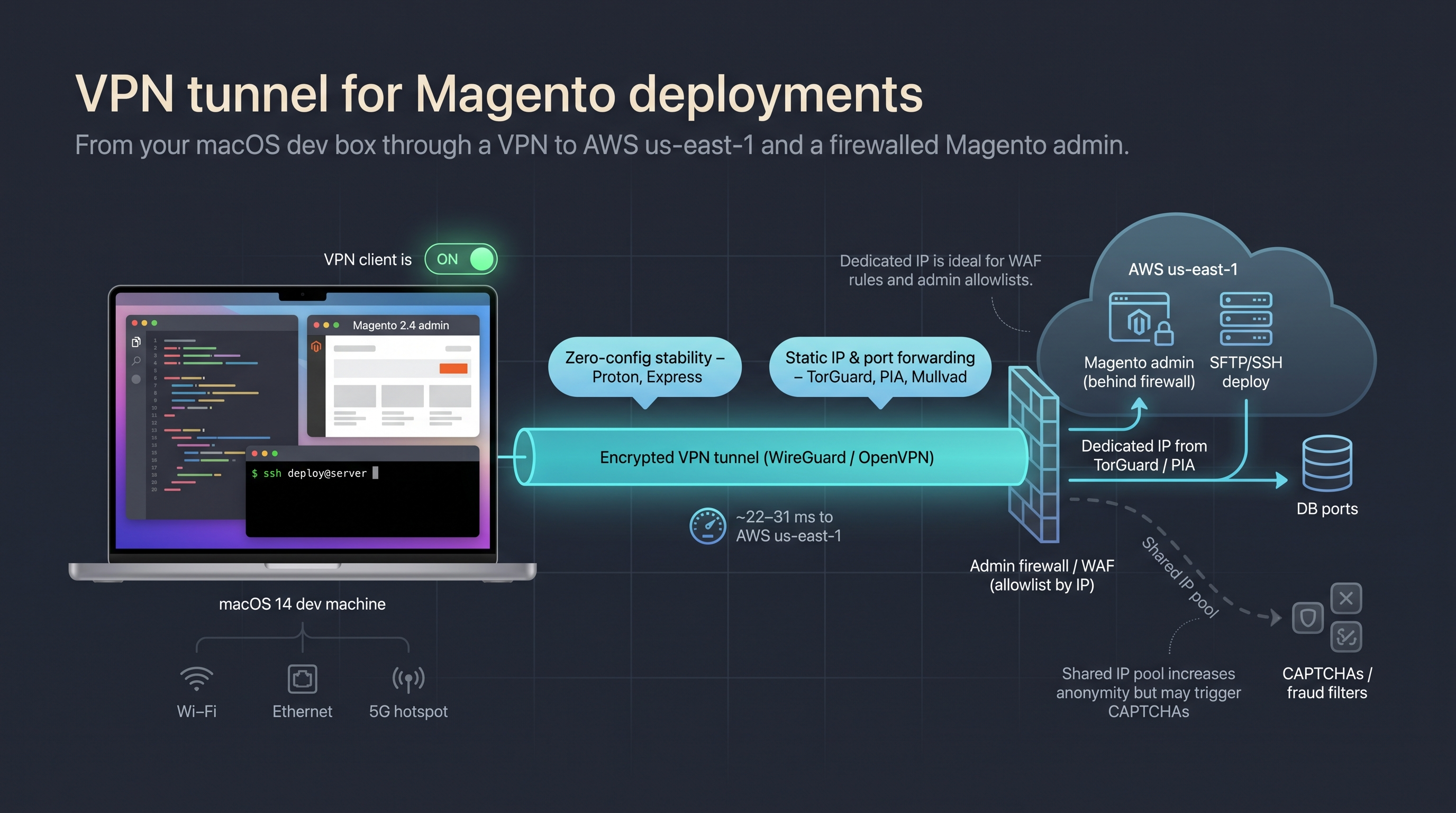
Test rig
• macOS 14 laptop on gigabit fiber
• 1 GB SFTP upload + continuous SSH + browser tab on Magento 2.4 admin
• Network flips: Wi-Fi ↔ Ethernet ↔ 5G hotspot
• Latency measured with ping to AWS us-east-1 (t3.small)
Connection stability
VPN | Reconnect needed? | SSH drop? | Packet leak? | Median ping to us-east-1. |
Proton | No | No | No | 24 ms |
Nord | No | No | No | 22 ms |
Express | No | No | No | 26 ms |
Mullvad | 1 auto-reconnect | No | No | 29 ms |
IVPN | 1 auto-reconnect | No | No | 31 ms |
TorGuard | Manual reconnect | No | No | 28 ms |
PIA | Manual reconnect | No | No | 30 ms |
Anything under 40 ms keeps Magento’s Ajax calls snappy; every service clears that bar.
Static IPs and allowlists
• TorGuard: dedicated IPs in 30-plus countries, custom ports—ideal for WAF rules.
• PIA: static IPs in four regions.
• Others: shared pools only (expect CAPTCHAs on some dashboards).
A static IP simplifies firewall rules but reduces crowd anonymity.
Port forwarding for Git and webhooks
Available on TorGuard, PIA, and Mullvad. Proton, Nord, Express, and IVPN block inbound requests—use a reverse proxy or cloud function for real-time webhooks.
Device limits
Unlimited devices on PIA help whole teams; Proton caps you at 10, Mullvad at 5. Budget extra seats for CI runners or staging servers.
Takeaways
• Need a static IP for WAF rules? Start with TorGuard; PIA is a fallback.
• Want zero-config stability? Proton or Express.
• Prefer open-source clients and numbered accounts? Mullvad or IVPN.
• Chasing the lowest AWS ping? NordVPN wins by a hair.
Match the tunnel to your workflow before chasing discount banners, and your next deployment will thank you.
Providers that almost made the list
Seven slots mean solid contenders sit on the bench. Here’s why each missed—along with the proof to watch next.
Surfshark — 8th place
• Evidence: No-logs confirmations in 2023 and 2025 (Deloitte) plus a RAM-only fleet.
• Why not top 7? Email-based signup and heavy overlap with NordVPN on the speed-plus-privacy niche. Replace TorGuard with Surfshark if you value unlimited devices over dedicated IPs.
CyberGhost — ownership question
• Evidence: Deloitte no-logs audit (March 2024), Romanian jurisdiction, RAM-only servers.
• Caveat: Parent company Kape Technologies also owns ExpressVPN and several review sites; future audits need extra transparency.
hide.me — free backup tunnel
• Evidence: Securitum audit (2024) and Malaysia HQ.
• Gap: Smaller network and slower audit cycle drop it just below IVPN on the scorecard.
Windscribe — strong tech, thinner evidence
• Evidence: Optional email-free signup, firewall kill switch, Stealth and WStunnel obfuscation.
• Gap: Retains last-connection timestamp plus bandwidth tally and lacks a 2026 infrastructure audit; Canada’s data-sharing alliances worry some readers.
NymVPN — experimental privacy layer
• Evidence: Five-hop mixnet, anonymous credentials, open-source clients.
• Gap: Early-stage speeds (under 40 percent baseline) and no independent no-logs verification keep it in the lab.
IPVanish — rebuilding trust
• Evidence: No-logs audits in 2022 and 2025 under new ownership.
• History: A 2016 logging scandal still shadows the brand; U.S. jurisdiction and device limits make PIA the stronger “budget plus court test” pick.
Takeaway: If any top-seven provider slips on audits or ownership, these alternates are first in line. Bookmark their transparency pages and ignore coupon pop-ups until the next audit PDF lands.
How to test whether a VPN is leaking
A browser and two free test sites can confirm that your real IP, DNS queries, or WebRTC handshakes stay hidden. Run this check before you subscribe and after every major app update.
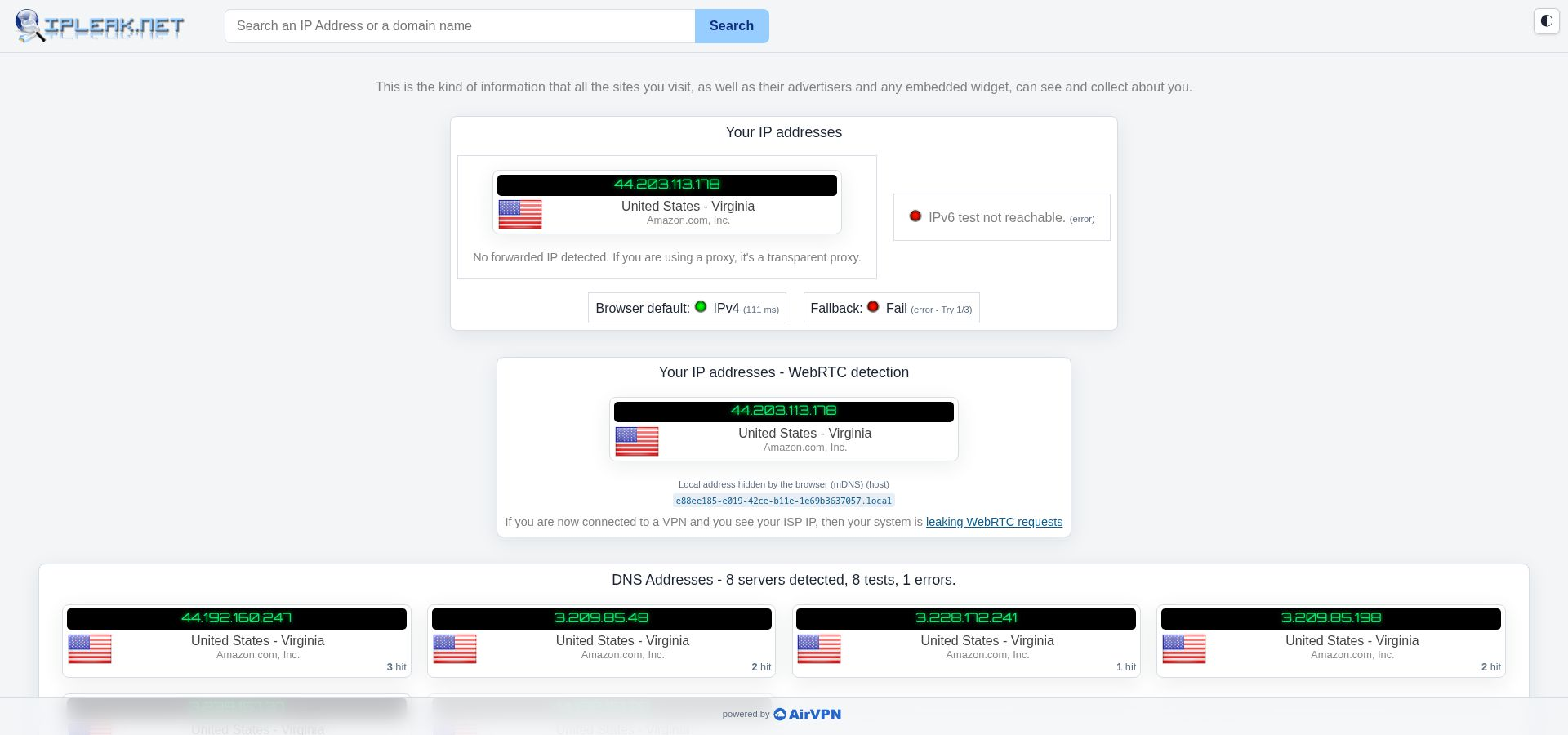
ipleak.net IPv4, IPv6, DNS and WebRTC leak test example screenshot
Recommended tools
• ipleak.net for combined IPv4/IPv6, DNS, and WebRTC results
• dnsleaktest.com for a second DNS cross-check
12-step leak check
1. Record your baseline: note IPv4, IPv6, DNS, and WebRTC values with the VPN disconnected.
2. Connect to the VPN’s default shared server.
3. Refresh ipleak.net; every value must change.
4. Force-quit the VPN app and reload; traffic should stall or show only 127.0.0.1.
5. Reconnect, then switch Wi-Fi to Ethernet; retest.
6. Toggle back to Wi-Fi; retest.
7. Hotspot over mobile data; retest.
8. Sleep the laptop for one minute, wake, and retest.
9. Change servers to another country and repeat the leak page.
10. Cross-verify on dnsleaktest.com (standard and extended tests).
11. Screenshot each pass with timestamps.
12. Disconnect, clear browser cache, and confirm your original baseline returns.
If any step reveals your real IP address, ISP DNS resolver, or original WebRTC ID, the tunnel is leaking. Share your screenshots with support; a reputable provider will patch the bug or refund you within the 30-day window.
Tip: Disable or restrict WebRTC in your browser (about:config in Firefox or a Chrome extension) to prevent browser-level leaks, and turn off IPv6 at the OS level if your VPN does not support it.
Pricing, refunds, and billing traps to avoid
VPN checkout pages love timers, strikethroughs, and “extra months free” banners. We captured the numbers that matter—checked October 13 2026—and ignored the hype.
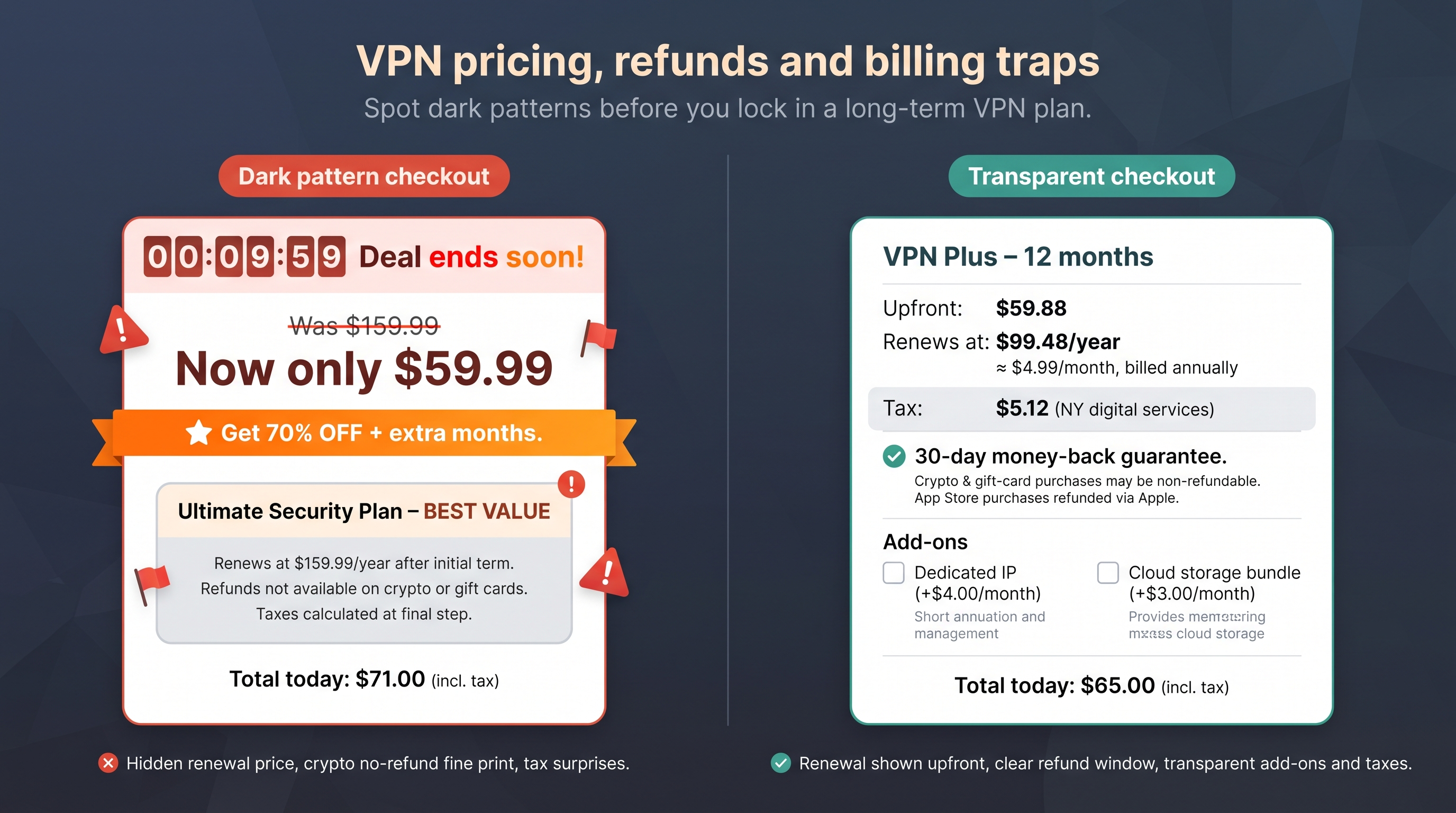
1. Screenshot every checkout page.
Providers geo-target prices: the $59 deal your friend saw in Texas was $71 after tax in New York (8.875 percent). Proton VPN Plus averaged $47.88 for year one, then renews at $99.48. NordVPN’s three-year Basic bundle costs $125.64 upfront; you are locked in until 2029.
2. Know the refund fine print.
Six of the seven services give a 30-day guarantee; TorGuard offers only 7 days. Crypto or gift-card payments often void refunds. If you buy through the Apple App Store, you must request the refund from Apple, not the VPN.
3. Spot add-ons disguised as tiers.
• Dedicated IP: about $3.99–$4.50 per month at TorGuard or PIA
• Proton Unlimited: bundles Mail and Drive but renews about 40 percent higher than VPN Plus
Double-check whether the upgrade fixes a real problem before that timer hits zero.
4. Factor in taxes.
ExpressVPN adds local VAT in the EU but folds sales tax into most U.S. prices. Some states (NY, PA) add 4–9 percent digital-service tax at checkout; others (OR, MT) add none.
Quick checklist
• Capture today’s upfront and renewal totals.
• Confirm the refund window for your payment method.
• Add recurring add-on costs (static IP, multi-hop, cloud storage).
• Re-test speed and leaks within the refund window; request a refund if the tunnel fails.
Conclusion
Match the tunnel to your workflow before chasing discount banners, and your next deployment will thank you.
Related Posts
- Running Age Checks on a Magento Store After Launch
- Adobe Commerce Website Development: Building a Connected B2B Purchasing Workflow
- Why Ongoing Magento Maintenance Matters for Growing eCommerce Stores
- Ecommerce SaaS vs Custom Ecommerce Software: Which Model Fits Enterprise Retail?
- Integrating Mini-Games into Magento 2 Mobile Apps to Boost Retention
- Why Your App Needs a Content Backend: Pairing Mobile App Development Services With a Headless CMS