


If you run a behavioral health program, you already know that filling beds isn't just about visibility, it's about reaching the right family at the right moment. SEO isn't a branding exercise. It's a direct line into every stage of your admissions funnel. Understanding how it maps to your actual advertising objectives changes everything about how you approach it.
What Is the Behavioral Health Admissions Funnel?
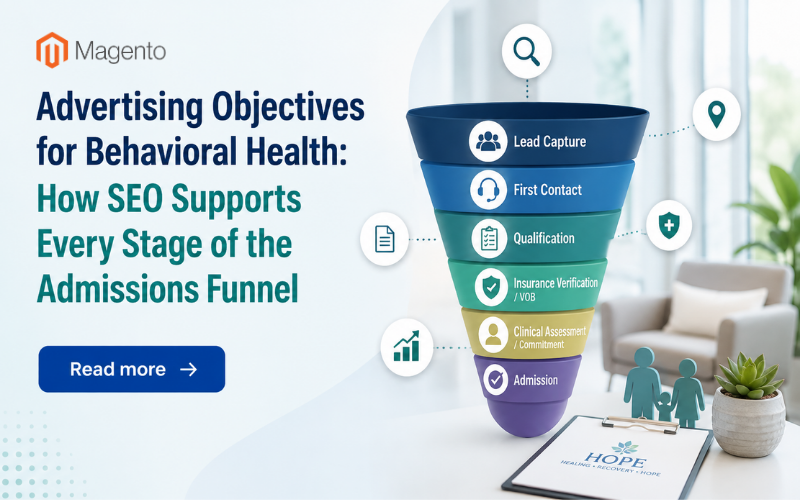
The behavioral health admissions funnel is an intake-specific framework designed to convert initial inquiries into treatment admissions. It typically includes six stages: Lead Capture, First Contact, Qualification, Insurance Verification/Verification of Benefits (VOB), Clinical Assessment/Commitment, and Admission.
Each stage has defined success criteria, responsible staff, and common failure points. For example, response time strongly influences outcomes at the First Contact stage, while accurate and timely completion of coverage details affects results at the VOB stage.
To understand what's constraining admission volume, it's necessary to monitor conversion rates between each stage, lead to contact, contact to qualification, qualification to VOB, and VOB to admission. These metrics help identify specific bottlenecks so that process improvements can be targeted where they'll have the greatest impact. Working with a behavioral health SEO company that understands this funnel gives you a meaningful advantage, one that connects search visibility directly to each intake stage rather than treating SEO as a separate channel.
Where Families Search Before Contacting a Treatment Center
Families typically begin researching treatment options before contacting a center directly. This process often starts with high-intent search queries such as "drug rehab near me," "detox center [city]," or "outpatient mental health treatment [city]."
Search engines usually prioritize local map listings for these terms, so a center's visibility is strongly influenced by the presence of well-structured, location-specific pages.
After identifying potential options, families commonly look for confirmation that a center offers evidence-based treatments, accepts their insurance, and provides clear information about admission or intake procedures.
In addition, they may encounter AI-generated search summaries and third-party review platforms that reference a center without requiring a direct site visit.
If a center's online content isn't semantically clear, accurate, and consistent across these channels, it may be excluded from consideration before any direct contact occurs.
Keywords Families Use When Comparing Treatment Programs

When families move from initial awareness to active comparison, their search behavior shifts toward more specific, intent-driven keywords.
They begin using condition-plus-level-of-care phrases such as "opioid use disorder MAT" or "residential vs. outpatient rehab" to understand which type of treatment may be appropriate.
They also research therapeutic approaches and provider qualifications with terms like "trauma-informed care," "CBT/DBT," or "EMDR therapist near me" to evaluate clinical quality and fit.
Insurance-related searches, including "does Aetna cover drug rehab" or "in-network mental health facility," often occur before any direct contact with a provider.
An effective SEO strategy addresses these needs by building content around these keyword clusters, using modality-specific pages and clinically accurate, compliant language.
This approach helps ensure that families can access clear, reliable information at the point when they're comparing and narrowing treatment options.
How Clinical Authority Signals Build Trust in Search Results
Once families begin comparing programs using specific clinical terms, your site's ability to demonstrate clear, verifiable authority often determines whether they click through or move on.
List evidence-based modalities such as CBT, DBT, and EMDR on dedicated pages, with brief explanations and indications, so families can evaluate clinical fit before contacting your program.
Display credentials, state licensure, and accreditations prominently near the top of service pages to support trust and improve click-through from both organic and AI-generated search results.
Use terminology consistent with NIDA and SAMHSA to align with established clinical standards and help search engines recognize your content as reliable.
Identify clinical leadership by name and summarize their training and experience in the specific therapies you offer; this level of detail generally leads to more informed inquiries than broad or generic program descriptions.
What Behavioral Health Landing Pages Need to Drive Inquiries
For families in crisis, a landing page often serves as the first meaningful decision point in their search for help. Align each high-intent search term with a dedicated page that includes clear calls to action, such as phone, form, or text options, and emphasizes rapid response times. Minimize barriers by clearly outlining accepted insurance plans, verification of benefits (VOB) steps, typical program length, and level of care.
Developing effective landing pages also requires understanding advertising vs marketing. While advertising brings prospective patients to your page through paid campaigns, marketing ensures the page delivers the information, trust signals, and user experience needed to encourage inquiries. Develop separate pages for each treatment modality, condition, and location to improve semantic relevance for both users and search engines. Include licenses, accreditations, and staff credentials to support credibility and trust.
Assign unique URLs and implement conversion tracking for every page to monitor inquiry volume and evaluate the effectiveness of each page in moving visitors from interest to contact.
Which SEO Metrics Predict Admissions Pipeline Growth
Tracking specific SEO metrics can turn raw traffic data into a more reliable forecast of your admissions pipeline.
Start by monitoring rankings for high-intent, location-based keywords, and regularly compare changes in impressions and clicks with monthly CRM inquiry volume to identify consistent relationships.
Emphasize organic conversion rates on admissions landing pages, focusing on form submissions and call initiations, as these actions are more closely tied to pipeline growth than pageviews alone.
Measure lead-to-contact time by UTM source; shorter times from inquiry to first contact for organic leads often indicate stronger intent and higher qualification potential.
Monitor indexing status and coverage for treatment-modality and location pages to ensure that long-tail search demand is consistently captured.
Building authority through a mix of free backlink sites and earned editorial links adds domain credibility that reinforces your ranking potential for competitive treatment-related keywords.
In addition, track inquiries, qualification rates, and VOB-to-admit ratios by cohort (such as channel, campaign, or page group) to identify which pages and content types contribute most to improving the weakest stage in your funnel.
Conclusion
When you align your SEO strategy with each stage of the admissions funnel, you're not just improving rankings—you're removing barriers between struggling families and the care they need. From high-intent keyword targeting to landing pages built for fast inquiries, every optimization moves someone closer to picking up the phone.
Understanding the difference between advertising and marketing clarifies why SEO carries such long-term value in this space — paid advertising generates immediate visibility, while an optimized content strategy builds a compounding pipeline that doesn't stop when the budget does. Start by auditing where your current gaps are, then build content that meets families exactly where they're searching.
Related Posts
- What Developers Should Understand Before Moving an Ecommerce Store to the Cloud
- RWA Tokenization Platform Development Trends 2026: Technologies, Benefits, Costs & Business Opportunities
- What Essential Tools Do You Need for Road Trip Vlogging?
- How Do You Choose an Electronics Manufacturing Partner for Your First Product?
- What Documents Should You Request With Custom Electrical Components?
- What Should You Include in a Realistic Budget for a Custom Electronic Product?