



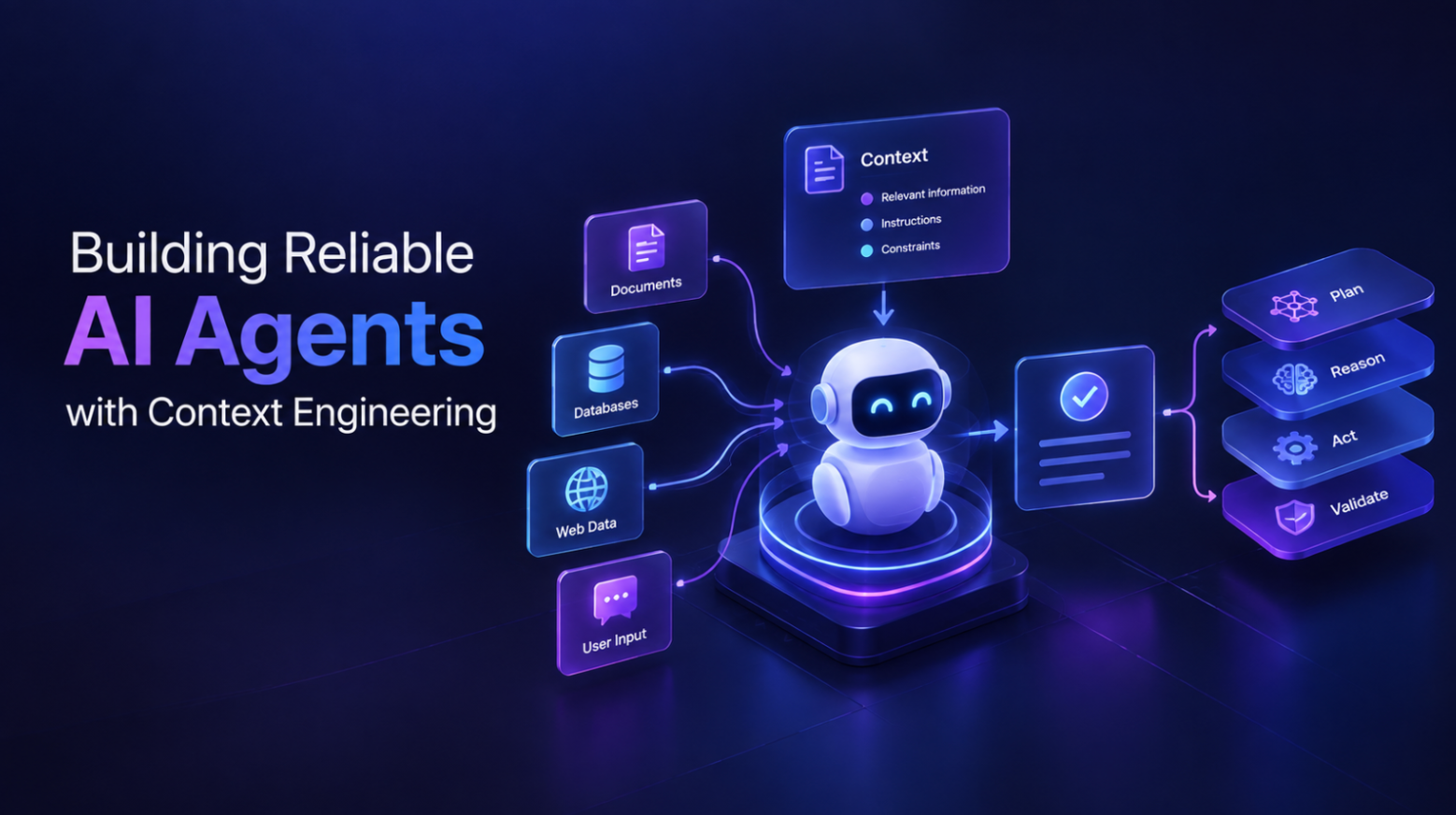
Autonomous foundation models face execution degradation during long-running enterprise tasks. Extended interaction loops accumulate token payloads, causing models to lose active goals or repeat completed actions. Engineering teams fix these failures using structured AI Agents with Context Engineering. Context engineering systematically organizes system tools, instructions, memories, and artifacts given to models during task execution, enabling AI Agents to maintain state across enterprise workflows.
Architectural Tiers of Context Memory Management
Managing multi-step operational state requires organizing enterprise context into distinct persistence tiers. Segmenting information by scope and lifespan prevents context rot and eliminates memory saturation during continuous task execution.
Context Tier | Persistence Scope | Infrastructure Mechanics | Operational Role |
System Context | Permanent platform deployment | System configuration files, global rules | Sets system parameters, agent capabilities, and universal tool governance. |
Session Context | Active thread lifetime | Interaction logs, message protocol tables | Maintains verbatim conversation records and sequential tool invocation histories. |
Working Memory | Multi-step execution runtime | State engines, step logs, scratchpad files | Tracks active sub-task progress, intermediate calculations, and pending item lists. |
Long-Term Memory | Multi-session persistence | Vector stores, knowledge graphs, log stores | Preserves institutional knowledge, historical decisions, and domain rules. |
Artifacts & On-Demand | Runtime context retrieval | Model Context Protocol servers, repositories | Provides external file access, schema definitions, and repository code on demand. |
System context establishes overall operational governance prior to task execution. Base instructions stored in configuration files apply universally across active sub-agents and tool execution threads.
Session context records raw tool returns and direct conversation exchanges within an active working session. Systems query session logs to maintain sequence integrity during immediate interaction loops.
Working memory carries operational state across intermediate tasks without overloading the primary prompt window. Externalized state files allow execution engines to reference prior outputs without re-reading long message histories.
Long-term memory organizes organizational experience across vector databases and knowledge graph networks. Stored patterns grant systems historical perspective across independent software projects.
On-demand context utilizes protocol interfaces like Model Context Protocol to fetch external repositories, database schemas, and documentation artifacts dynamically. Selective retrieval limits token consumption while preserving access to critical enterprise assets.
Core Engineering Patterns for Context Optimization
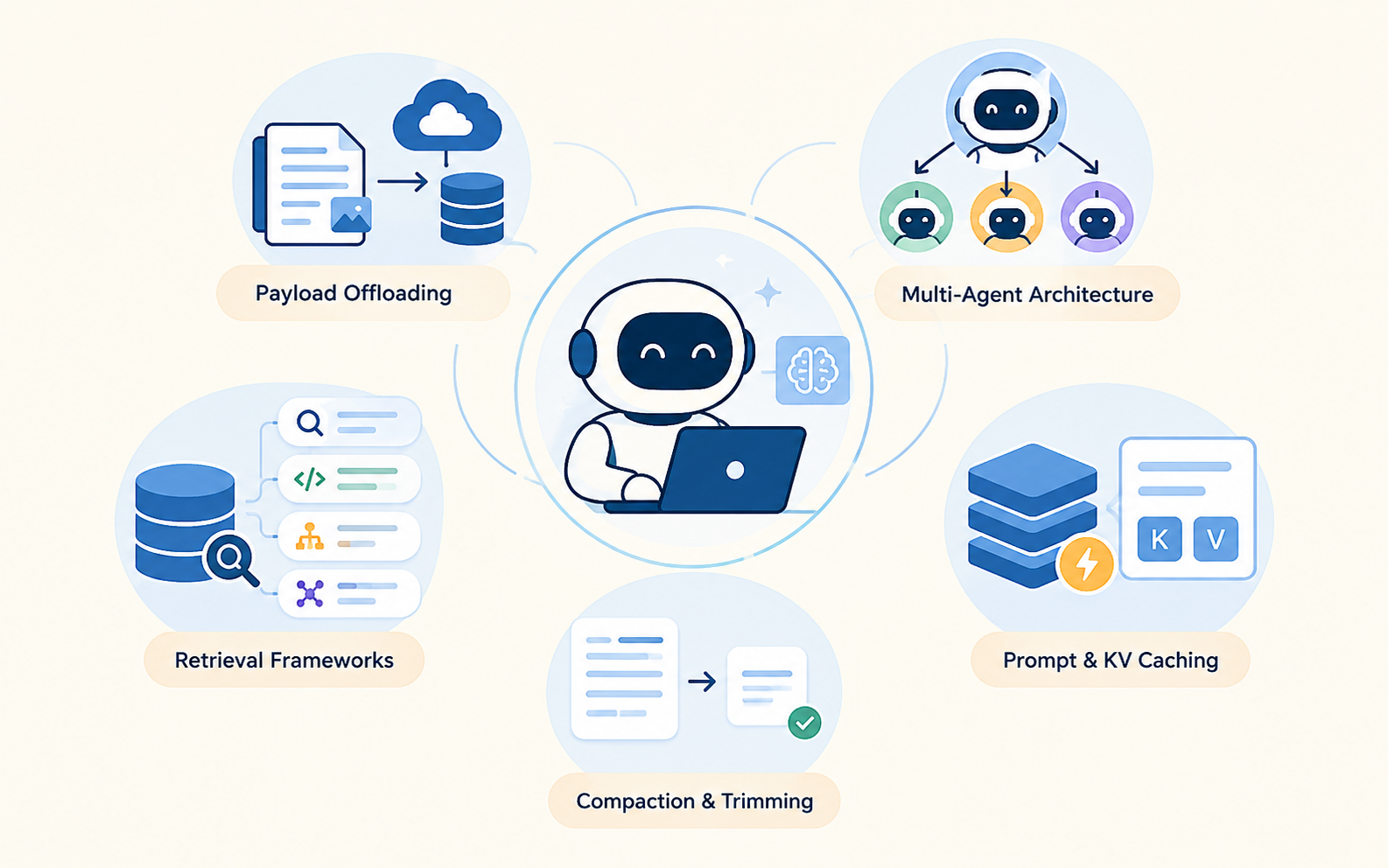
Production deployment of agentic AI systems depends on five primary architectural patterns designed to maintain clean context windows.
Dynamic Payload Offloading
Tool executions returning expansive payloads quickly exhaust available prompt allocations. Payload offloading writes heavy tool returns, raw web pages, or large source files directly to local storage or external memory stores. Models receive lightweight pointers and concise summaries, preserving full data recovery options through file system references.
Context Isolation in Multi-Agent Architecture
Parallel investigative tasks operate best within isolated sub-agent context windows. Dispatching dedicated sub-agents to conduct independent research prevents context contamination inside main execution threads. Sub-agents complete specialized sub-tasks inside independent context environments before returning consolidated summaries to primary orchestrators.
Multi-Technique Retrieval Frameworks
Standard vector similarity search often lacks structural precision when parsing complex codebases or enterprise schemas. Advanced retrieval architectures combine dense vector search with exact keyword matching, Abstract Syntax Tree parsing, and knowledge graph queries. Integrating structural search methods yields higher context accuracy across technical environments.
Compaction and Automated State Trimming
Context compaction monitors token utilization metrics throughout active sessions. Reaching defined context watermarks triggers compaction algorithms that summarize chat histories, extract key decisions, and discard redundant tool calls. Offloading original data prior to pruning creates a safety buffer against information loss.
System Prompt and Key-Value Caching
Key-Value cache optimization and system prompt caching reduce inference latency and operational compute costs. Caching static system instructions, base tool definitions, and common context blocks avoids redundant processing across repeated execution steps.
Implementation Frameworks for Enterprise AI Solutions
Structuring modern AI agents Solutions requires moving past loose prompt templates toward formal context infrastructure. Standardizing tool interactions and execution playbooks drives reliable software automation.
Implementation Layer | Architecture Component | Mechanism of Action | Strategic Impact |
Interface Layer | Model Context Protocol | Standardized protocol interfaces | Connects models directly to internal enterprise data platforms, code repositories, and tools. |
Process Layer | Contextual Playbooks | Combined operational scripts and instructions | Provides models with explicit step-by-step guidance alongside execution tools. |
Feedback Layer | Self-Improving Loops | Automated repository pull request workflows | Enables agents to update system playbooks based on runtime discoveries. |
Integrating AI/ML services with standardized protocol implementations gives models clean access to internal enterprise tools, issue trackers, and code storage platforms. Standardized protocols eliminate custom integration overhead across enterprise applications.
Contextual playbooks package execution scripts together with explicit domain instructions inside tool responses. When models identify relevant playbooks, execution engines inject structured guidance directly into working context, directing task completion without manual human intervention.
Collaborating with an established AI/ML development company enables organizations to transform fragmented experimental tools into production-grade agent platforms. Technical specialists construct context infrastructure that manages memory persistence, protects system security, and isolates agent execution threads.
Continuous improvement loops emerge when models suggest edits to existing playbooks following task execution. Agents document resolved edge cases by submitting repository pull requests, expanding institutional operational knowledge across future execution cycles.
Strategic Value of Enterprise AI Solutions
Deploying structured enterprise AI solutions fundamentally changes corporate automation paradigms. Strategic advantage relies on organizational context architecture rather than model parameter scale.
Model fine-tuning imposes significant compute costs and creates maintenance friction as base architectures evolve. AI Context engineering decouples reasoning capability from static training sets, allowing base models to adapt to dynamic operational context instantly.
Self-improving playbook architectures create cumulative efficiency gains across software teams. Organizational knowledge scales continuously as agents document successful debugging steps, architectural rules, and process adaptations inside shared repositories.
Data infrastructure readiness serves as the foundational requirement for autonomous agent deployment. Enterprises maintaining structured metadata, clear documentation, and accessible APIs achieve higher operational precision than organizations relying on unstructured data stores.
Operational roles evolve as autonomous execution frameworks mature. Human software engineers transition from manual execution to system design, curating context playbooks and governance boundaries while autonomous agents handle routine implementation tasks.
Operational Implementation Roadmap
Building reliable autonomous execution systems requires a systematic progression across data architecture, security boundaries, and protocol standardization. Organizations execute this transition through structured implementation stages.
Defining clear context boundaries forms the initial step. Separating static system configurations, active session records, and long-term memory repositories protects execution threads from context rot and context window bloat.
Standardizing tool interfaces across internal applications guarantees seamless integration. Connecting issue tracking databases, service documentation, and version control systems through uniform protocol servers grants models full operational visibility.
Deploying dynamic compaction algorithms and external file offloading maintains system stability during long-running task threads. Writing raw tool outputs to local file stores keeps primary context windows focused on high-level decision tasks.
Establishing self-improving feedback mechanisms guarantees process playbooks refine over time. Capturing resolution patterns within version-controlled repositories builds a compounding institutional knowledge base across execution teams.
Context engineering provides the structural framework necessary to convert non-deterministic language models into dependable software automation systems. Organizations constructing resilient context infrastructure build scalable agent platforms capable of executing multi-faceted enterprise operations reliably.
Scaling Enterprise Automation with Context Architecture
Transitioning from simple prompt engineering to production-grade enterprise deployment requires disciplined context architecture. Systematically structuring instruction playbooks, protocol interfaces, and multi-tiered memory systems enables autonomous AI agents to execute multi-step workflows reliably.
By establishing clear context boundaries, dynamic pruning mechanisms, and version-controlled operational playbooks, organizations empower software engineering teams to scale enterprise automation safely while maintaining total system control and decision precision.
Related Posts
- Running Age Checks on a Magento Store After Launch
- Adobe Commerce Website Development: Building a Connected B2B Purchasing Workflow
- Why Ongoing Magento Maintenance Matters for Growing eCommerce Stores
- Ecommerce SaaS vs Custom Ecommerce Software: Which Model Fits Enterprise Retail?
- Integrating Mini-Games into Magento 2 Mobile Apps to Boost Retention
- Why Your App Needs a Content Backend: Pairing Mobile App Development Services With a Headless CMS