



Agentic AI shopping is changing how consumers discover and buy products, with AI shopping agents increasingly researching, comparing, and potentially purchasing on their behalf. Learn how autonomous buyers, machine-readable product data, trust, and agentic commerce are reshaping retail and what businesses can do to prepare.
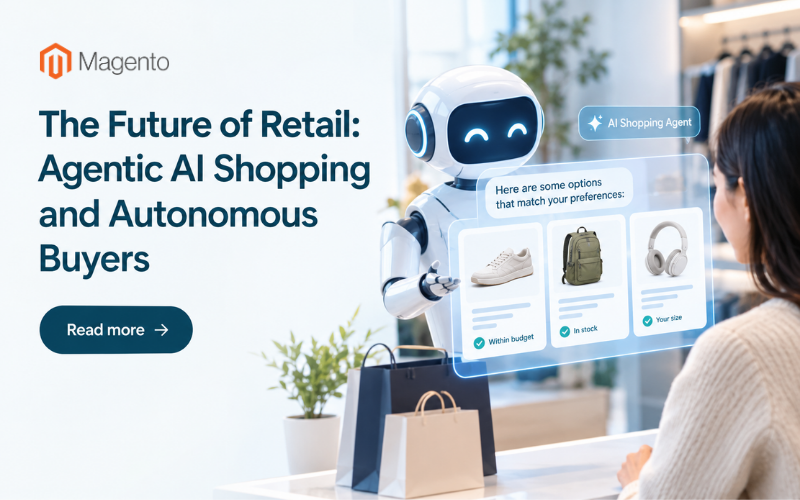
Agentic AI shopping is changing how consumers discover and buy products. Instead of browsing a storefront themselves, shoppers can rely on AI agents to research products, compare options, check prices, and make recommendations based on their preferences.
Picture this: your customer never visits your homepage. They never scroll your product grid, never see your banner ad, never read your carefully crafted meta description. Instead, an AI agent does all of that on their behalf, in milliseconds, and hands them a shortlist of three items it has already vetted against their budget, their size, and their aversion to synthetic fabrics.
That's not a thought experiment anymore. It's Tuesday.
Why Agentic AI Shopping Is Different From Every Retail Disruption Before It
E-commerce changed where people bought. Mobile changed when they bought. Agentic AI changes who is actually doing the buying, and that distinction should keep every retail executive up at night.
Retailers spent two decades optimizing for human attention: eye-tracking heatmaps, checkout-flow psychology, urgency banners. None of that persuades a machine. An autonomous agent doesn't get seduced by a countdown timer. It reads structured data, compares it against stated constraints, and executes.
Nearly three-quarters of consumers still shop in stores. However, AI-assisted shopping is already emerging. Roughly four in ten consumers use AI assistants to research products. About a third use them to find deals. That's not a fringe behavior anymore; it's a parallel shopping channel developing in real time, and most retail organizations are building for the wrong customer.
What "Autonomous Buyer" Actually Means in Practice
Autonomy isn't binary. It's a spectrum, and understanding where your customers sit on it matters more than chasing the flashiest AI headline.
Most agentic shopping today looks less like a robot with a credit card and more like a highly capable research assistant with delegated authority on narrow, well-defined tasks. Consider the tiers retailers actually need to design for:
• Advisory mode: the agent researches, compares, and summarizes, but a human still clicks "buy."
• Bounded delegation: the customer sets rules ("reorder detergent under $25, ship by Friday") and the agent executes within those guardrails.
• Open delegation: the agent has standing budget authority across categories and acts continuously, with only exception cases escalated back to the human.
Almost nobody operates at that third tier today. Most of the real commercial activity is happening at the first two, which means the immediate opportunity for retailers isn't building a fully autonomous checkout. It's making sure your catalog is legible to the agents already doing the research phase.
That's the core thesis behind agentic AI shopping: visibility to machines is becoming as important as visibility to humans, and the retailers treating it as an SEO afterthought are going to lose share before they notice the bleeding.
The Trust Problem Nobody Wants to Own
Here's the uncomfortable part. Consumers are curious about AI agents, but they don't yet trust them with real money, and that gap is where most of the near-term strategic risk lives.
McKinsey's research frames this well: the transition is unfolding in two distinct layers, one where AI already influences decisions at scale, and a slower, more cautious layer where consumers hand over actual execution authority. In a McKinsey survey across France, Germany, and the UK, 84% of consumers reported using AI daily, yet only 38% said they leverage it for purchase decisions.
That gap between "I'll ask AI for advice" and "I'll let AI spend my money" is the single most important number in this entire conversation. Close it too fast without the right guardrails and you get fraud, mistaken purchases, and a consumer backlash that sets adoption back years. Ignore it and competitors who solve for trust first will capture the delegated spend when it finally arrives.
Where the Trust Gap Actually Gets Closed
Three levers move this needle faster than marketing ever could:
1. Reversibility. Customers delegate more readily when they know a purchase can be undone without a fight.
2. Transparent constraints. Agents that show their reasoning, "I chose this one because it matched your size and was in stock nearby," earn more repeat delegation than black-box picks.
3. Spending caps with real teeth. Hard limits, not soft suggestions, are what convert curiosity into standing authority.
Retailers who build these into their agent-facing infrastructure now are essentially pre-selling trust before the market fully arrives. That's a rare kind of head start.

Retail's Infrastructure Wasn't Built for Machine Customers
Most product feeds were built for a human scrolling on a phone. Inconsistent sizing charts, vague material descriptions, and marketing copy dressed up as specs all worked fine when a person could squint and infer intent. An agent can't infer. It parses.
Last holiday season, AI played a major role in retail, contributing to about 20% of total sales and helping generate $262 billion in revenue, largely through personalized product recommendations and improved customer engagement, according to the U.S. Chamber of Commerce. Major retailers aren't waiting to see how this plays out.
Walmart, Target, Home Depot, and Lowe's are all partnering with technology providers to build agentic AI capabilities directly into their operations. That's not experimentation, that's a competitive land grab happening while most mid-market retailers are still debating whether this is a fad.
The operational shift required is unglamorous but urgent:
• Clean, structured product data that machines can parse without ambiguity
• Real-time inventory feeds accurate enough for an agent to commit to a purchase
• Return and cancellation policies an agent can quote with confidence
• Pricing logic that doesn't break when queried thousands of times a minute by non-human traffic
None of this is exciting to put in a boardroom deck. All of it determines whether your brand shows up in an agent's shortlist or gets silently filtered out because your data couldn't be trusted.
What Leadership Should Actually Do Next
Stop treating agentic commerce as an IT project buried three layers down the org chart. This is a customer acquisition channel, a trust exercise, and a data infrastructure overhaul happening simultaneously, and it deserves the attention level of a channel that's already influencing purchase decisions today.
The retailers who win the next decade won't be the ones with the flashiest chatbot. They'll be the ones whose product data an agent can trust without a second thought, whose return policy an agent can quote verbatim, and whose brand an autonomous buyer keeps coming back to because the experience never gave it a reason not to.
Start auditing your product feed for machine readability this quarter. The agents are already shopping your competitors. Make sure they can shop you too.
Related Posts
- Running Age Checks on a Magento Store After Launch
- Adobe Commerce Website Development: Building a Connected B2B Purchasing Workflow
- Why Ongoing Magento Maintenance Matters for Growing eCommerce Stores
- Ecommerce SaaS vs Custom Ecommerce Software: Which Model Fits Enterprise Retail?
- Integrating Mini-Games into Magento 2 Mobile Apps to Boost Retention
- Why Your App Needs a Content Backend: Pairing Mobile App Development Services With a Headless CMS