


Discover the top 6 proxy providers for competitor price monitoring. Compare features, pricing, and use cases to choose the best solution for accurate data.
Competitor price monitoring lets businesses keep an eye on how their rivals set prices for similar products — whether it’s online shops, marketplaces, or across different regions. It’s a big deal for building smart pricing strategies, figuring out where your brand fits in the market, and getting the most out of your revenue. Especially in industries where prices seem to change overnight.
To keep all that data flowing smoothly, companies usually turn to proxies. They’re handy tools that help you skip around blocks, dodge rate limits, and grab pricing info from wherever you need it. With the right proxy setup, you get cleaner data and your monitoring process doesn’t get bogged down.
Why Proxies Are Essential for Competitor Price Monitoring
When you’re scraping pricing info from retail sites and marketplaces, you’re making tons of requests — which can easily get your IP blocked or rate-limited. Without proxies, it’s tough to gather reliable data from loads of product pages, or catch price shifts quickly enough to make smart choices.
Proxies also let you see prices from different locations, which is crucial when retailers play around with pricing, promotions, or availability depending on where you’re browsing. If you want sharp, scalable price intelligence, proxies keep your access steady, help your data stay reliable, and make your monitoring smoother across the board.
Types of Proxies Used for Price Monitoring
As for the types of proxies businesses use, there’s no one-size-fits-all. Some work better for huge data grabs, others are just right for smaller, budget-friendly jobs. It all depends on what you need — the scale, the sites you’re targeting, and how sensitive the data is.
Provider | Main proxy fit for price monitoring | Notable strengths | Best for |
GoProxies | Rotating residential proxies | 30M+ rotating residential proxies, 200+ locations, automatic IP rotation, unlimited concurrent sessions | Businesses that need residential proxies for scalable competitor price monitoring across multiple targets and regions. |
Proxy-Seller | Residential, datacenter, IPv4/IPv6, and SOCKS5 proxies | 20M+ private residential proxies across 220+ GEOs, SOCKS5 and HTTP(S) protocols, 99% uptime, unlimited bandwidth up to 1 Gbps, reliable web scraping support, easy automation tool integration, 24/7 technical support, flexible rental periods | Businesses aiming to expand their data collection and competitor price monitoring without sacrificing speed or security. |
Bright Data | Residential, ISP, datacenter, and rotating proxies | 400M+ monthly residential IPs across 195+ countries; broad proxy coverage across residential, ISP, datacenter, and rotating options | Large-scale monitoring projects that need very wide geographic coverage and multiple proxy types. |
Oxylabs | Residential proxies | 175M+ residential IPs, country and city targeting, designed for data collection at scale | Teams that need enterprise-grade residential proxies for large competitor tracking operations. |
SOAX | Residential proxies | 155M+ residential IPs, 195+ countries, sticky and rotating sessions, unlimited proxy connections | Price monitoring workflows that need flexible session control and broad geo-targeting. |
NetNut | Rotating and static residential proxies | 85M+ residential IPs in 195 countries, sticky and rotating IPs, static residential options with direct ISP connectivity | Businesses that need both rotating monitoring and longer sticky sessions for tougher targets. |
IPRoyal | Residential and static residential proxies | Residential proxies with non-expiring traffic, static residential options, explicit price-monitoring use case on site | Smaller teams or budget-conscious users that still need residential proxy coverage for monitoring tasks. |
Top Proxy Providers for Competitor Price Monitoring
GoProxies
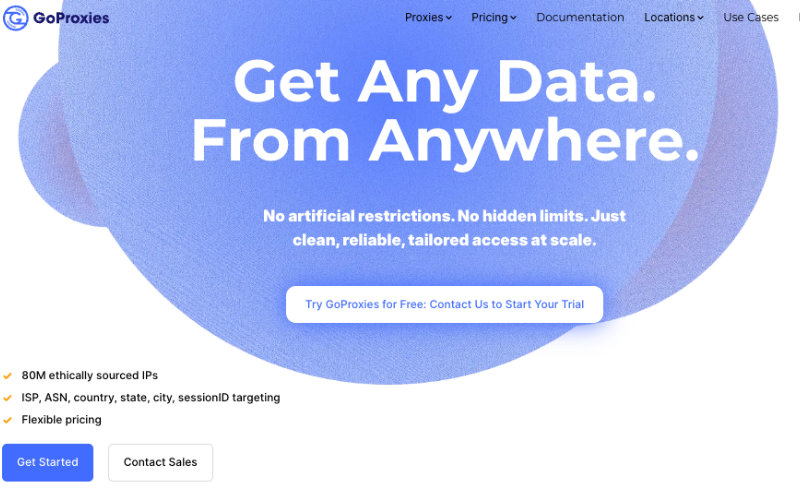
GoProxies is a strong fit for competitor price monitoring because its rotating residential proxy network is built for scalable data collection without relying on a small IP pool. On its rotating residential proxies page, GoProxies highlights a 30M+ pool, unlimited concurrent sessions, automatic IP rotation, sticky sessions, ethically sourced residential IPs, and city-focused targeting, which all line up well with large-scale price tracking workflows.
• Best for: Businesses that want rotating residential proxies for competitor price monitoring across multiple locations and high-volume targets.
• Pros: 30M+ rotating residential proxies, unlimited concurrent sessions, automatic IP rotation, sticky sessions, city-focused targeting, ethically sourced residential IPs, and 24/7 support.
Proxy-Seller
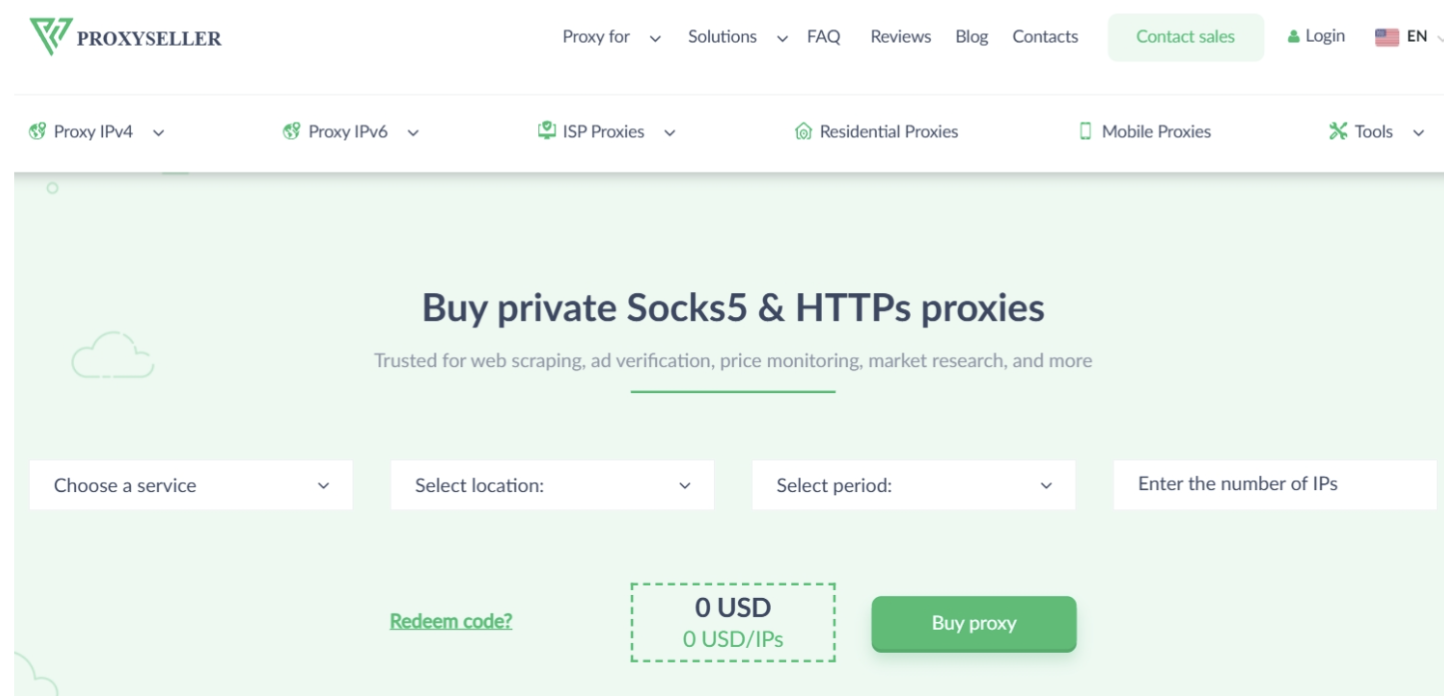
Proxy Seller is another proxy provider, optimized for heavy competitor price monitoring. For businesses that increasingly need online data to keep up, this platform provides web scraping options and easy integration with numerous automation tools. From high-speed IPv4 and IPv6 datacenter pools to reliable residential proxies, they have a vast selection of IP addresses to keep your business automation processes uninterrupted. Their dedicated SOCKS 5 proxy capabilities are especially useful when fetching public market data and maximizing request success rates during real-time price tracking.
• Best for: Businesses aiming to expand their data collection without sacrificing speed or security.
• Pros: 20M+ private residential proxies across 220+ GEOs, SOCKS5 and HTTP(S) protocols, 99% uptime, unlimited bandwidth up to 1 Gbps, 24/7 technical support, flexible rental periods.
Bright Data
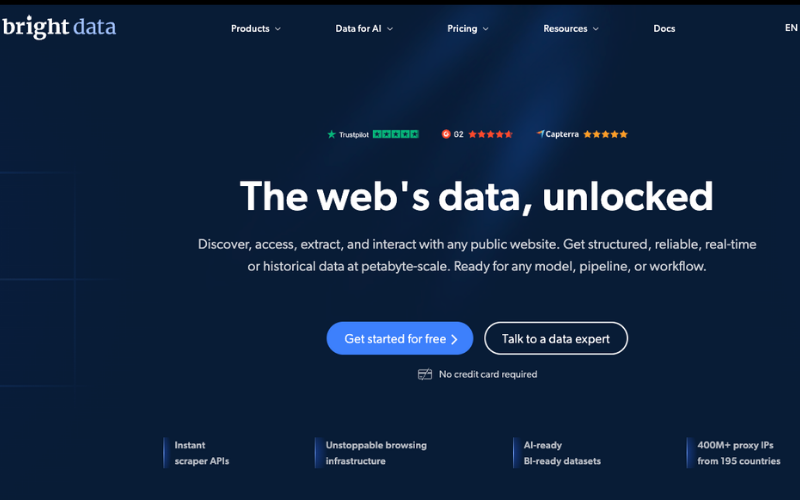
Bright Data is one of the biggest players in this space and is well suited for competitor price monitoring at scale. Its residential proxy page says it offers over 400M+ monthly ethical residential IPs from 195 countries, supports both sticky and rotating sessions, includes geo-location targeting, and allows targeting by country, city, ZIP code, carrier, and ASN. For businesses that need broad international coverage and fine-grained location controls, it is one of the most feature-rich options in this list.
• Best for: Enterprises that need very large residential proxy coverage and advanced geo-targeting for localized price monitoring.
• Pros: Over 400M+ monthly ethical residential IPs, coverage in 195 countries, sticky and rotating sessions, country/city/ZIP/carrier/ASN targeting, unlimited concurrent sessions, and a stated 99.95% success rate.
Oxylabs
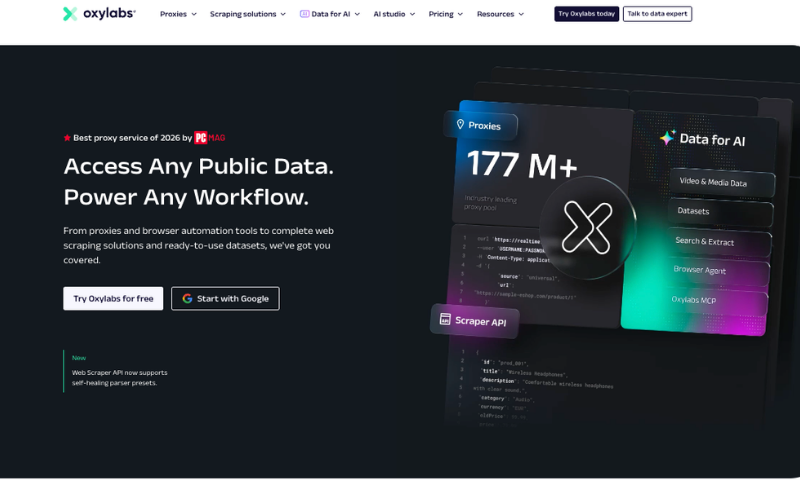
Oxylabs is a strong choice for competitor price monitoring because it directly positions its services around price monitoring use cases and emphasizes location-based data access. Its site says the residential proxy network includes 175M+ proxies, covers 195 countries, supports detailed geo-targeting, and offers unlimited concurrent sessions. On its price monitoring solution page, Oxylabs also states that its proxy network covers all countries in the world and offers city-level targeting, which is directly relevant when competitor prices vary by location.
• Best for: Large-scale price monitoring projects that need strong geo-targeting and enterprise-grade residential proxy infrastructure.
• Pros: 175M+ residential proxies, coverage across 195 countries, targeting by country, city, state, ZIP, coordinates, and ASN, unlimited concurrent sessions, sticky sessions, flexible rotation, and explicit positioning for price monitoring.
SOAX
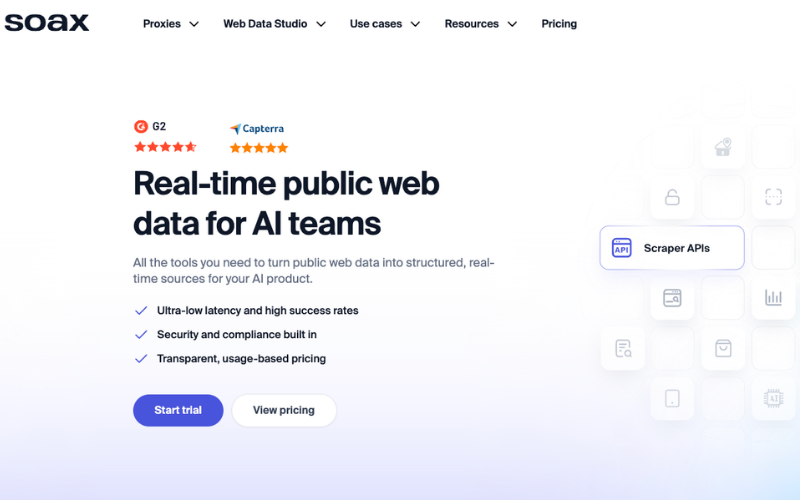
SOAX is a good match for competitor price monitoring because it explicitly markets its proxies for price monitoring at scale. Its site says users can access region-specific prices in real time, while its residential proxy pages highlight 155M+ residential IPs in 195+ locations, rotating and sticky sessions, unlimited concurrent sessions, and ethically sourced proxies. That makes SOAX especially relevant for businesses that need location-specific pricing visibility without running into frequent blocks.
• Best for: Teams that need region-specific pricing data, flexible session control, and residential proxies designed for price monitoring at scale.
• Pros: 155M+ residential proxies, 195+ locations, rotating and sticky sessions, unlimited concurrent sessions, ethically sourced proxies, 99.9% uptime, and a stated 99.95% proxy success rate for price monitoring.
NetNut
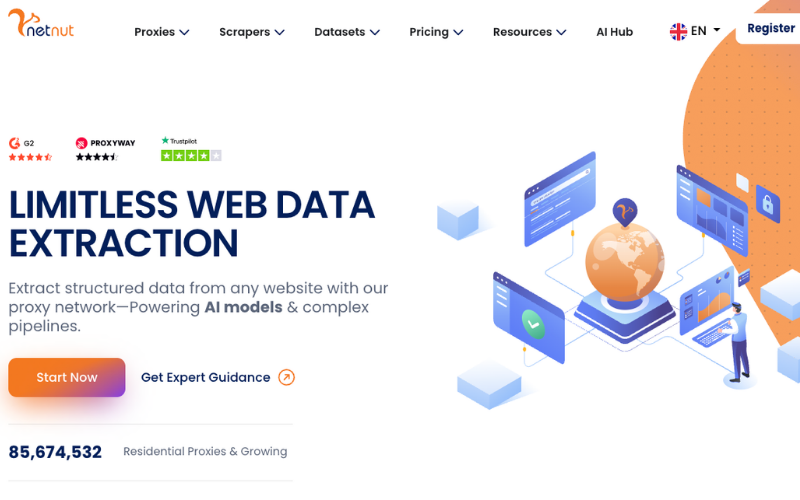
NetNut is positioned as a web data collection proxy provider and also has specific content around price monitoring and price comparison use cases. Its official site snippets highlight 85M+ residential IPs in 195 countries, city/state targeting, unlimited concurrency, and support for HTTP, HTTPS, and SOCKS5. That combination makes it relevant for businesses that need a sizable residential network and protocol flexibility for competitor price tracking across multiple sites and regions.
• Best for: Businesses that want a large residential proxy network with city/state targeting and protocol flexibility for monitoring jobs.
• Pros: 85M+ residential IPs, coverage in 195 countries, city/state targeting, unlimited concurrency, and support for HTTP, HTTPS, and SOCKS5.
IPRoyal
IPRoyal is a practical option for competitor price monitoring, especially for teams that want residential proxies with straightforward pricing. Its site says its residential proxy offering includes a 32M+ proxy pool, 195+ locations, smart rotation options, and non-expiring traffic. On its price monitoring page, IPRoyal also states that its price monitoring proxy pool is made up of residential proxies, supports daily price monitoring, and is designed to help collect geographically tailored pricing data while reducing blocks and CAPTCHAs.
• Best for: Budget-conscious businesses that still need residential proxies for frequent price monitoring across many locations.
• Pros: 32M+ proxy pool, 195+ locations, rotating residential proxies, city/state targeting, flexible rotation, traffic that never expires, usage-based pricing, and a dedicated price monitoring use-case page.
How to Choose the Right Proxy Provider for Your Monitoring Needs
The right proxy provider depends on how large your monitoring operation is, which websites you need to track, and how much location control you need. If you monitor competitor prices across many product pages or across multiple countries, a provider with a large residential proxy pool, flexible rotation, and precise geo-targeting will usually be the better fit. If your targets are easier to access and your monitoring needs are lighter, a more affordable option may be enough.
It is also important to look at practical factors such as session types, concurrency, uptime, and how well the proxies are suited for repeated data collection. Some providers are better for enterprise-scale monitoring, while others are a better fit for smaller teams that want simpler pricing and setup. In most cases, the best choice is the one that gives you reliable access, location flexibility, and enough scale to support consistent price monitoring without adding unnecessary complexity.
Common Mistakes to Avoid
One common mistake is choosing a proxy provider based only on price instead of how well the proxies perform for actual monitoring tasks. Low-cost proxies may look attractive at first, but they can lead to more blocks, less reliable data, and weaker location coverage. Another mistake is using the wrong proxy type for the job, such as relying on datacenter proxies for websites that have stronger anti-bot systems and are better handled with residential IPs.
Businesses also often underestimate the importance of geo-targeting and proxy scale. If competitor prices vary by country, city, or region, limited targeting can lead to inaccurate comparisons. In the same way, using a provider with a smaller or less flexible proxy pool can reduce the quality of monitoring over time. The best approach is to match the provider to the websites, locations, and monitoring volume you actually need.
FAQ
1. What type of proxy is best for competitor price monitoring?
Residential proxies are usually the best fit because they look like real user traffic and are less likely to get blocked on retail sites and marketplaces. For larger monitoring tasks, rotating residential proxies are often the most practical option.
2. Why are rotating residential proxies useful for price monitoring?
They automatically change IPs over time, which helps reduce blocks and makes it easier to collect pricing data across many product pages and websites at scale.
3. Can proxies help monitor competitor prices in different countries or cities?
Yes. Many proxy providers offer geo-targeting by country, city, or region, which makes it possible to check localized pricing, promotions, and product availability.
4. Are datacenter proxies good for competitor price monitoring?
They can work for lighter monitoring tasks or for websites with weaker anti-bot protection, but they are generally more likely to be blocked than residential proxies on stricter targets.
5. What should businesses look for in a proxy provider for price monitoring?
The most important factors are proxy type, IP pool size, rotation options, geo-targeting, session control, concurrency, and overall reliability for repeated data collection.
6. How often should competitor prices be monitored?
That depends on the market and how often prices change. Some businesses monitor prices daily, while others need more frequent checks to respond quickly to market changes.