



Compare Shopify Plus vs Adobe Commerce for a $4M MRR ecommerce business. Discover which platform delivers better ROI, scalability, and long-term value.
For this calculation, MRR means monthly revenue run rate. At $4 million a month, an ecommerce company is operating at roughly $48 million in annual revenue.
That is enough scale to afford either Shopify Plus or Adobe Commerce.
It is not enough to make the choice obvious.
At this level, platform fees become a small part of the equation. The larger costs come from developer time, integrations, release speed, maintenance, and the revenue lost when the platform cannot support how the business sells.
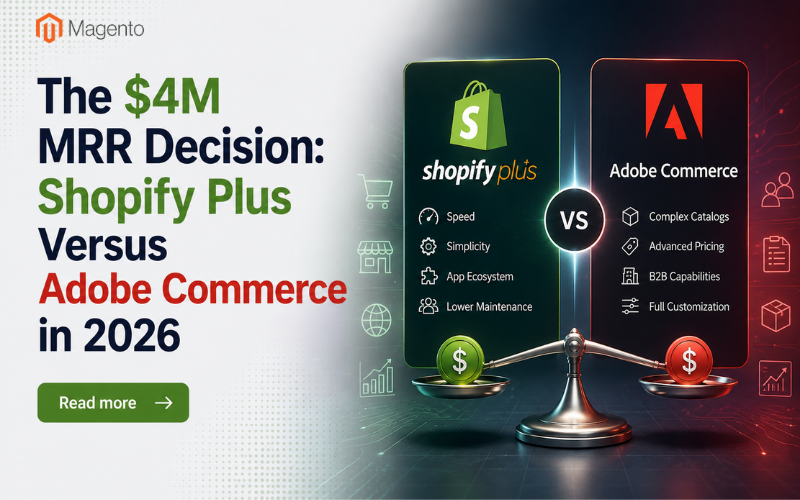
Shopify Plus usually favors a leaner operating model. Adobe Commerce earns its keep when complex catalogs, pricing rules, B2B requirements, and multi-brand structures are part of the commercial engine.
At $48M, the License Is Not the Main Cost
Shopify Plus currently starts at $2,300 per month on a three-year term or $2,500 on a one-year term. More complex, high-volume businesses move to a variable platform fee.
At $48 million in annual revenue, the $27,600 three-year base fee equals less than 0.06% of sales.
https://www.youtube.com/watch?v=pzcNqccK9nM
Adobe does not publish one standard Commerce price. Its current pricing page requires companies to request a custom quote, with packages varying across its SaaS, cloud, and Commerce Optimizer products.
That lack of like-for-like pricing is why license comparisons often mislead. A Shopify implementation may add paid apps, custom middleware, an ERP connector, and an agency retainer. Adobe may require a larger engineering team, more testing, and deeper release management.
The implementation partner can add or remove more cost than the license itself. If that work will sit with an outside team, you can view their recommendations here.
The revenue math also changes at this scale. Every 0.1% of $48 million is $48,000. A platform that costs $150,000 more each year only needs to protect or create roughly 0.31% of annual revenue to cover that gap.
The hard part is proving that it will.
Shopify Plus Wins When Simplicity Has Value

BuiltWith currently detects more than 84,000 live Shopify Plus websites. Adoption alone does not prove suitability, but it shows that Plus is not limited to emerging direct-to-consumer brands.
Its strongest financial argument is operational.
Brooklinen used Shopify Plus B2B to add a wholesale store inside the same admin used by its consumer business. Allbirds used Shopify POS and custom API workflows to make store inventory available online and support ship-from-store fulfillment.
https://www.youtube.com/watch?v=je6vfmO6Hp0
Those cases show where Plus performs well: standard products, familiar checkout behavior, international storefronts, wholesale needs that fit native B2B features, and teams that want marketers to change the site without opening a development ticket.
A $4 million MRR retailer with a relatively straightforward catalog may gain more from speed than unlimited control. Faster campaigns, fewer infrastructure decisions, automatic platform updates, and a broad app ecosystem can keep technical labor focused on customer-facing work.
The weak point appears when the app stack starts rebuilding a custom platform one subscription at a time. If core pricing, order, catalog, or account logic depends on several fragile extensions, the lower-maintenance argument starts to fall apart.
Adobe Wins When Commerce Logic Is the Product
BuiltWith detects more than 101,000 live Magento websites, a category that includes Adobe Commerce and Magento Open Source implementations.
Adobe Commerce is built for businesses whose selling rules are difficult to standardize. Its published feature set includes B2B company accounts, purchase approvals, quotes, requisition lists, payment on credit, localized storefronts, and catalogs containing millions of SKUs.
https://www.youtube.com/watch?v=YZZ9keqLi5Q
That depth matters when different buyers see different prices, several brands share infrastructure, approval chains affect checkout, or ERP and product-information systems drive the storefront.
Adobe is harder to justify when the business does not use that flexibility. Customization creates code that has to be tested, secured, documented, and maintained. Control is valuable only when it supports a requirement that affects revenue or cost.
A useful break-even test is to model the premium. If an Adobe setup costs $200,000 more per year than the Shopify alternative, it must create or protect about 0.42% of a $48 million revenue base.
That could come from better B2B conversion, fewer manual orders, more accurate contract pricing, or support for a catalog Shopify would struggle to manage.
Without one of those gains, the extra architecture is simply overhead.
The Decision Is About Exceptions
The $4 million MRR line should trigger a platform review, not an automatic migration.
Business condition | Shopify Plus usually fits | Adobe Commerce usually fits |
Main sales mode | DTC or standard B2B | Complex B2B and B2C |
Catalog | Moderate and standardized | Very large or highly configurable |
Pricing | Shared rules and discounts | Contract, account, or tier-specific |
Internal team | Lean ecommerce and development team | Dedicated engineering and platform ownership |
Release priority | Speed and lower maintenance | Control and custom business logic |
Existing ecosystem | Flexible or Shopify-led | Deep Adobe, ERP, PIM, or OMS dependencies |
The simplest test is to list the exceptions that make the company difficult to serve.
If most of them can be handled through Shopify’s native features and a small number of reliable integrations, Plus is usually the cleaner financial choice.
If those exceptions define how the company prices, sells, fulfills, and serves business accounts, Adobe may be worth the higher ownership burden.
At $4 million MRR, both platforms can process the revenue. The decision comes down to what the business has to build around them.
Shopify Plus is the stronger default when simplicity protects margin. Adobe Commerce wins when complexity is not technical vanity, but the way the company makes money.
Related Posts
- What an AI Performance Agent Does With Your Shopify Ad Account
- 5 Latest E-Commerce Trends to Watch Out For in 2026
- How Retail Automation Is Transforming Magento Stores Through Smarter Inventory and Order Management
- Wearable Technology and the Future of E-Commerce
- Migrating to Shopify? Here's How to Protect Your Search Rankings
- How to Hire and Manage a Remote Development Team for Your Magento Store