



Learn why effective ecommerce data and file management improves operations, customer experience, inventory accuracy, security, and business growth.
Growing ecommerce stores need better data and file management because the amount, mix, and speed of information in online retail can quickly overwhelm old, disconnected tools. Without strong, smart data management, businesses run into wasted time, missed opportunities, and rising costs that slow down the growth they're trying to achieve.
Ecommerce has changed how people shop and opened huge opportunities — but it also generates a constant flow of data that stores must manage well to deliver real-time insights and a smooth customer experience. As a store grows, its data setup becomes more than a basic requirement; it becomes something that can help the business grow faster — or hold it back.
To keep up with data volumes that older storage systems can't handle well, many leaders are moving to cloud-native tools, including advanced enterprise cloud storage options built for speed, flexibility, and reliability.
How Does Poor File Management Impact Ecommerce Operations and Growth?
Weak data and file management can hurt nearly every part of an ecommerce business — and it hits revenue directly. Even small delays in load and response time cost money: slow storage leads to abandoned carts and lost sales, because shoppers won't wait around for a site that feels slow or broken.
Beyond lost transactions, poor data quality creates problems company-wide. If customer data is wrong or incomplete, messaging and personalization fall flat, hurting the shopping experience and reducing repeat purchases. Marketing gets messy too, with overlapping campaigns, duplicated work, and missed opportunities to target specific customer segments. Poor inventory tracking causes stockouts of popular items or excess stock that ties up cash — both cost money and hurt sales. Low-quality data also makes it harder to understand which products perform well, what margins really look like, and how to set pricing.
On top of that, teams often resort to manual data entry and cleanup, which adds work and pulls people away from higher-value tasks. Outdated or inconsistent information can damage customer trust and cause missed upsell and cross-sell opportunities. Over time, without clean, reliable data, an ecommerce business struggles to grow sales, improve customer satisfaction, and stay profitable.
Types of Ecommerce Data and Files Businesses Must Manage
Ecommerce businesses create and use a large mix of data every day. This data falls into a few main categories, each with its own challenges and benefits.
Structured vs. Unstructured Ecommerce Data
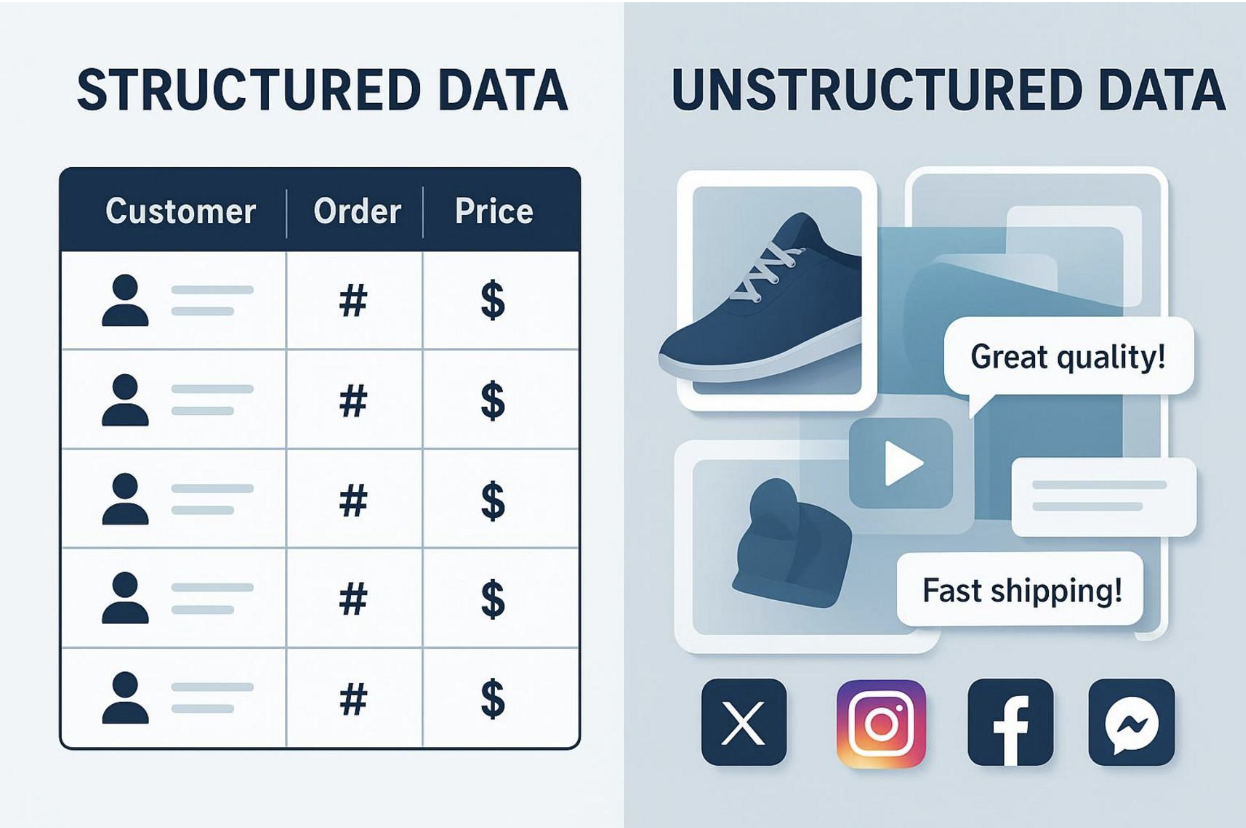
Big data in ecommerce includes both structured and unstructured data collected at scale. Structured data is organized and easy to search because it fits into set database fields — customer names, addresses, product SKUs, order numbers, and prices. It's usually numeric or clearly defined, so it's easier to analyze.
Unstructured data doesn't follow a fixed format and is harder to work with: product images, videos, customer reviews, social media posts, emails, blog content, and audio files. While harder to process, unstructured data often holds valuable signals about customer sentiment, brand reputation, and emerging trends. As an ecommerce store grows, it may manage millions of records across both types — which means it needs stronger systems to store, search, and act on that information.
Product Images, Videos, and Digital Assets
Digital assets are the visuals and media that bring an online store to life: product photos, videos, logos, brand graphics, artwork, brochures, and audio. Most assets exist in multiple versions for different campaigns, platforms, or seasonal promotions. Managing them well matters because they directly shape the customer experience. Metadata — details about an asset such as file name, creation date, and keywords — helps people find the right content quickly.
Better on-site search can raise ecommerce conversions by 15.8%. But as a store grows, keeping metadata clean and consistent gets harder. Video is a special case: it consumes far more storage and bandwidth, and it often exists in multiple formats (MP4, MOV, AVI, WAV), making it harder to manage at scale.
Order, Customer, and Transactional Data
This is the day-to-day operational data that keeps an ecommerce business running: customer profiles (names, addresses, emails, billing info, and other personally identifiable information, or PII), order history, browsing behavior, product interests, and support messages. For growing stores, handling large volumes of individual customers — not just business accounts — requires detailed, accurate data that many older CRM systems weren't built to capture correctly.
This category also includes order status updates, shipping details, returns, refunds, exchanges, and loyalty rewards. Accuracy here matters for personalization, support, and fraud prevention — spotting unusual behavior patterns in real time can improve transaction safety and build customer trust.
Inventory and Supply Chain Data
Good inventory and supply chain data management supports smooth operations and happy customers. This includes tracking stock levels in real time across warehouses or drop-shipping partners, managing large product catalogs (variants, price changes, stock levels), and monitoring the full supply chain from purchasing to delivery. Poor tracking causes stockouts or overstock, both of which hurt sales and drive up costs. Data analytics can also reveal where the supply chain slows down, wastes resources, or runs into delays, helping businesses forecast demand and plan ahead.
Common Data and File Management Challenges for Growing Ecommerce Stores
As ecommerce businesses grow, quick-fix data habits stop working, and new problems emerge that require better systems and processes.
Scalability and Handling Data Volume Growth
A major challenge is keeping up with data volume. Ecommerce platforms generate huge amounts of data daily, and growth makes it harder to manage the information needed for real-time insights and strong customer experiences. Older storage designs often struggle to scale out — they weren't built to expand quickly and smoothly. Retail demand also runs in cycles, with sharp spikes during promotions or viral moments, making capacity planning difficult.
Businesses often end up stuck between two bad options: buying too much storage "just in case" (wasting money) or buying too little (risking slow performance, timeouts, and abandoned carts). This is pushing stores toward newer, software-defined, cloud-ready storage approaches, where capacity and performance can grow and shrink on demand without downtime.
Inconsistent or Inaccurate Data Across Systems

When data comes from many sources — CRM tools, ERP systems, marketing platforms, inventory tools, and others — keeping it consistent is difficult. Conflicting information reduces trust in reports and leads to bad decisions. Data silos make this worse, trapping information within certain teams or systems and blocking a single, clear view of customers, products, and operations. The result: duplicate customer records, messy product categories, mismatched order and stock data, and incomplete purchase history — all leading to weaker personalization, less effective marketing, and lower efficiency.
Collaboration and Access Control for Remote Teams
Many ecommerce teams are distributed and work with outside partners, vendors, or agencies. These groups need easy access to files and data, but security still has to hold. Central sharing helps teams collaborate and keeps the brand consistent — but managing permissions, tracking versions, and enforcing brand rules across many users and channels is genuinely hard. Without strong access controls and login protections, assets can be exposed to risk. Teams also waste time hunting for the right file or working from an outdated version, which slows work and delays launches.
Ensuring Security and Regulatory Compliance
Ecommerce stores collect large volumes of sensitive information, including names, addresses, payment data, and other PII. Protecting that data from breaches — and meeting strict privacy regulations like the EU's GDPR and, for US-based and California-facing businesses, the CCPA/CPRA — is a constant challenge. A data breach can trigger major fines, long-term brand damage, and lost customer trust.
Security goes beyond stopping breaches; it also means following rules for lawful, ethical data use. Stores may need encryption, access controls, audit logs, and disaster recovery plans. Infosys estimates that $223 billion is at risk for the world's top 100 brands due to data breaches — a clear signal of how serious this issue has become.
How Better Data and File Management Drives Ecommerce Success
Better data and file management isn't just about avoiding problems — done well, it becomes a genuine competitive advantage.
Improves Operational Efficiency and Reduces Errors
Better data management simplifies daily work and reduces mistakes. When product data is organized, consistent, and easy to find, tasks like updating listings, tracking inventory, and processing orders become faster and more accurate. This cuts manual cleanup work and frees teams from constant data fixes. Automated provisioning, common in software-defined storage, further reduces hands-on work — the result is smoother operations, fewer fulfillment errors, and more time for teams to focus on growing the business.
Enables Personalized Marketing and Improved Customer Experience
Clean, reliable data is the foundation of personalization. Using purchase history, browsing behavior, and engagement data, stores can build more relevant marketing, better product recommendations, and a shopping experience that feels personal — raising conversion rates and repeat purchases. Companies with a strong customer experience (CX) focus reportedly grow revenue 4–8% more than competitors. Good data management helps stores build accurate customer segments so messaging reaches the right audience, improving satisfaction and loyalty.
Supports Real-Time Data Analysis for Faster Decision-Making
Ecommerce moves fast, so timing matters. Strong data systems support real-time processing and analytics, letting businesses see sales trends, inventory changes, customer activity, and campaign performance as they happen. This helps stores adjust pricing based on demand, competitor moves, and seasonal shifts. Real-time data support can be the difference between staying ahead and falling behind, since teams can respond and adjust plans without delay.
Optimizes Inventory and Supply Chain Management
Good product data management improves how stores run inventory and supply chains. Real-time tracking keeps popular items in stock and reduces the risk of overstocking. Studying past sales and market trends lets businesses set smarter inventory levels, lowering storage costs, while analytics highlight supply chain slowdowns and waste so teams can fix issues faster. The payoff: lower carrying costs, better delivery performance, and fewer customer frustrations around availability.
Enhances SEO and Product Discoverability
Search engines favor well-organized data. When product details are clean, consistent, and complete, pages are more likely to rank higher — driving more organic traffic and sales. Strong metadata for digital assets, clear categories, and accurate descriptions also help customers find what they want quickly, improving discoverability and speeding up buying decisions.
Conclusion
An ecommerce store's growth — from a new startup to a market leader — depends heavily on how well it handles data. As the future becomes even more data-heavy, the line between structured and unstructured data will keep blurring, aided by AI that can pull meaning from many different sources. The next stage of ecommerce data management will likely focus more on privacy-focused data platforms that support secure collaboration between industries — potentially creating new ways for businesses to monetize their data by offering insights and analytics to other companies while still protecting customer privacy. This kind of approach can open new revenue streams and help brands build stronger partnerships and a better market position.
Using modern software-defined cloud architecture is no longer a "nice to have" — it's necessary to compete in fast-moving online retail. Ecommerce businesses that keep refining their data strategy, protect data quality, and adopt modern tools will be best positioned to succeed and lead in the online market ahead.
Related Posts
- What an AI Performance Agent Does With Your Shopify Ad Account
- 5 Latest E-Commerce Trends to Watch Out For in 2026
- How Retail Automation Is Transforming Magento Stores Through Smarter Inventory and Order Management
- Wearable Technology and the Future of E-Commerce
- Migrating to Shopify? Here's How to Protect Your Search Rankings
- How to Hire and Manage a Remote Development Team for Your Magento Store